$20$ $ampere$ current is flowing in a long straight wire. The intensity of magnetic field at a distance $20\, cm$ from the wire will be
Easy


Download our appand get started for free
Experience the future of education. Simply download our apps or reach out to us for more information. Let's shape the future of learning together!No signup needed.*
Similar Questions
- 1A long straight wire of radius a carries a steady current I. The current is uniformly distributed across its cross section. The ratio of the magnetic field at $\frac{a}{2}$ and $2$a from axis of the wire is:View Solution
- 2View SolutionCurrent flows through uniform, square frames as shown. In which case is the magnetic field at the centre of the frame not zero?
- 3Two long parallel wires are at a distance $2d$ apart. They carry steady equal currents flowing out of the plane of the paper, as shown. The variation of the magnetic field $B$ along the line $XX’$ is given byView Solution
- 4A steady current $i$ flows in a small square loop of wire of side $L$ in a horizontal plane. The loop is now folded about its middle such that half of it lies in a vertical plane. Let $\overrightarrow {{\mu _1}} $ and $\overrightarrow {{\mu _2}} $ respectively denote the magnetic moments due to the current loop before and after folding. ThenView Solution
- 5A galvanometer having a coil resistance $100 \;\Omega$ gives a full scale deflection when a current of $1 \;\mathrm{mA}$ is passed through it. What is the value of the resistance which can convert this galvanometer into a voltmeter giving full scale deflection for a potential difference of $10\; \mathrm{V} ?$......$k\Omega$View Solution
- 6View SolutionAn electron is travelling horizontally towards east. A magnetic field in vertically downward direction exerts a force on the electron along
- 7A particle is moving with velocity $\overrightarrow{ v }=\hat{ i }+3 \hat{ j }$ and it produces an electric field at a point given by $\overrightarrow{ E }=2 \hat{ k }$. It will produce magnetic field at that point equal to (all quantities are in SI units)View Solution
- 8An electron moves with a speed of $2 \times 10^5\, m/s$ along the $+ x$ direction in a magnetic field $\vec B = \left( {\hat i - 4\hat j - 3\hat k} \right)\,tesla$. The magnitude of the force (in newton) experienced by the electron is (the charge on electron $= 1.6 \times 10^{-19}\, C$)View Solution
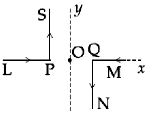
- 9As shown in the figure, two infinitely long, identical wires are bent by $90^o$ and placed in such a way that the segments $LP$ and $QM$ are along the $x-$ axis, while segments $PS$ and $QN$ are parallel to the $y-$ axis. If $OP = OQ = 4\, cm$, and the magnitude of the magnetic field at $O$ is $10^{-4}\, T$, and the two wires carry equal current (see figure), the magnitude of the current in each wire and the direction of the magnetic field at $O$ will be $(\mu_ 0 = 4\pi \times10^{-7}\, NA^{-2})$View Solution
- 10A deuteron and an alpha particle having equal kinetic energy enter perpendicular into a magnetic field. Let $r_{d}$ and $r_{\alpha}$ be their respective radii of circular path. The value of $\frac{r_{d}}{r_{\alpha}}$ is equal toView Solution