Question
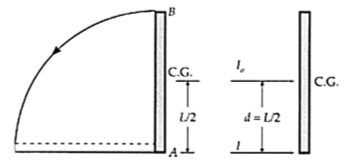
A metre scale AB is held vertically with its one end A on the floor and is then allowed to fall. Find the speed of the other end B when it strikes the floor, assuming that the end on the floor does not slip.

Need a full question paper?

Generate a complete, print-ready paper with questions like this in minutes — across 16+ boards, with answer keys.
Start Generating Free

Similar questions

An ideal gas is kept in a long cylindrical vessel fitted with a frictionless piston of cross-sectional area $10cm^2$ and weight $1kg$ (figure.) The vessel itself is kept in a big chamber containing air at atmospheric pressure $100kPa$. The length of the gas column is $20cm$. If the chamber is now completely evacuated by an exhaust pump, what will be the length of the gas column? Assume the temperature to remain constant throughout the process.
Calculate the total energy of a satellite and define binding energy.
Define co-efficient of linear expansion coefficient of areal expansion and coefficient of volume expansion and obtain mutual relation between them.
A capacitance C, a resistance R and an emf $\in$ are connected in series at t = 0. What is the maximum value of (a) the potential difference across the resistor (b) the current in the circuit (c) the potential difference across the capacitor (d) the energy stored in the capacitor (e) the power delivered by the battery and (f) the power converted into heat?
  1. Define critical velocity of liquid flow and state the factors affecting the critical velocity of liquid.
  2. Define terminal velocity. Establish an expression for it for a spherical body falling through a viscous medium.
A laser light bean sent to the moon takes 2.56s to return after reflection at the Moon's surface. Calculate the radius of the lunar orbit around the earth.
Separation of Motion of a system of particles into motion of the centre of mass and motion about the centre of mass: Show $\frac{\text{dL}}{\text{dt}}=\sum\text{r}'_\text{i}\times\frac{\text{dp}'}{\text{dt}}$ Further, show that $\frac{\text{dL}'}{\text{dt}}=\tau'_\text{ext}$ where $\tau'_\text{ext}$ is the sum of all external torques acting on the system about the centre of mass. (Hint: Use the definition of centre of mass and third law of motion. Assume the internal forces between any two particles act along the line joining the particles)
An isolated particle of mass m is moving in a horizontal plane (x - y), along the x-axis at a certain height about the ground. It explodes suddenly into two fragments of masses $\frac{\text{m}}{4}$ and $3\frac{\text{m}}{4}.$ An instant later, the smaller fragment is at y = + 15 cm. What is the position of larger fragment at this instant?
What is the ratio between the distance travelled by the oscillator in one time period and amplitude?
A steel wire of cross-sectional area $0.5 \mathrm{~mm}^2$ is held between two fixed supports. If the tension in the wire is negligible and it is just taut at a temperature of $20^{\circ} \mathrm{C}$, determine the tension when the temperature falls to $0^{\circ} \mathrm{C}$. Young's modulus of steel is $21 \times 10^{11}$ dyne $\mathrm{cm}^{-2}$ and the coefficient of linear expansion of steel is $12 \times 10^{-6}$ per ${ }^{\circ} \mathrm{C}$. Assume that the distance between the supports remains unchanged.