Separation of Motion of a system of particles into motion of the centre of mass and motion about the centre of mass: Show $\frac{\text{dL}}{\text{dt}}=\sum\text{r}'_\text{i}\times\frac{\text{dp}'}{\text{dt}}$ Further, show that $\frac{\text{dL}'}{\text{dt}}=\tau'_\text{ext}$ where $\tau'_\text{ext}$ is the sum of all external torques acting on the system about the centre of mass. (Hint: Use the definition of centre of mass and third law of motion. Assume the internal forces between any two particles act along the line joining the particles)
Exercise
Download our app for free and get started
We have the relation, $\text{L}'=\sum\limits_\text{i}\text{r}'_\text{i}\times\text{p}'_\text{i }$
$\frac{\text{dL}'}{\text{dt}}=\frac{\text{d}}{\text{dt}}\Big(\sum\limits_\text{i }\text{r}'_\text{i}\times\text{p}'_\text{i}\Big)$
$=\frac{\text{d}}{\text{dt}}\Big(\sum\limits_\text{i }\text{r}'_\text{i}\Big)\times\text{p}'_\text{i }+\sum\limits_\text{i}\text{r}'_\text{i}\times\frac{\text{d}}{\text{dt}}(\text{p}'_\text{i})$
$=\frac{\text{d}}{\text{dt}}\Big(\sum\limits_\text{i}\text{m}_\text{i}\text{r}'_\text{i}\Big)\times\text{v}'_\text{i}+\sum\limits\limits\text{r}'_\text{i} \times\frac{\text{d}}{\text{dt}}(\text{p}'_\text{i})$ Where, $r'_i$ is the position vector with respect to the centre of mass of the system of particles.
$\therefore\ \sum\limits_\text{i}\text{m}_\text{i}\text{r}'_\text{i}=0$
$\therefore\ \frac{\text{dL}'}{\text{dt}}=\sum\limits_\text{i}\text{r}'_\text{i}\times\frac{\text{d}}{\text{dt}}(\text{p}'_\text{i})$ We have the relation, $\frac{\text{dL}'}{\text{dt}}=\sum\limits_\text{i}\text{r}'_\text{i}\times\frac{\text{d}}{\text{dt}}(\text{p}'_\text{i})$
$=\sum_\limits{\text{i}}\text{r}'_\text{i}\times\text{m}_\text{i}\frac{\text{d}}{\text{dt}}(\text{v}'_\text{i})$ Where, $\frac{\text{d}}{\text{dt}}(\text{v}'_\text{i})$ is the rate of change of velocity of the $i^{th}$ particle with respect ot the centre of mass of the system. Therefore, according to Newton's third law of motion, we can write, $\text{m}_\text{i}\frac{\text{d}}{\text{dt}}(\text{v}'_\text{i})$ = Extrenal force acting on the ith particle $=\sum\limits_\text{i}(\tau'_\text{i})_\text{ext}$ i.e., $\sum\limits_\text{i}\text{r}'\times\text{m}_\text{i}\frac{\text{d}}{\text{dt}}(\text{v}'_\text{i})=\tau'_\text{ext}=$ External torque acting on the system as a whole, $\therefore\ \frac{\text{dL}'}{\text{dt}}=\tau'_\text{ext}$
$\frac{\text{dL}'}{\text{dt}}=\frac{\text{d}}{\text{dt}}\Big(\sum\limits_\text{i }\text{r}'_\text{i}\times\text{p}'_\text{i}\Big)$
$=\frac{\text{d}}{\text{dt}}\Big(\sum\limits_\text{i }\text{r}'_\text{i}\Big)\times\text{p}'_\text{i }+\sum\limits_\text{i}\text{r}'_\text{i}\times\frac{\text{d}}{\text{dt}}(\text{p}'_\text{i})$
$=\frac{\text{d}}{\text{dt}}\Big(\sum\limits_\text{i}\text{m}_\text{i}\text{r}'_\text{i}\Big)\times\text{v}'_\text{i}+\sum\limits\limits\text{r}'_\text{i} \times\frac{\text{d}}{\text{dt}}(\text{p}'_\text{i})$ Where, $r'_i$ is the position vector with respect to the centre of mass of the system of particles.
$\therefore\ \sum\limits_\text{i}\text{m}_\text{i}\text{r}'_\text{i}=0$
$\therefore\ \frac{\text{dL}'}{\text{dt}}=\sum\limits_\text{i}\text{r}'_\text{i}\times\frac{\text{d}}{\text{dt}}(\text{p}'_\text{i})$ We have the relation, $\frac{\text{dL}'}{\text{dt}}=\sum\limits_\text{i}\text{r}'_\text{i}\times\frac{\text{d}}{\text{dt}}(\text{p}'_\text{i})$
$=\sum_\limits{\text{i}}\text{r}'_\text{i}\times\text{m}_\text{i}\frac{\text{d}}{\text{dt}}(\text{v}'_\text{i})$ Where, $\frac{\text{d}}{\text{dt}}(\text{v}'_\text{i})$ is the rate of change of velocity of the $i^{th}$ particle with respect ot the centre of mass of the system. Therefore, according to Newton's third law of motion, we can write, $\text{m}_\text{i}\frac{\text{d}}{\text{dt}}(\text{v}'_\text{i})$ = Extrenal force acting on the ith particle $=\sum\limits_\text{i}(\tau'_\text{i})_\text{ext}$ i.e., $\sum\limits_\text{i}\text{r}'\times\text{m}_\text{i}\frac{\text{d}}{\text{dt}}(\text{v}'_\text{i})=\tau'_\text{ext}=$ External torque acting on the system as a whole, $\therefore\ \frac{\text{dL}'}{\text{dt}}=\tau'_\text{ext}$

Download our appand get started for free
Experience the future of education. Simply download our apps or reach out to us for more information. Let's shape the future of learning together!No signup needed.*
Similar Questions
- 1View SolutionA body is in translational equilibrium under the action of coplanar forces. If the torque of these forces is zero about a point, is it necessary that it will also be zero about any other point?
- 2View SolutionA metre stick is balanced on a knife edge at its centre. When two coins, each of mass 5g are put one on top of the other at the 12.0cm mark, the stick is found to be balanced at 45.0cm. What is the mass of the metre stick?
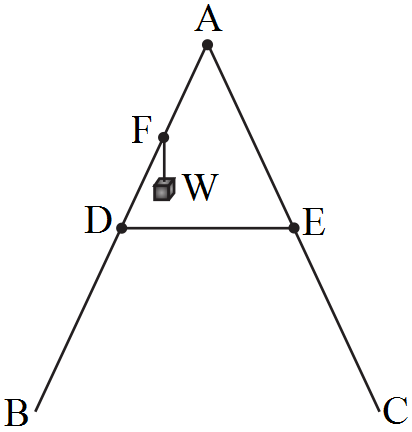
- 3As shown in the two sides of a step ladder BA and CA are 1.6m long and hinged at A. A rope DE, 0.5m is tied half way up. A weight 40kg is suspended from a point F, 1.2m from B along the ladder BA. Assuming the floor to be frictionless and neglecting the weight of the ladder, find the tension in the rope and forces exerted by the floor on the ladder. (Take $g = 9.8m/s^2$) (Hint: Consider the equilibrium of each side of the ladder separately).View Solution
- 4View SolutionA threaded rod with 12turns/ cm and diameter 1.18cm is mounted horizontally. A bar with a threaded hole to match the rod is screwed onto the rod. The bar spins at 216rev/ min. How long will it take for the bar to move 1.50cm along the rod?
- 5A star of mass twice the solar mass and radius $106km$ rotates about its axis with an angular speed of $10^{‑6}$ rad per sec. What is the angular speed of the star when it collapses (due to inward gravitational forces) to a radius of $10^4km$? Solar mass = $1.99 \times 10^{23}kg$.View Solution
- 6Calculate the angular momentum and rotational kinetic energy of earth about its own axis. How long could this amount of energy supply one kilowatt power to each of the $3.5 \times 10^9$ persons on earth? (Mass of earth = $6.0 \times 1024kg$ and radius = $6.4 \times 10^{24}km)$.View Solution
- 7A beam of uniform cross-section and uniform mass-density of mass $20kg$ is supported at ends. A mass of $5kg$ is placed at a distance of $\frac{\text{L}}{5\text{m}} $ from one of its end. If beam is L m long, what are reactions of supports? In dealing with problems of equilibrium of a rigid body (like beam in this question). first of all draw a free body diagram of the system, indicating all of the forces acting on the system.View Solution
- 8Two particles of mass $2kg$ and $1kg$ are moving along the same line with speeds $2ms-1$ and $5ms^{-1}$ respectively. What is the speed of the centre of mass of the system if both the particles are moving (a) in same direction (b) in opposite direction?View Solution
- 9Prove that the velocity v of translation of a rolling body (like a ring, disc, cylinder or sphere) at the bottom of an inclined plane of height h is given by:$\text{v}^2=\frac{2\text{gh}}{\big(1+\frac{\text{K}^2}{\text{R}^2}\big)}$View Solution
Note K is the radius of gyration of the body about its symmetry axis, and R is the radius of the body. The body starts from rest at the top of the plane. - 10A uniform rod pivoted at its upper end hangs vertically. It is displaced through an angle of $60°$ and then released. Find the magnitude of the force acting on a particle of mass dm at the tip of the rod when the rod makes an angle of $37°$ with the vertical.View Solution