Question
A metre scale is made up of steel and measures correct length at $16^{\circ} \mathrm{C}$. What will be the percentage error if this scale is used:
a. On a summer day when the temperature is $46^{\circ} \mathrm{C}$.
b. On a winter day when the temperature is $6^{\circ} \mathrm{C}$ ? Coefficient of linear expansion of steel $=11 \times 10^{-60} \mathrm{C}^{-1}$.
Answer

  1. Length at $16^\circ C = L$
L = ?
$T_1 = 16^\circ C$
$T_2 = 46^\circ C$
$\alpha=1.1\times10^{-5/^\circ}\text{C}$
$\Delta\text{L}=\text{L}\alpha\Delta\theta=\text{L}\times1.1\times10^{-5}\times30$
$\%\ \text{of error}$ $=\Big(\frac{\Delta\text{L}}{\text{L}}\times100\Big)\%$
$=\Big(\frac{\text{L}\alpha\Delta\theta}{2}\times100\Big)\%$
$=1.1\times10^{-5}\times30\times100\%=0.33\%$
  1. $\text{T}_2=6^\circ\text{C}$
$\%\ \text{of error}$ $=\Big(\frac{\Delta\text{L}}{\text{L}\times100}\Big)\%$
$=\Big(\frac{\text{L}\alpha\Delta\theta}{\text{L}}\times100\Big)\%$
$=-1.1\times10^{-5}\times10\times100=-0.011\%$

Need a full question paper?

Generate a complete, print-ready paper with questions like this in minutes — across 16+ boards, with answer keys.

Start Generating Free

Similar questions

A ball is thrown upward with an initial velocity of $100m/s$. After how much time will it return? Draw velocity$-$time graph for the ball and find from the graph.
  1. Maximum height attained by ball.
  2. Height of the ball after $15s$. Take, $g = 10ms^{-2}$
The bob of a simple pendulum has a mass of 40 g and a positive charge of $4.0 \times 10^{-6} \mathrm{C}$. It makes 20 oscillations in 45 s . A vertical electric field pointing upward and of magnitude $2.5 \times 10^4 \mathrm{NC}^{-1}$ is switched on. How much time will it now take to complete 20 oscillations?
A large steel wheel is to be fitted on to a shaft of the same material. At $27^{\circ} C$, the outer diameter of the shaft is $8.70 \ cm$ and the diameter of the central hole in the wheel is $8.69 \ cm$ . The shaft is cooled using 'dry ice'. At what temperature of the shaft does the wheel slip on the shaft? Assume coefficient of linear expansion of the steel to be constant over the required temperature range: asteel $= 1.20 \times 10^{–5} K^{–1}.$
On the basis of molecular kinetic theory derive an expression for the pressure exerted on the walls of a vessel by a gas filled in it.
If momentum of a body increased by 300%, then what will be percentage increase in momentum of a body?
  1. Prove that the work done in stretching a wire per unit volume is $\frac{1}{2}\times\text{tension}\times\text{extension.}$
  2. Prove that the work done per unit volume in stretching a wire for every type of strain $=\frac{1}{2}\times\text{stress}\times\text{strain}.$
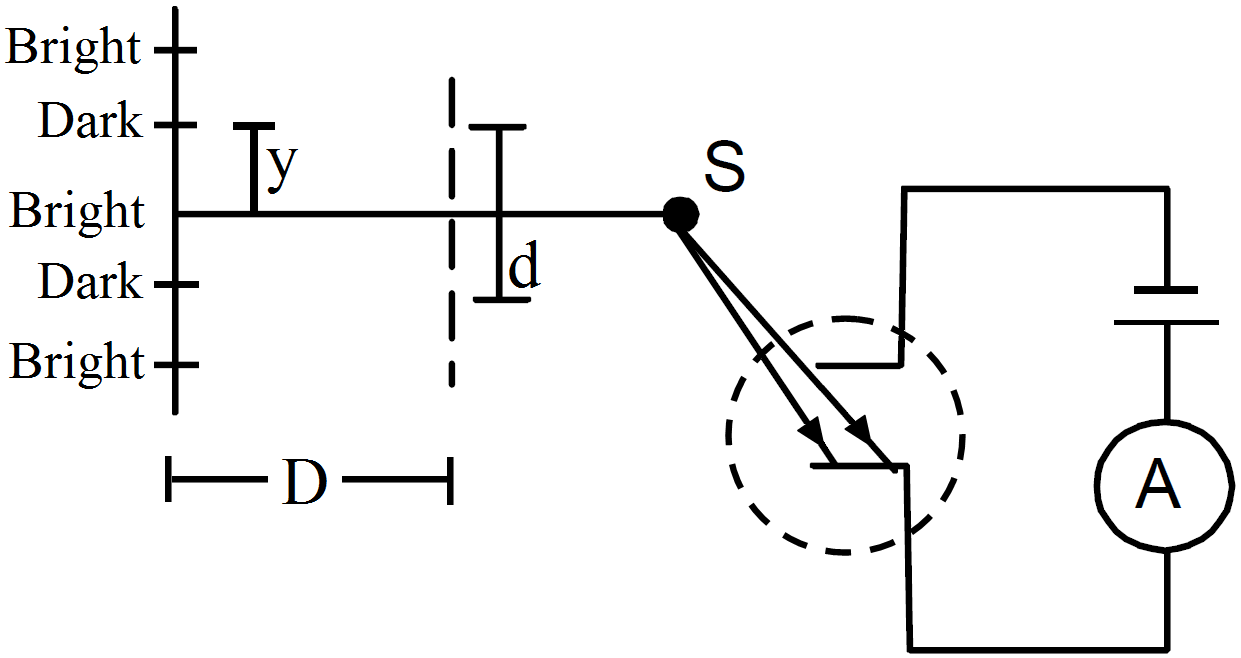
In the arrangement shown in figure $y = 1.0mm. d = 0.24mm$ end $D = 1.2m$. The work function of the materiel of the emitter is $2.2eV$. Find the stopping potential V needed to stop the photocurrent.
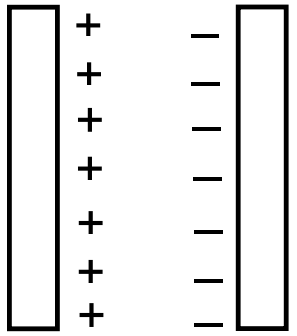
Two large conducting plates are placed parallel to each other and they carry equal and opposite charges with surface density $\sigma$ as shown in figure. Find the electric field:
  1. At the left of the plates.
  2. In between the plates.
  3. At the right of the plates.
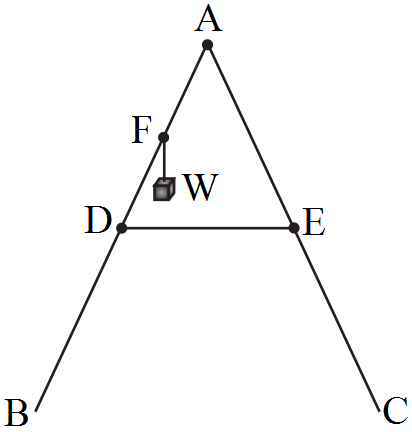
As shown in the two sides of a step ladder BA and CA are $1.6m$ long and hinged at A. A rope DE, $0.5m$ is tied half way up. A weight $40kg$ is suspended from a point F, 1.2m from B along the ladder BA. Assuming the floor to be frictionless and neglecting the weight of the ladder, find the tension in the rope and forces exerted by the floor on the ladder. (Take $g = 9.8m/s^2$) (Hint: Consider the equilibrium of each side of the ladder separately).
A particle of mass m and charge q is thrown at a speed u against a uniform electric field E. How much distance will it travel before coming to momentary rest?