Question
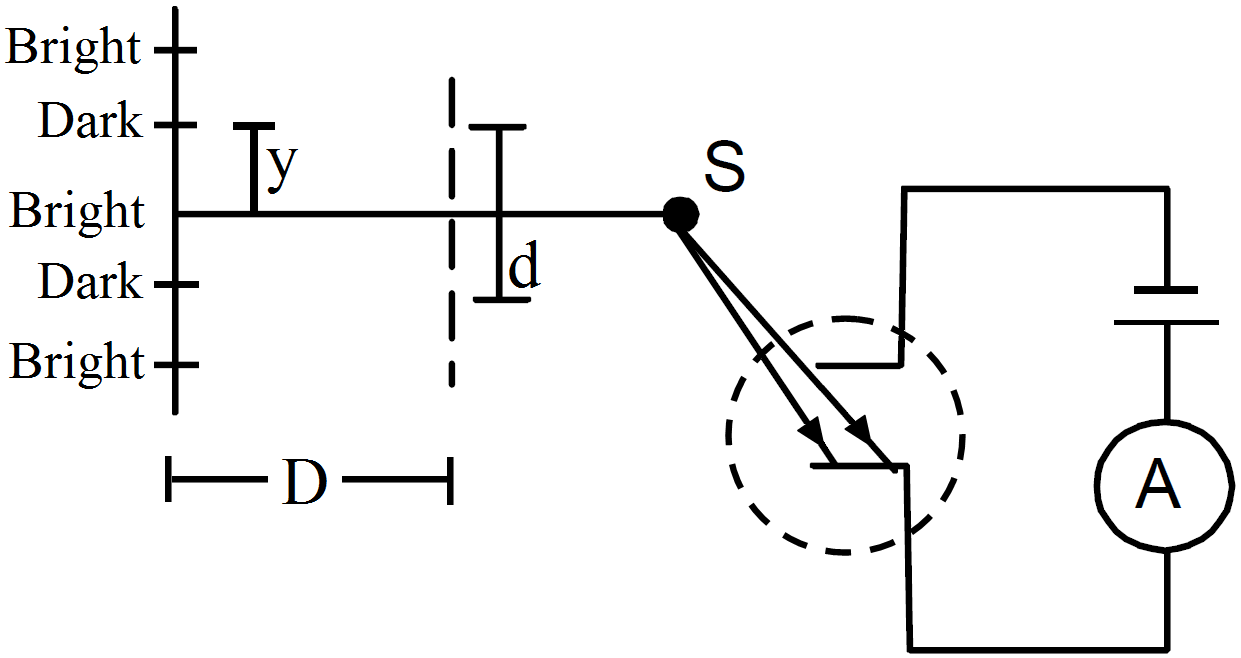
In the arrangement shown in figure $y = 1.0mm. d = 0.24mm$ end $D = 1.2m$. The work function of the materiel of the emitter is $2.2eV$. Find the stopping potential V needed to stop the photocurrent.
Answer

Given : fringe width, $y = 1.0mm × 2 = 2.0mm, D = 0.24mm, W_0 = 2.2ev, D = 1.2m \text{y}=\frac{\lambda\text{D}}{\text{d}}$
$\lambda=\frac{\text{yd}}{\text{D}}=\frac{2\times10^{-3}\times0.24\times10^{-3}}{1.2}=4\times10^{-7}\text{m}$
$\text{E}=\frac{\text{hc}}{\lambda}=\frac{4.14\times10^{-15}\times3\times10^{8}}{4\times10}=3.105\text{ev.}$
Stopping potential $eV_0 = 3.105 - 2.2 = 0.905V$

Need a full question paper?

Generate a complete, print-ready paper with questions like this in minutes — across 16+ boards, with answer keys.
Start Generating Free

Similar questions

A particle executes a simple harmonic motion of amplitude $1.0cm$ along the principal axis of a convex lens of focal length $12cm$. The mean position of oscillation is at $20cm$ from the lens. Find the amplitude of oscillation of the image of the particle.
State Newton's second law of motion. How does it help to measure force? Also state the units of force.
Establish the following vector inequalities geometrically or otherwise: $|\text{a}+\text{b}|\le|\text{a}|+|\text{b}|$ When does the equality sign above apply?
A parallel-plate capacitor having plate area $400cm^2$ and separation between the plates $1.0mm$ is connected to a power supply of 100V. A dielectric slab of thickness $1.0mm$ and dielectric constant $5.0$ is inserted into the gap:
  1. Find the increase in electrostatic energy.
  2. If the power supply is now disconnected and the dielectric slab is taken out, find the further increase in energy.
  3. Why does the energy increase in inserting the slab as well as in taking it out?
We would like to make a vessel whose volume does not change with temperature (take a hint from the problem above). We can use brass and iron $\big(\beta_\text{ubrass}=6\times10^{-5}/\text{K and }\beta_\text{uiron}=3.55\times10^{-5}\text{K}\big)$ to create a volume of $100cc$. How do you think you can achieve this.
When air is pumped into a cycle tyre the volume and pressure of the air in the tyre both are increased. What about Boyle’s law in this case?
Each capacitor in figure has a capacitance of $10\mu\text{F}.$ The emf of the battery is 100V. Find the energy stored in each of the four capacitors.
A particle of mass m is kept on a fixed, smooth sphere of radius R at a position, where the radius through the particle makes an angle of 30° with the vertical. The particle is released from this position.
  1. What is the force exerted by the sphere on the particle just after the release?
  2. Find the distance travelled by the particle before it leaves contact with the sphere.
Io, one of the satellites of Jupiter, has an orbital period of $1.769$ days and the radius of the orbit is $4.22 \times 10^8m$. Show that the mass of Jupiter is about one-thousandth that of the sun.
A child running a temperature of $101^{\circ} \mathrm{F}$ is given an antipyrin (i.e. a medicine that lowers fever) which causes an increase in the rate of evaporation of sweat from his body. If the fever is brought down to $98^{\circ} \mathrm{F}$ in 20 minutes, what is the average rate of extra evaporation caused, by the drug. Assume the evaporation mechanism to be the only way by which heat is lost. The mass of the child is 30 kg . The specific heat of human body is approximately the same as that of water, and latent heat of evaporation of water at that temperature is about $580 \mathrm{cal} \mathrm{g}^{-1}$.