Question
A metre scale is moving with uniform velocity. This implies:
  1. The force acting on the scale is zero, but a torque about the centre of mass can act on the scale.
  2. The force acting on the scale is zero and the torque acting about centre of mass of the scale is also zero.
  3. The total force acting on it need not be zero but the torque on it is zero.
  4. Neither the force nor the torque need to be zero.

Answer

  1. The force acting on the scale is zero and the torque acting about centre of mass of the scale is also zero.

Explanation:

Key concept: To solve these types of problem we have to apply Newton’s second law of motion! Newton’s Second Law of Motion

According to this law: The rate of change of linear momentum of a body is directly proportional to the external force applied on the body and this change takes place always in the direction of the force applied.

Need a full question paper?

Generate a complete, print-ready paper with questions like this in minutes — across 16+ boards, with answer keys.

Start Generating Free

Similar questions

A body is moving unidirectionally under the influence of a source of constant power supplying energy. Which of the diagrams shown in correctly shows the displacement-time curve for its motion?

Standing stationary waves can be obtained in an air column even if the interfering waves are
A geostationary satellite orbits around the earth in a circular orbit of radius $36000\, km$. Then, the time period of a satellite orbiting a few hundred kilometres above the earth’s surface $({R_{{\rm{Earth}}}} = 6400\,km)$ will approximately be ....... $hours$
We have half a bucket ($6$ litre) of water at $20^oC $.If we want water at $40^oC$, how much steam at $100^oC$ should be added to it ?
$Assertion$ : A helicopter must necessarily have two propellers.
$Reason$ : Two propellers are provided in helicopter in order to conserve linear momentum
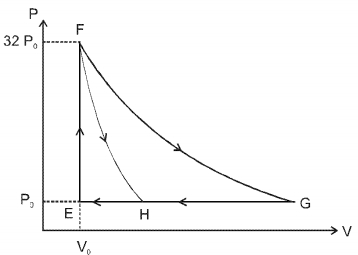
One mole of a monatomic ideal gas is taken along two cyclic processes $E \rightarrow F \rightarrow G \rightarrow E$ and $E \rightarrow F \rightarrow H \rightarrow$ E as shown in the $PV$ diagram. The processes involved are purely isochoric, isobaric, isothermal or adiabatic. $Image$

Match the paths in List $I$ with the magnitudes of the work done in List $II$ and select the correct answer using the codes given below the lists.

List $I$ List $I$
$P.$ $\quad G \rightarrow E$ $1.$ $\quad 160 P_0 V_0 \ln 2$
$Q.$ $\quad G \rightarrow H$ $2.$ $\quad 36 P _0 V _0$
$R.$ $\quad F \rightarrow H$ $3.$ $\quad 24 P _0 V _0$
$S.$ $\quad F \rightarrow G$ $4.$ $\quad 31 P_0 V_0$

Codes: $ \quad  \quad P \quad Q \quad R \quad S $ 

Which of the following statements is incorrect?
Two equal masses are attached to the two ends of a spring of spring constant k. The masses are pulled out symmetrically to stretch the spring by a length x over its natural length. The work done by the spring on each mass is:
A particle executes $SHM$ with amplitude of $20 \,cm$ and time period is $12\, sec$.  What is the minimum time required for it to move between two points $10\, cm$ on  either side of the mean position ..... $\sec$ ?
Match the columns

  Column $-I$
    $R/H_{max}$
  Column $-II$
  Angle of projection $\theta $
   $A.$ $1$    $1.$ ${60^o}$
   $B.$ $4$    $2.$ ${30^o}$
   $C.$ $4\sqrt 3$    $3.$ ${45^o}$
   $D.$ $\frac {4}{\sqrt 3}$    $4.$ $tan^{-1}\,4\,=\,{76^o}$