MCQ
A micron is related to centimetre as
  • A
    $1\,micron = {10^{ - 8}}cm$
  • B
    $1\,micron = {10^{ - 6}}cm$
  • C
    $1\,micron = {10^{ - 5}}cm$
  • $1\,micron = {10^{ - 4}}\,cm$

Answer

Correct option: D.
$1\,micron = {10^{ - 4}}\,cm$
d
(d) $1\,\,micron = {10^{ - 6}}m = {10^{ - 4}}cm$

Need a full question paper?

Generate a complete, print-ready paper with questions like this in minutes — across 16+ boards, with answer keys.
Start Generating Free

Similar questions

The relation between the gas pressure $P$ and average kinetic energy per unit volume $E$ is
A ball of mass 0.2kg is thrown vertically upwards by applying a force by hand. If the hand moves 0.2m which applying the force and the ball goes upto 2m height further, find the magnitude of the force. Consider g = 10m/ s2
Two particles are in $SHM$ in a straight line. Amplitude $A$ and time period $T$ of both the particles are equal. At time $t=0,$ one particle is at displacement $y_1= +A$ and the other at $y_2= -A/2,$ and they are approaching towards each other. After what time they cross each other ?
At what temperature the kinetic energy of gas molecule is half of the value at 27°C?
A vehicle with a horn of frequency n is moving with a velocity of 30m/s in a direction perpendicular to the straight line joining the observer and the vehicle. The observer precedes the sound to have a frequency (n + n1). If velocity of sound in air is 300m/s, n, would be:
A person draws water from a $5\,m$ deep well in a bucket of mass $2\,kg$ of capacity $8\,litre$ by a rope of mass $1\,kg.$ What is the total work done by the person ? .............. $\mathrm{J}$ (Assume $g = 10\,m/sec^2$ )
Acceleration of a particle, executing $SHM$, at it’s mean position is
At some temperature $T$, a bronze pin is a little large to fit into a hole drilled in a steel block. The change in temperature required for an exact fit is minimum when
A particle executes simple harmonic oscillation with an amplitude $a.$ The period of oscillation is $T.$ The minimum time taken by the particle to travel half of the amplitude from the equilibrium position is 
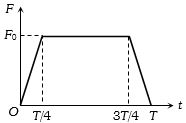
A particle of mass m moving with a velocity $u$ makes an elastic one dimensional collision with a stationary particle of mass $m$ establishing a contact with it for extremely small time $T$. Their force of contact increases from zero to $F_0$ linearly in time $\frac{T}{4}$, remains constant for a further time $\frac{T}{2}$ and decreases linearly from  $F_0$  to zero in further time $\frac{T}{4}$ as shown. The magnitude possessed by $F_0$  is