MCQ
Acceleration of a particle, executing $SHM$, at it’s mean position is
  • A
    Infinity
  • B
    Varies
  • C
    Maximum
  • Zero

Answer

Correct option: D.
Zero
d

So acceleration is minimum (zero).

Need a full question paper?

Generate a complete, print-ready paper with questions like this in minutes — across 16+ boards, with answer keys.

Start Generating Free

Similar questions

An ideal gas equation can be written as $P=\frac{\rho R T}{M_{0}}$ where $\rho$ and $M_{0}$ are respectively,
A particle moves in a plane with constant acceleration in a direction different from the initial velocity. The path of the particle will be
A piston is slowly pushed into a metal cylinder containing an ideal gas. Which of the following statements is/are incorrect?
A satellite is moving with a constant speed ' $V$ ' in a circular orbit about the earth. An object of mass ' $m$ ' is ejected from the satellite such that it just escapes from the gravitational pull of the earth. At the time of its ejection, the kinetic energy of the object is
The position vectors of radius are $2\hat i + \hat j + \hat k$ and $2\hat i - 3\hat j + \hat k$ while those of linear momentum are $2\hat i + 3\hat j - \hat k.$ Then the angular momentum is
A girl riding a bicycle with a speed of 5ms-1 towards North direction sees raindrops falling vertically downwards. On increasing the speed to 15ms rain appears to fall making an angle of 45° of the vertical. Find the magnitude of velocity of rain.
Which of the following statements can be suitable?
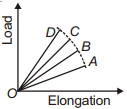
The load versus elongation graph for four wires of same length and the same material is shown in figure. The thinnest wire is represented by line
An ideal heat engine working between temperature $T_1$ and $T_2 $ has an efficiency $\eta$, the new efficiency if both the source and sink temperature are doubled, will be
A constant pressure air thermometer gave a reading of $47.5$ units of volume when immersed in ice cold water, and $67$ units in a boiling liquids. The boiling point of the liquid will be .......... $^oC$