Question
A monkey climbs up a slippery pole for 3 seconds and subsequently slips for 3 seconds. Its velocity at time t is given by v(t) = 2t(3 - t); 0 < t < 3 and v(t) = -(t - 3)(6 - t) for 3 < t < 6s in m/s. It repeats this cycle till it reaches the height of 20m. At what time is its velocity maximum?
Answer

Given velocity $\text{v}(\text{t})=2\text{t}(3-\text{t})=6\text{t}-2\text{t}^2$ For maximum velocity $\frac{\text{dv(t)}}{\text{dt}}=0$ $\Rightarrow\frac{\text{d}}{\text{dt}}(6\text{t}-2\text{t}^2)=0$ $\Rightarrow6-4\text{t}=0$ $\Rightarrow\text{t}=\frac{6}{4}=\frac{3}{2}\text{s}=1.5\text{s}$

Need a full question paper?

Generate a complete, print-ready paper with questions like this in minutes — across 16+ boards, with answer keys.

Start Generating Free

Similar questions

Find the average magnitude of linear momentum of a helium molecule in a sample of helium gas at $0^{\circ} \mathrm{C}$. Mass of a helium molecule $=6.64 \times 10^{-27} \mathrm{~kg}$ nd Boltzmann constant $=1.38 \times 10^{-23} \mathrm{JK}^{-1}$.
How many types of inertia are there? Explain by example.
Two identical cylinders 'run a race' starting from rest at the top of an inclined plane, one slides without rolling and other rolls without slipping. Assuming that no mechanical energy is dissipated in heat, which one will win?
Water flows at a speed of 6cm/ s through a tube of radius 1cm. Coefficient of viscosity of water at room temperature is 0.001 Poise. What is the nature of the flow?
What is the angular acceleration of a particle moving in a circle of radius 'r' with a angular speed $'\omega'?$
A passenger of mass $72.2\ kg$ is riding in an elevator while standing on a platform scale. What does the scale read when the elevator cab is:
  1. Descending with constant velocity,
  2. Ascending with constant acceleration, $3.5\ m/ s$?
Two equal drops of water are falling through air with a steady velocity v. If the drops coalesce, what will be the new steady velocity?
Does he velocity of falling rain drops continuously increases? Do all the drops of rains (big and small) reach the earth with the same velocity?
A load of $10\ kg$ is suspended by a metal wire $3m$ long and having a cross-sectional area $4mm^2$. Find.
  1. The stress.
  2. The strain and.
  3. The elongation. Young's modulus of the metal is $2.0 \times 10N^{11}N/ m^2$.
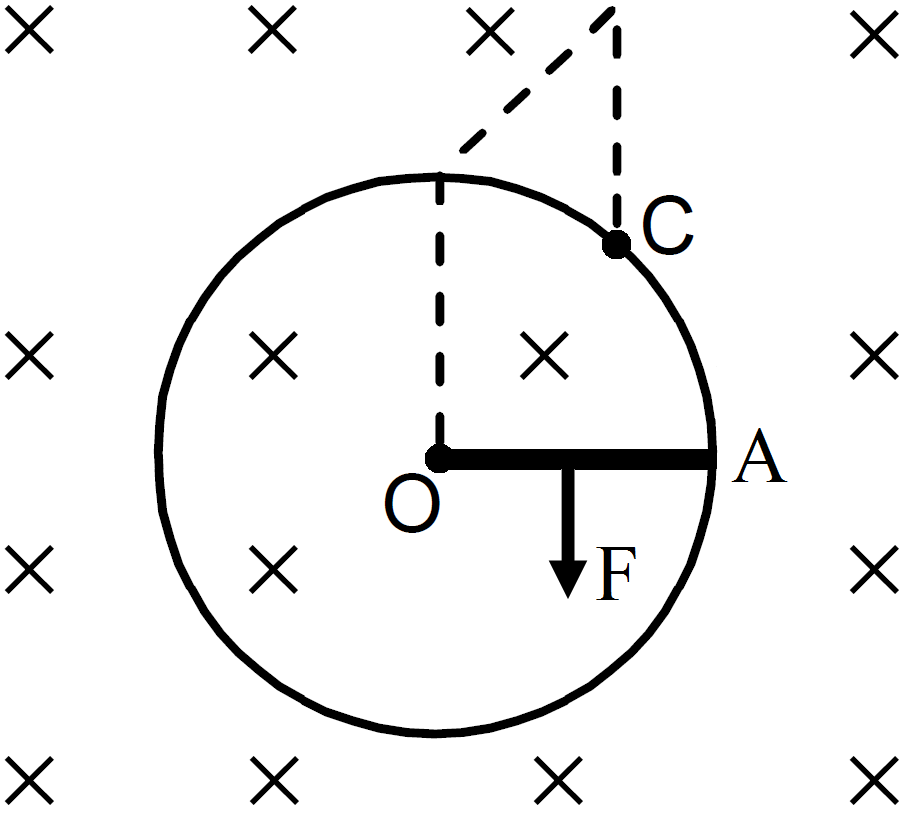
Figure shows a conducting circular loop of radius a placed in a uniform, perpendicular magnetic field B. A thick metal rod OA is pivoted at the centre O. The other end of the rod touches the loop at A. The centre O and a fixed point C on the loop are connected by a wire OC of resistance R. A force is applied at the middle point of the rod OA perpendicularly, so that the rod rotates clockwise at a uniform angular velocity $\omega.$ Find the force.