MCQ
A monoatomic gas molecule has
  • Three degrees of freedom
  • B
    Four degrees of freedom
  • C
    Five degrees of freedom
  • D
    Six degrees of freedom

Answer

Correct option: A.
Three degrees of freedom
a
An atomic gas molecule has only three transferable degrees of freedom.

Need a full question paper?

Generate a complete, print-ready paper with questions like this in minutes — across 16+ boards, with answer keys.
Start Generating Free

Similar questions

When a $4\, kg$ mass is hung vertically on a light spring that obeys Hooke's law, the spring stretches by $2\, cms$. The work required to be done by an external agent in stretching this spring by $5\, cms$ will be ......... $joule$       $(g = 9.8\,metres/se{c^2})$
$A$ bal $A$ collides elastically with another identical ball $B$ initially at rest $A$ is moving with velocity of $10m/ s$ at an angle of $60^o$ from the line joining their centres. Select correct alternative :
$Assertion$: The total translational kinetic energy of all the molecules of a given mass of an ideal gas is $1.5\, times$ the product of its pressure and its volume.
$Reason$ : The molecules of a gas collide with each other and the velocities of the molecules change due to the collision.
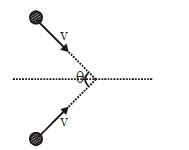
Two identical particles are moving with same velocity $v$  as shown in figure. If the collision is completely inelastic then
Which of the following are electromagnetic waves?

  1. $\alpha-\text{decay}$

  2. $\beta^+-\text{decay}$

  3. $\beta^--\text{decay}$

  4. $\gamma-\text{decay}$

A swimmer can swim with velocity of $12 \,km / h$ in still water. Water flowing in a river has velocity $6\, km / h$. The direction with respect to the direction of flow of river water he should swim in order to reach the point on the other bank just opposite to his starting point is ........$^{\circ}$. (Round off to the Nearest Integer) (find the angle in degree)
Two particles A and B initially at rest move towards each other under a mutual force of attraction. The speed of centre of mass at the instant when the speed of A is v and the speed of B is 2v is:
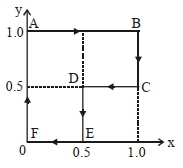
A particle is moved along a path $A B-B C-C D-D E-E F-F A$, as shown in figure, in presence of a force $\overrightarrow{ F }=(\alpha \hat{y}+2 \alpha \hat{x} \hat{j}) N$, where $x$ and $y$ are in meter and $\alpha=-1 N / m ^{-1}$. The work done on the particle by this force $\vec{F}$ will be. . . . . . Joule.
A wire suspended vertically from one end is stretched by attaching a weight $200 \,N$ to the lower end. The weight stretches the wire by $1 \,mm$. The elastic potential energy gained by the wire is ....... $J$
Two solid rubber balls $A$ and $B$ having masses $200$ and $400\, gm$ respectively are moving in opposite directions with velocity of $A$ equal to $0.3 \,m/s$. After collision the two balls come to rest, then the velocity of $B$ is .............. $\mathrm{m} / \mathrm{s} $