- A$3.9$
- B$7.9$
- ✓$1.9$
- D$5.9$
$E = \frac{{Pt}}{n}$
$\mathrm{E}=\frac{5 \times 10^{-3}}{8 \times 10^{15}} \mathrm{\,J}$
$\mathrm{E}=\frac{5 \times 10^{-3}}{8 \times 10^{15}} \times \frac{1}{1.6 \times 10^{-19}} \mathrm{\,eV}$
$\mathrm{E}=3.9 \mathrm{\,eV}$
$(\mathrm{K.E})_{\max }=\mathrm{E}-\phi$
$\phi=3.9-2$
$\boxed{\phi = 1.9{\mkern 1mu} {\text{eV}}}$
Generate a complete, print-ready paper with questions like this in minutes — across 16+ boards, with answer keys.

(IMAGE)
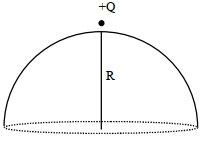
$[A]$ The electric flux passing through the curved surface of the hemisphere is $-\frac{\mathrm{Q}}{2 \varepsilon_0}\left(1-\frac{1}{\sqrt{2}}\right)$
$[B]$ Total flux through the curved and the flat surfaces is $\frac{Q}{\varepsilon_0}$
$[C]$ The component of the electric field normal to the flat surface is constant over the surface
$[D]$ The circumference of the flat surface is an equipotential