Question
A monoenergetic (18 keV) electron beam initially in the horizontal direction is subjected to a horizontal magnetic field of 0.04 G normal to the initial direction. Estimate the up or down deflection of the beam over a distance of 30 cm $(m_e = 9.11 \times 10^{–19} C).$
[Note: Data in this exercise are so chosen that the answer will give you an idea of the effect of earth’s magnetic field on the motion of the electron beam from the electron gun to the screen in a TV set.]
Answer

Energy of an electron beam, $E = 18 keV = 18 \times 10^3 eV$
Charge on an electron, $e = 1.6 \times 10^{−19}C$
$E = 18 \times 10^3 \times 1.6 \times 10^{−19} J$
Magnetic field, $B = 0.04 G$
Mass of an electron, $m_e = 9.1 \times 10^{−31} kg$
Distance up to which the electron beam travels, $d = 30 cm = 0.3 m$
We can write the kinetic energy of the electron beam as:
$\text{E}=\frac{1}{2}\text{mv}^2$
$\text{v}=\sqrt{\frac{2\text{E}}{\text{m}}}$
$\text{v}=\sqrt{\frac{2\times18\times10^3\times1.6\times10^{-19}}{9.1\times10^{-31}}}=0.795\times10^{8}\text{m}/\text{s}$
The electron beam deflects along a circular path of radius, r.
The force due to the magnetic field balances the centripetal force of the path.
$\text{B}_e\text{V}=\frac{\text{mv}^2}{\text{r}}$
$\therefore\ \text{r}=\frac{\text{mv}}{\text{Be}}$
$=\frac{9.1\times10^{-31}\times0.795\times10^8}{0.4\times10^{-4}\times1.6\times10^{-19}}=11.3\text{ m}$
Let the up and down deflection of the electron beam be $\text{x}=\text{r}(1-\cos\theta)$
Where, $\theta$ = Angle of declination.
$\sin\theta=\frac{\text{d}}{\text{r}}$
$=\frac{0.3}{11.3}$
$\theta=\sin^{-1}\frac{0.3}{11.3}=1.521^\circ$
And $\text{x}=11.3(1-\cos1.521^\circ)$
$=0.0039\text{ m}=3.9\text{ mm}$
Therefore, the up and down deflection of the beam is 3.9 mm.

Need a full question paper?

Generate a complete, print-ready paper with questions like this in minutes — across 16+ boards, with answer keys.

Start Generating Free

Similar questions

An ideal gas is kept in a long cylindrical vessel fitted with a frictionless piston of cross-sectional area $10cm^2$ and weight 1kg (figure.) The vessel itself is kept in a big chamber containing air at atmospheric pressure 100kPa. The length of the gas column is 20cm. If the chamber is now completely evacuated by an exhaust pump, what will be the length of the gas column? Assume the temperature to remain constant throughout the process.
The electric potential existing m space is V(x, y, z) = A(xy + yz + zx).
  1. Write the dimensional formula of A.
  2. Find the expression for the electric field.
  3. If A is 10 SI units, find the magnitude of the electric field at (1m, 1m, 1m).
A steel frame $(\text{K}=45\text{Wm}^{-1}{^{\circ}}\text{C}^{-1})$of total length 60cm and cross sectional area $0.20cm^2,$ forms three sides of a square. The free ends are maintained at 20°C and 40°C. Find the rate of heat flow through a cross section of the frame.
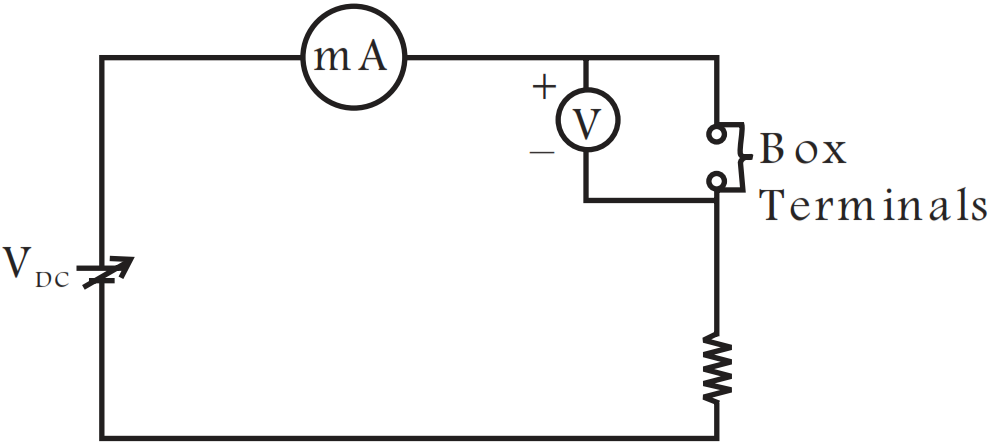
Consider a box with three terminals on top of it as shown in Fig (a):

Three components namely, two germanium diodes and one resistor are connected across these three terminals in some arrangement. A student performs an experiment in which any two of these three terminals are connected in the circuit shown in Fig. (b).

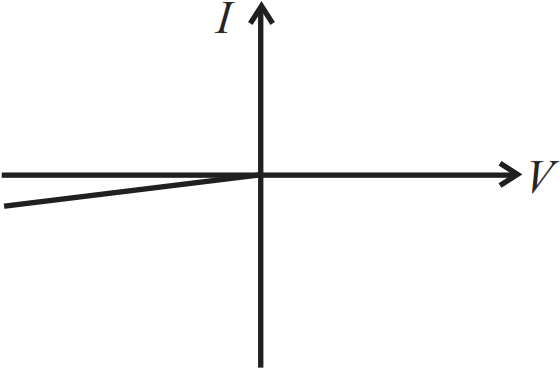
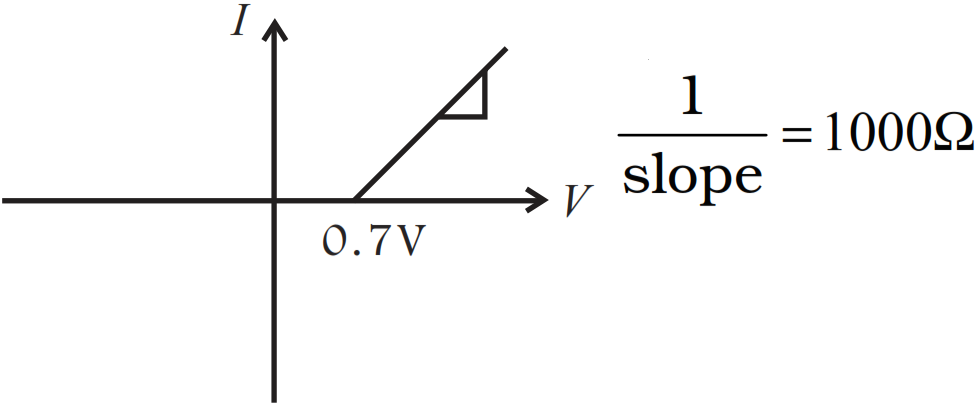
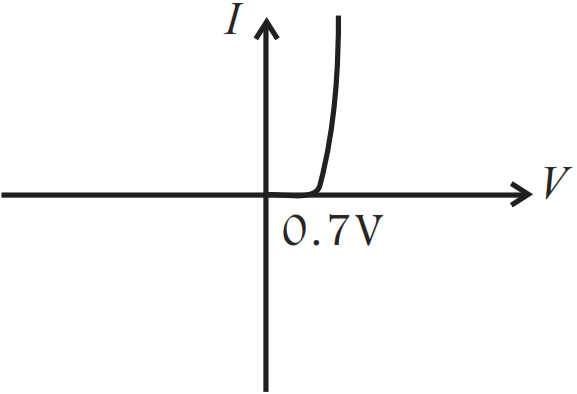
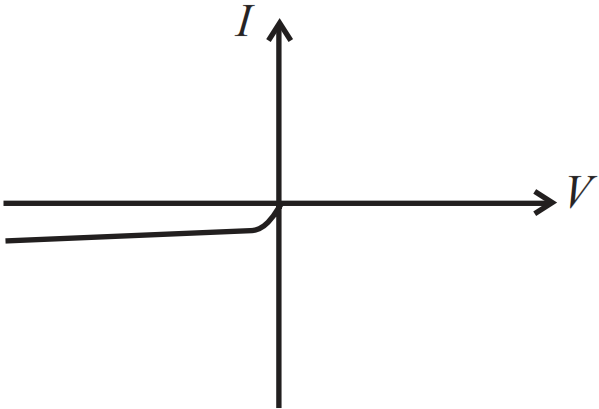
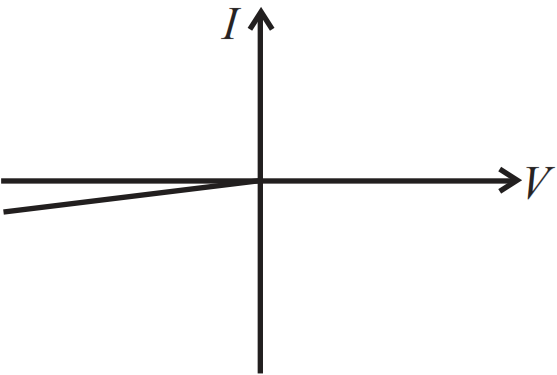
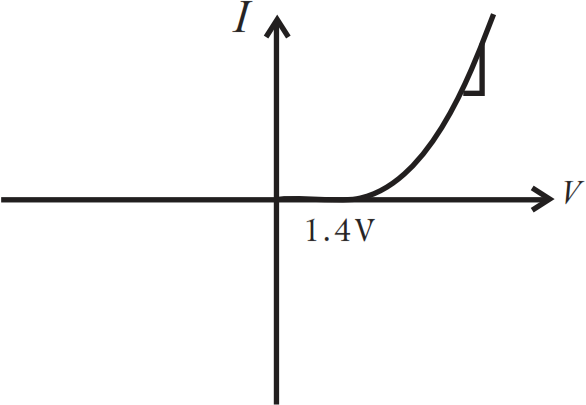
The student obtains graphs of current-voltage characteristics for unknown combination of components between the two terminals connected in the circuit. The graphs are
  1. When A is positive and B is negative,
  1. When A is negative and B is positive,
  1. When B is negative and C is positive,
  1. When B is positive and C is negative,
  1. When A is positive and C is negative,
  1. When A is negative and C is positive,

From these graphs of current - voltage characteristic shown in Fig. (c) to (h), determine the arrangement of components between A, B and C.
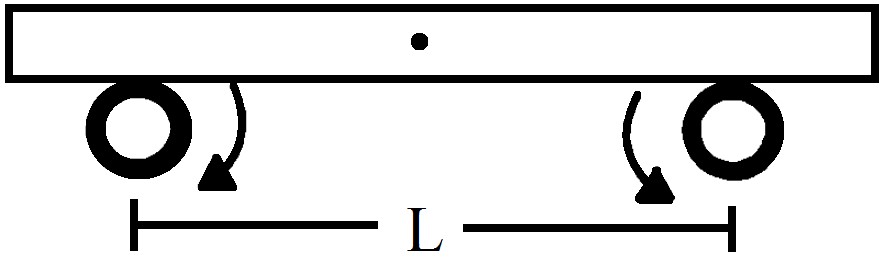
A uniform plate of mass M stays horizontally and symmetrically on two wheels rotating in opposite directions figure The separation between the wheels is L. The friction coefficient between each wheel and the plate is N. Find the time period of oscillation of the plate if it is slightly displayed along its length and released.
A parallel-plate capacitor has plate area $100cm^2$ and plate separation 1.0cm. A glass plate (dielectric constant 6.0) of thickness 6.0mm and an ebonite plate (dielectric constant 4.0) are inserted one over the other to fill the space between the plates of the capacitor. Find the new capacitance.
  1. Compare the individual dipole moment and the specimen dipole moment for $H_2O $ molecule and $O_2$ molecule when placed in:
  1. Absence of external electric field.
  2. Presence of external eclectic field. Justify your answer.
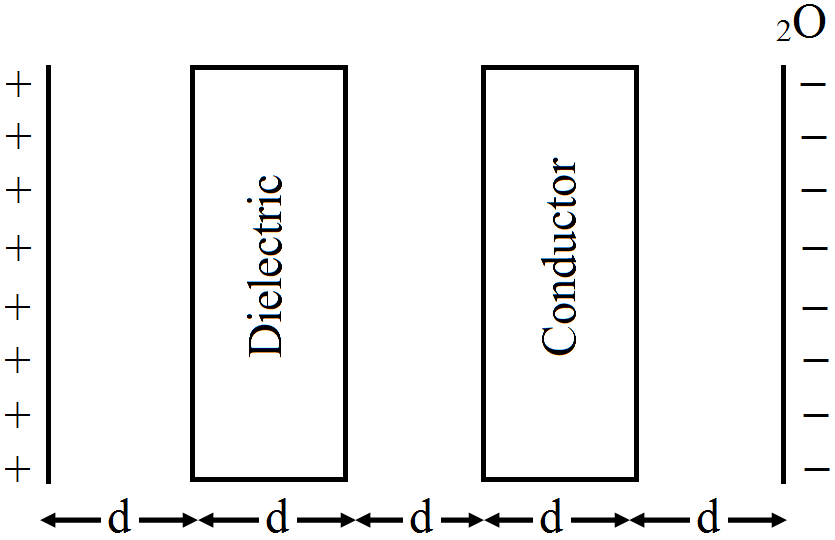
  1. Given two parallel conducting plates of area A and charge densities $+\sigma$ and $-\sigma.$ A dielectric slab of constant K and a conducting slab of thickness d each are inserted in between them as shown.
  1. Find the potential difference between the plates.
  2. Plot E versus x graph, taking x = 0 at positive plate and x = 5d at negative plate.
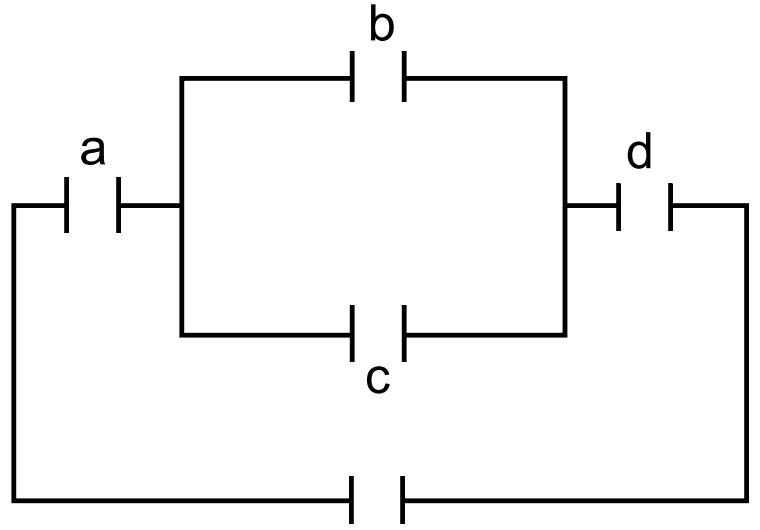
Each capacitor in figure has a capacitance of $10\mu\text{F}.$ The emf of the battery is 100V. Find the energy stored in each of the four capacitors.
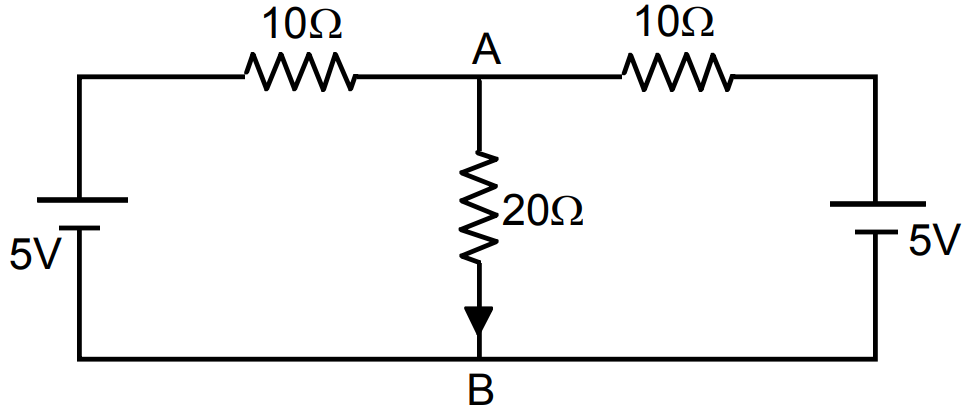
(a) Find the current in the $20\Omega$ resistor shown in the figure. (b) If a capacitor of capacitance $4\mu\text{F}$ is joined between the points A and B, what would be the electrostatic energy stored in it in steady state?
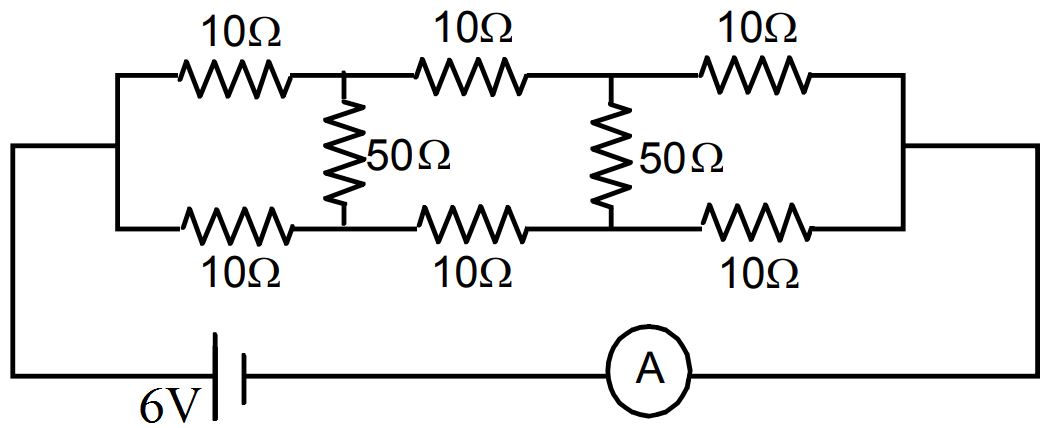
Find the current measured by the ammeter in the circuit shown in the figure.