Question
Consider a box with three terminals on top of it as shown in Fig (a):
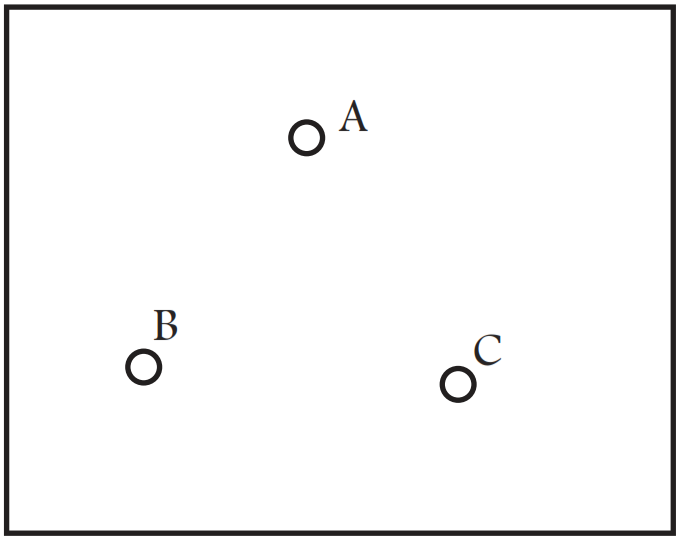
Three components namely, two germanium diodes and one resistor are connected across these three terminals in some arrangement. A student performs an experiment in which any two of these three terminals are connected in the circuit shown in Fig. (b).
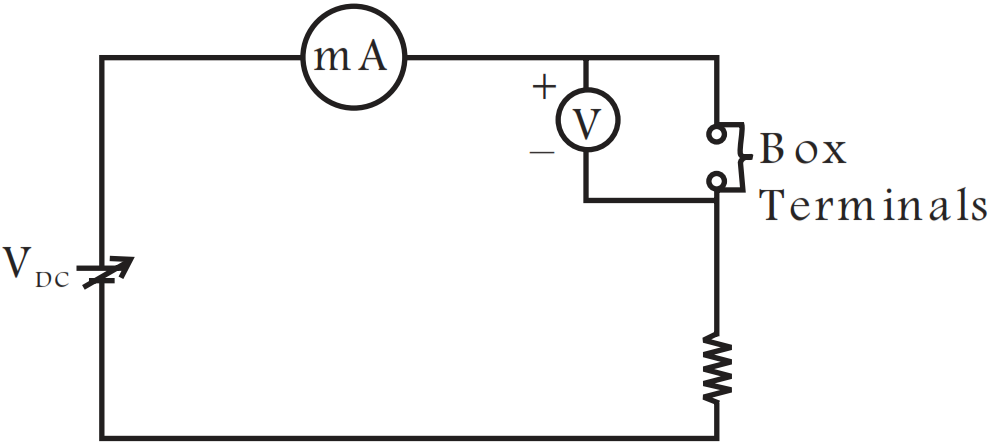
The student obtains graphs of current-voltage characteristics for unknown combination of components between the two terminals connected in the circuit. The graphs are
  1. When A is positive and B is negative,
  1. When A is negative and B is positive,
  1. When B is negative and C is positive,
  1. When B is positive and C is negative,
  1. When A is positive and C is negative,
  1. When A is negative and C is positive,

From these graphs of current - voltage characteristic shown in Fig. (c) to (h), determine the arrangement of components between A, B and C.
Answer

The V-I characteristics of these graph is discussed in points:
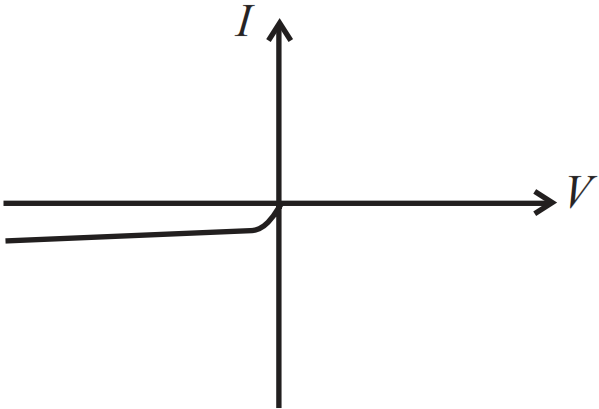
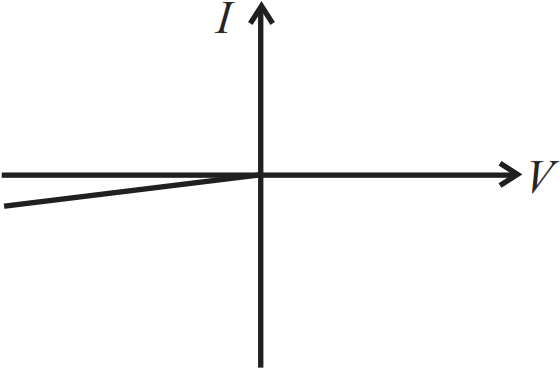
  1. In V-I graph of condition (i), a reverse characteristics is shown in fig. (c).
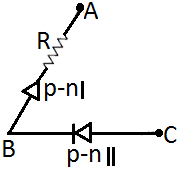
Here A is connected to n-side of p-n junction I and B is connected top-side of p-n junction I with a resistance in series.
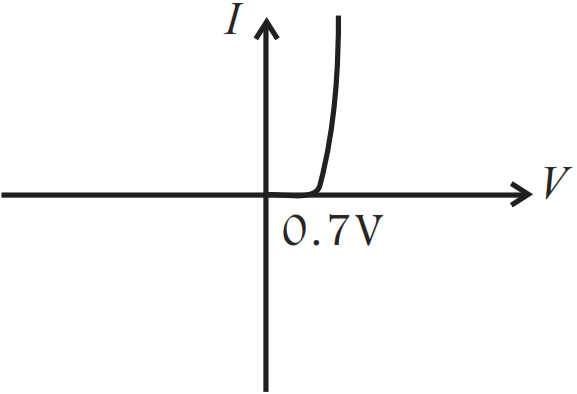
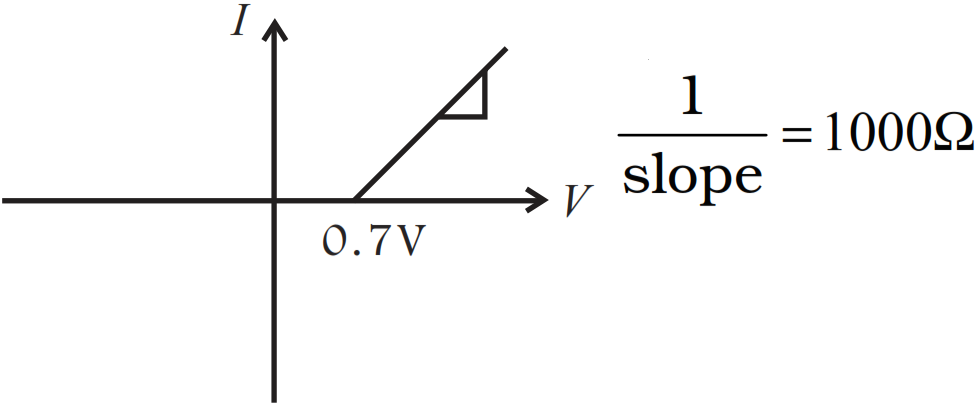
  1. In V-I graph of condition (ii), a forward characteristics is shown in fig. (d), where 0.7 V is the knee voltage of p-n junction I. 1/slope = (1/1000)Ω.
It means A is connected to n-side of p-n junction I and B is connected to p-side of p-n junction I and resistance R is in series of p-n junction I between A and B.
  1. In V-I graph of condition (iii), a forward characteristics is shown in figure (e) , where 0.7 V is the knee voltage. In this case p-side of p-n junction II is connected to C and n-side of p-n junction II to B.
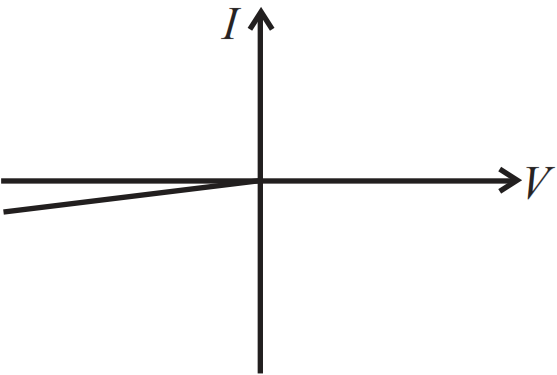
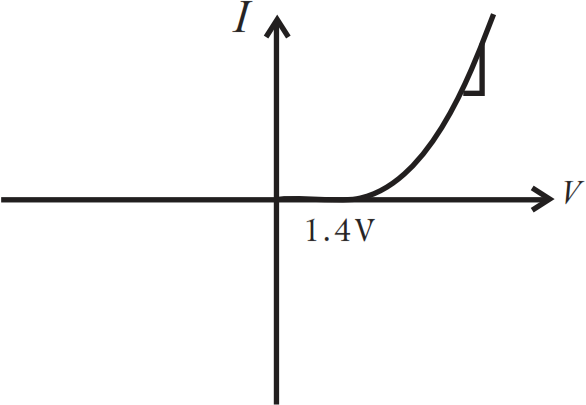
  2. In V-I graphs of conditions (iv), (v), (vi) also concludes the above connection of p-n junctions I and II along with a resistance R.
Thus, the arrangement of p-n I, p-n II and resistance R between A, B and C will be as shown in the figure.

Need a full question paper?

Generate a complete, print-ready paper with questions like this in minutes — across 16+ boards, with answer keys.

Start Generating Free

Similar questions

Suppose the entire system of the previous question is kept inside an elevator which is coming down with an acceleration a < g. Repeat parts (a) and (b).
Explain equations of Maxwell in detail.
A parallel-plate capacitor of plate area A and plate separation d is charged to a potential difference V and then the battery is disconnected. A slab of dielectric constant K is then inserted between the plates of the capacitor so as to fill the space between the plates. Find the work done on the system in the process of inserting the slab.
Positronium is just like a H-atom with the proton replaced by the positively charged anti-particle of the electron (called the positron which is as massive as the electron). What would be the ground state energy of positronium?
The amplifiers X, Y and Z are connected in series. If the voltage gains of X, Y and Z are 10, 20 and 30, respectively and the input signal is 1 mV peak value, then what is the output signal voltage (peak value):
  1. If dc supply voltage is 10V?
  2. If dc supply voltage is 5V?
In a plane electromagnetic wave, the electric field oscillates sinusoidally at a frequency of $2.0 \times 10^{10} $Hz and amplitude $48\ V\ m^{-1}.$
  1. What is the wavelength of the wave?
  2. What is the amplitude of the oscillating magnetic field?
  3. Show that the average energy density of the E field equals the average energy density of the B field. $[c = 3 \times 10^8\ m\ s^{-1}.]$
A bicycle is resting on its stand in the east-west direction and the rear wheel is rotated at an angular speed of 100 revolutions per minute. If the length of each spoke is 30.0cm and the horizontal component of the earth's magnetic field is $2.0 \times 10^{-5} T,$ find the emf induced between the axis and the outer end of a spoke. Neglect centripetal force acting on the free electrons of the spoke.
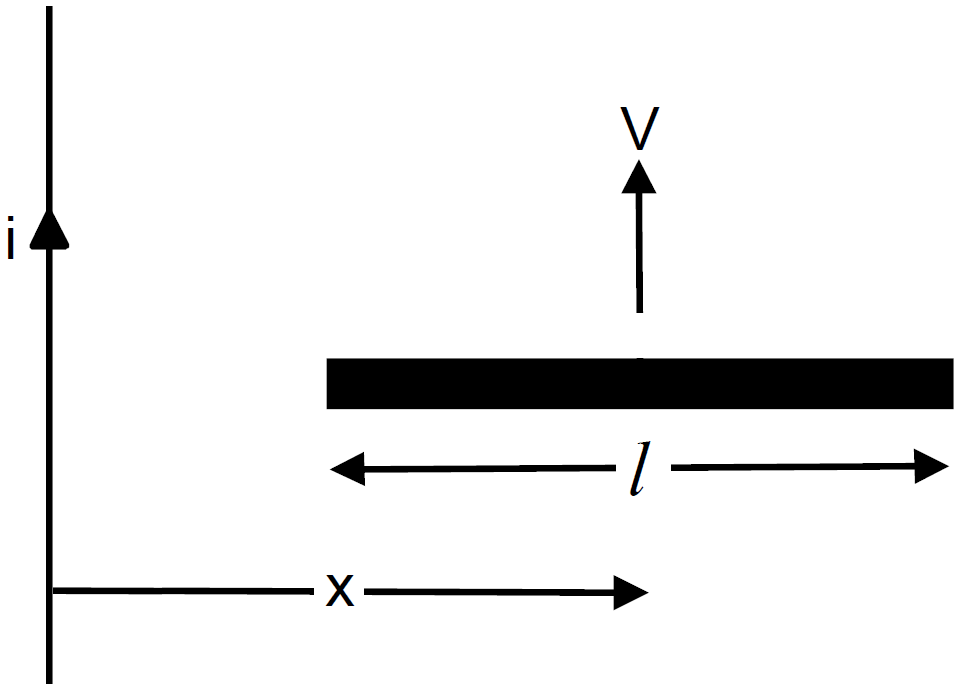
Figure shows a straight, long wire carrying a current i and a rod of length l coplanar with the wire and perpendicular to it. The rod moves with a constant velocity v in a direction parallel to the wire. The distance of the wire from the centre of the rod is x. Find motional emf induced in the rod.
The coil of an electric bulb takes 40 watts to start glowing. If more than 40W is supplied, 60% of the extra power is converted into light and the remaining into heat. The bulb consumes 100W at 220V. Find the percentage drop in the light intensity at a point if the supply voltage changes from 220V to 200V.
Coulomb's law for electrostatic force between two point charges and Newton's law for gravitational force between two stationary point masses, both have inverse-square dependence on the distance between the charges and masses respectively. (a) Compare the strength of these forces by determining the ratio of their magnitudes (i) for an electron and a proton and (ii) for two protons. (b) Estimate the accelerations of electron and proton due to the electrical force of their mutual attraction when they are $1 \mathring A\left(=10^{-10} m \right)$ apart? $\left(m_p=1.67 \times\right.$ $\left.10^{-27} kg , m_e=9.11 \times 10^{-31} kg \right)$