Question
A more powerful vehiclewould complete a journey in a shorter timethan a less powerful one. We talk of the powerof machines like motorbikes and motorcars.The speed with which these vehicles changeenergy or do work is a basis for theirclassification. Power measures the speed ofwork done, that is, how fast or slow work isdone. Power is defined as the rate of doingwork or the rate of transfer of energy. If anagent does a work $W$ in time $t$, then power isgiven by$P$= work/time
$P= W/T$. The unit of power is watt.
(i) The rate of doing work is defined as
$(a)$ Energy
$(b)$ Force
$(c)$ Power
$(d)$ None of these
(ii) Total energy consumed divided by total time taken is called as
$(a)$ Average power
$(b)$ Instantaneous power
$(c)$ Both $a$ and $b$
$(d)$ None of these
(iii) Let A and B having same weight start climbing the rope and reach height of 10m. Let A takes 10sec while B takes 12sec then work done
$(a)$ By both will be same
$(b)$ By $A$ is more than work done by $B$
$(c)$ By $B$ is more than work done by $A$
$(d)$ None of these
(iv) Define 1 Watt of power
(v) An electric bulb of 20W is used for 5h per day. Calculate the ‘units’ of energy consumed in one day by the bulb.
Answer

$(i) c$
$(ii) a$
$(iii) a$
$(iv)$ A power is said to be $1$ watt when $1$ joule of work is done within $1$ second of time.
$(v)$ Power of electric bulb $= 20\ W$
$= 0.02\ kW.$
Time used, $t = 5\ h$
Energy = power $\times $ time taken
$= 0.02kW \times 5 h$
$= 0.10 kW\ h$
$= 0.10$‘units’.
The energy consumed by the bulb $0.10$ units

Need a full question paper?

Generate a complete, print-ready paper with questions like this in minutes — across 16+ boards, with answer keys.

Start Generating Free

Similar questions

Read the following text carefully and answer the questions that follow:
A farmer has grown wheat on his field consecutively two times but when the third time he grows wheat on the same field the quality of the wheat was not up to the desired level. To improve the quality of his crops he uses chemical fertilizer but the condition of the crop became worse. One of his friends told him to grow a different variety of crops after wheat so as to grow two or three crops in a year with good harvests and use biological manure in place of chemical fertilizers which he prepares by animal excreta and plant waste to get the good quality of crops. He also told him about the good storage of his grains to protect them from the biotic and abiotic losses as in agriculture storage losses are very high.
i. What are the bases on which the next crop is decided to grow in the same field also name the process?
ii. What is the advantage of using biological manure over chemical fertilizers?
iii. Is it possible for the farmer to grow two crops at the same time if yes what is the requirement?
OR
Enlist the biotic and abiotic losses?
Rutherford $(1871-1937)$ was known as the ‘Father’ of nuclear physics. He is famous for his work on radioactivity and the discovery of the nucleus of an atom with the gold foil experiment. Ernest Rutherford was interested in knowing how the electrons are arranged within an atom. Rutherford designed an experiment for this. In this experiment, fast moving alpha $(\alpha )$-particles were made to fall on a thin gold foil. On the basis of his experiment, Rutherford put forward the nuclear model of an atom, which had the following features:
  • There is a positively charged centre in an atom called the nucleus. Nearly all the mass of an atom resides in the nucleus.
  • The electrons revolve around the nucleus in circular paths.
  • The size of the nucleus is very small as compared to the size of the atom.
Drawbacks of Rutherford’s model of the atom: The revolution of the electron in a circular orbit is not expected to be stable. Any particle in a circular orbit would undergo acceleration. During acceleration, charged particles would radiate energy. Thus, the revolving electron would lose energy and finally fall into the nucleus. If this were so, the atom should be highly unstable and hence matter would not exist in the form that we know. We know that atoms are quite stable.
(1) Which of the following scientist was known as the ‘Father of nuclear physics?
$(a)$ $J.J.$ Thomson
$(b)$ John Dalton
$(c)$ $E.$ Rutherford
$(d)$ Neilsbhore
(2) Positively charged centre in an atom is termed as
$(a)$ Nucleus
$(b)$ Molecule
$(c)$ Atom
$(d)$ Protons
(3) Identify the correct statement
Statement $1$ – Positively charged centre in an atom called the nucleus.
Statement $2$ – The electrons revolve around the nucleus in circular paths.
Statement $3$ – Nearly all the mass of an atom resides in the nucleus.
Statement $4$ – The size of the nucleus is very small as compared to the size of the atom.
$(a)$ Only $2$
$(b)$ Both $3$ & $4$
$(c)$ Both $1$ & $2$
$(d)$ All of the above
(4) Write the features of Rutherford’s nuclear model of an atom?
(5) Define Nucleus.
A violin and a flute may both be played the same time in an orchestra. Bothsounds travel through the same medium,that is, air and arrive at our ear at the sametime. Both sounds travel at the same speedirrespective of the source. But the soundswe receive are different. This is due to thedifferent characteristics associated with thesound. Pitch is one of the characteristics.How the brain interprets the frequency ofan emitted sound is called its pitch. The fasterthe vibration of the source, the higher is the frequency and the higher is the pitch. The magnitude of the maximumdisturbance in the medium on either side ofthe mean value is called the amplitude of thewave. It is usually represented by the letter $(A)$.The loudness or softness of a sound isdetermined basically by its amplitude. Theamplitude of the sound wave depends uponthe force with which an object is made tovibrate. If we strike a table lightly, we hear asoft sound because we produce a sound waveof less energy (amplitude).
The quality or timber of sound is thatcharacteristic which enables us to distinguishone sound from another having the same pitchand loudness. The sound which is morepleasant is said to be of a rich quality. A sound of single frequency is called a tone. The sound which is produced due to a mixture of several frequencies is called a note and is pleasant to listen to. Noise is unpleasant to the ear! Music is pleasant to hear and is of rich quality.
(i) Pitch of sound is higher when
$(a)$ Vibration of source of sound is higher
$(b)$ Vibration of source of sound is Lower
$(c)$ Independent of vibration of source of sound
$(d)$ None of these
(ii) Loudness and softness of sound depends upon
$(a)$ Frequency of sound
$(b)$ Amplitude of sound
$(c)$ Wavelength of sound
$(d)$ None of these
(iii) Sound of single frequency is called
$(a)$ Note
$(b)$ Tone
$(c)$ Noise
$(d)$ None of these
(iv)If we strike a table lightly, we hear asoft sound. If we hit the tablehard we hear a louder sound up to large distance. Why?
(v) Determine which of the following has higher pitch railway horn or guitar?
Read the following text carefully and answer the questions that follow:
Animal tissue has various types of epithelial tissue, connective tissue, muscular tissue, and nervous tissue and of tissue one of them is the connective tissue which consists of blood, bone, cartilage. Blood is the fluid matrix called plasma in which red blood cells, white blood cells, and platelet are suspended while bone form the framework that supports the body it also anchors the muscle and supports the main organ of the body. Two bones are connected by a ligament. cartilage is a solid matrix composed of sugar and protein.
i. Name the tissue which connects muscle to a bone.
ii. Matrix of bone cells are composed of
iii. Two bones are connected by ligament how muscle connects to the bone?
OR
Where the cartilage is found in the human body?


Neils Bohr got the Nobel Prize for his work on the structure of atom in $1922$. Among Professor Bohr’s numerous writings, three appearing as books are: $(i)$ The Theory of Spectra and Atomic Constitution, $(ii)$ Atomic Theory and, $(iii)$ The Description of Nature.
In order to overcome the objections raised against Rutherford’s model of the atom, Neil’s Bohr put forward the following postulates about the model of an atom:
  • Only certain special orbits known as discrete orbits of electrons, are allowed inside the atom.
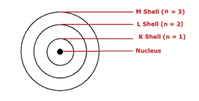
  • While revolving in discrete orbits the electrons do not radiate energy. These orbits or shells are called energy levels. Energy levels in an atom are shown in Fig. A few energy levels in an atom These orbits or shells are represented by the letters $K,L,M,N,…$ or the numbers, $n=1,2,3,4,….$
$(1)$ The orbits or shells are represented by
$(a)$ Letters
$(b)$ Numbers
$(c)$ Both a & b
$(d)$ Special symbols
$(2)$ These orbits or shells are called
$(a)$ Energy levels
$(b)$ Discrete orbit
$(c)$ Atomic levels
$(d)$ None of the above
$(3)$ Which of the following book is written by Professor Bohr’s
$(a)$ The Theory of Spectra and Atomic Constitution
$(b)$ Atomic Theory
$(c)$ The Description of Nature
$(d)$ All of the above
$(4)$ Identify the correct statement
Statement $1 –$ The orbits or shells are represented by letters only.
Statement $2 –$ The orbits or shells are represented by numbers only.
Statement $3 –$ While revolving in discrete orbits the electrons do not radiate energy.
Statement $4 –$ Certain special orbits known as discrete orbits of electrons.
$(a)$ Both $1 \& 2$
$(b)$ Both $3 \& 4$
$(c)$ Only $3$
$(d)$ All of the above
$(5)$ Write the postulate of Neil’s Bohr model of an atom?
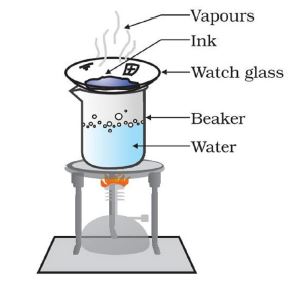
In the given below activity, on heating the solution, water evaporates, and we get back the ink dye in the watch glass. The different substance has a different boiling point. We use this property to separate the components of the mixture. Here, the boiling point of ink is much higher than that of water. On heating the ink solution, water evaporates while ink dye remains in the china dish.
$(i)$ Name the process shown in the diagram.
$(a)$ Boiling $(b)$ Filtration $(c)$ Crystallisation $(d)$ Distillation
$(ii)$ Which type of substance can be separated by this method ?
$(a)$ Any solvent from its non-volatile solute.
$(b)$ The volatile solvent from its non-volatile solute.
$(c)$ The non-volatile solvent from its non-volatile solute.
$(d)$ The volatile solvent from its volatile solute.
$(iii)$ What can we interpret about the nature of ink ?
$(a)$ We cannot separate components of ink $(b)$ Ink is not a mixture
$(c)$ Ink is pure substance $(d)$ Ink is a mixture of dyes in water.
$(iv)$ Name the component which gets evaporated.
$(a)$ Heating leads to the evaporation of water.
$(b)$ Heating leads to the evaporation of dyes.
$(c)$ Heating leads to the filtration of water.
$(d)$ Heating leads to the distillation of dyes.
$(v)$ Define the process shown in the diagram
$(a)$ It is the process of conversion of a liquid into its vapours.
$(b)$ It is a process of separating insoluble component by filtering the solution
$(c)$ It is a process that separates a pure solid in the form of its crystals
$(d)$ It is a technique to separate two miscible liquids
Sound is produced by vibrating objects. The matter or substance through which sound is transmitted is called a medium. It can be solid, liquid or gas. Sound moves through a medium from the point of generation to the listener. When an object vibrates, it sets the particles of the medium around it vibrating. The particles do not travel all the way from the vibrating object to the ear. Sound waves are characterized by the motion of particles in the medium and are called mechanical waves.When a vibrating objectmoves forward, it pushes and compresses theair in front of it creating a region of highpressure; this region is called a compression$(C)$.When the vibrating object moves backwards,it creates a region of low pressure calledrarefaction $(R)$. Hence sound is longitudinal wave.
(i) Sound waves are
$(a)$ Mechanical waves
$(b)$ Electromagnetic wave
$(c)$ Transverse waves
$(d)$ None of these
(ii) Sound travel in medium with
$(a)$ Compression and rare fraction
$(b)$ Crest and trough
$(c)$ Both can be possible
$(d)$ None of these
(iii) Compression is the region of
$(a)$ High pressure
$(b)$ Low pressure
$(c)$ Medium pressure
$(d)$ None of these
(iv) What is sound and how is it produced?
(v) Why sound wave is called as longitudinal wave?
A solid mixture contains four constituents $P, Q, R$ and $S. P$ consists of tiny grains and it is mixed with cement for plastering the walls. $Q$ is a white solid which is recovered on a large scale from sea water by the process of evaporation. $R$ is in the form of tiny particles of a material whose corrosion is called rusting. And $S$ is a white solid which is used in making ordinary dry cells.
  1. What could $P, Q, R$ and $S$ be?
  2. How would you separate a mixture containing $P, Q, R$ and $S?$
Blood is a type of connective tissue. The cells of connective tissue are loosely spaced and embedded in an intercellular matrix. The matrix may be jelly like, fluid, dense or rigid. The nature of matrix differs in concordance with the function of the particular connective tissue.Blood has a fluid (liquid) matrix called plasma, in which red blood corpuscles $(RBCs)$, white blood corpuscles $(WBCs)$ and platelets are suspended. The plasma contains proteins, salts and hormones. Blood flows and transports gases, digested food, hormones and waste materials to different parts of the body.
Bone is another example of a connective tissue. It forms the framework that supports the body. It also anchors the muscles and supports the main organs of the body. It is a strong and nonflexible tissue. Bone cells are embedded in a hard matrix that is composed of calcium and phosphorus compounds. Two bones can be connected to each other by another type of connective tissue called the ligament. This tissue is very elastic.
Another type of connective tissue, cartilage, has widely spaced cells. The solid matrix is composed of proteins and sugars. Cartilage smoothens bone surfaces at joints and is also present in the nose, ear, trachea and larynx.
Areolar connective tissue is found between the skin and muscles, around blood vessels and nerves and in the bone marrow. It fills the space inside the organs, supports internal organs and helps in repair of tissues.
(1) A connective tissue
(a) Has no matrix
(b) Covers the skin
(c) Has abundant matrix
(d) None of these
(2) Areolar connective tissue is found between
(a) Skin and muscles
(b) Blood vessels and nerves
(c) Both a & b
(d) None of these
(3) Two bones are connected to each other by another type of connective tissue called__
(a) Ligament
(b) Cartilage
(c) Bone marrow
(d) Blood
(4) What are the function of connective tissue?
(5) Give the examples of connective tissue.
Work done by force acting on an object is equal to the magnitude of the force multiplied by the distance moved in the direction of the force. Work has only magnitude and no direction. Work done is negative when the force acts opposite to the direction of displacement. Work done is positive when the force is in the direction of displacement.The unit of work is newton-metre ($N$ m)or joule $(J)$.
(i) Work done is
$(a)$ Scalar quantity
$(b)$ Vector quantity
$(c)$ Tensor quantity
$(d)$ None of these
(ii) When force acts against the direction of displacement then work done will be
$(a)$ positive
$(b)$ negative
$(c)$ both a and b can possible
$(d)$ None of these
(iii) SI unit of work is
$(a)$ Joule$(J)$
$(b)$ Newton meter$(N-m)$
$(c)$ both $a$ and $b$
$(d)$ None of these
(iv)You are lifting stone from floor. Work is done by theforce exerted by you on the stone. Theobject moves upwards. The force youexerted is in the direction ofdisplacement. However, there is theforce of gravity acting on the object. Which one of these forces is doingpositive work?
Which one is doing negative work?
(v) Define 1J of work.