Question
In the given below activity, on heating the solution, water evaporates, and we get back the ink dye in the watch glass. The different substance has a different boiling point. We use this property to separate the components of the mixture. Here, the boiling point of ink is much higher than that of water. On heating the ink solution, water evaporates while ink dye remains in the china dish.
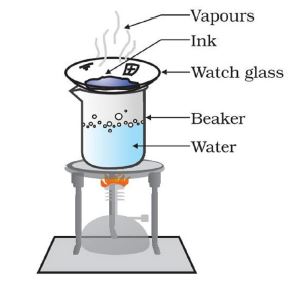
$(i)$ Name the process shown in the diagram.
$(a)$ Boiling $(b)$ Filtration $(c)$ Crystallisation $(d)$ Distillation
$(ii)$ Which type of substance can be separated by this method ?
$(a)$ Any solvent from its non-volatile solute.
$(b)$ The volatile solvent from its non-volatile solute.
$(c)$ The non-volatile solvent from its non-volatile solute.
$(d)$ The volatile solvent from its volatile solute.
$(iii)$ What can we interpret about the nature of ink ?
$(a)$ We cannot separate components of ink $(b)$ Ink is not a mixture
$(c)$ Ink is pure substance $(d)$ Ink is a mixture of dyes in water.
$(iv)$ Name the component which gets evaporated.
$(a)$ Heating leads to the evaporation of water.
$(b)$ Heating leads to the evaporation of dyes.
$(c)$ Heating leads to the filtration of water.
$(d)$ Heating leads to the distillation of dyes.
$(v)$ Define the process shown in the diagram
$(a)$ It is the process of conversion of a liquid into its vapours.
$(b)$ It is a process of separating insoluble component by filtering the solution
$(c)$ It is a process that separates a pure solid in the form of its crystals
$(d)$ It is a technique to separate two miscible liquids
Answer

self study

Need a full question paper?

Generate a complete, print-ready paper with questions like this in minutes — across 16+ boards, with answer keys.

Start Generating Free

Similar questions

Biologists, such as Ernst Haeckel $(1894)$, Robert Whittaker $(1969)$ and Carl Woese $(1977)$ have tried to classify all living organisms into broad categories, called kingdoms.The classification Whittaker proposed has five kingdoms: Monera, Protista, Fungi, Plantae and Animalia, and is widely used. These groups are formed on the basis of their cell structure, mode and source of nutrition and body organisation.
The modification Woese introduced by dividing the Monera into Archaebacteria (or Archaea) and Eubacteria (or Bacteria) is also in use. Further classification is done by naming the sub-groups at various levels as given in the following scheme:
Kingdom
Phylum (for animals) / Division (for plants)
Class
Order
Family
Genus
Species
Thus, by separating organisms on the basis of a hierarchy of characteristics into smaller and smaller groups, we arrive at the basic unit of classification, which is a ‘species’. A species includes all organisms that are similar enough to breed and perpetuate.
(1) Who proposed Five Kingdoms?
$(a)$ Ernst Haeckel $(1894)$
$(b)$ Robert Whittaker $(1969)$
$(c)$ Carl Woese $(1977)$
$(d)$ None of above
(2) Which of the following kingdom is a part of five kingdom system?
$(a)$ Monera
$(b)$ Protista
$(c)$ Animalia
$(d)$ All of the above
(3) Kingdom Monera divided into
$(a)$ Archaebacteria
$(b)$ Eubacteria
$(c)$ Both $a$ & $b$
$(d)$ None of above
(4) A groups of five kingdom are formed on the basis of
$(a)$ Cell structure,
$(b)$ Mode and source of nutrition
$(c)$ Body organisation.
$(d)$ All of the above
(5) What is species?
There are three states of matter – solid, liquid and gas.
Solids have a definite shape, distinct boundaries and fixed volumes, that is, have negligible compressibility. Solids have a tendency to maintain their shape when subjected to outside force. Solids may break under force but it is difficult to change their shape, so they are rigid.
Liquids have no fixed shape but have a fixed volume. They take up the shape of the container in which they are kept. Liquids flow and change shape, so they are not rigid but can be called fluid.
Gas as has indefinite shape, no fixed volume. Gas gets the shape and volume of container.
Gas has very low density hence are light. Gas can flow easily and hence are called fluid.
$i.)$ Which of the following state of matter takes shape of container in which it is filled?
$a.)$ Solid
$b.)$ Liquid
$c.)$ Gas
$d.)$ Both $b$ and $c$
$ii.)$ Distance between particles of matter least in
$a.)$ Solid
$b.)$ Liquid
$c.)$ Gas
$d.)$ None of these
$iii.)$ Compressibility is least in case of
$a.)$ Solid
$b.)$ Liquid
$c.)$ Gas
$d.)$ None of these
$iv.)$ Give properties of solids.
$v.)$ Give properties of Gases.
Elemental oxygen is normally found in the form of a diatomic molecule. However, in the upper reaches of the atmosphere, a molecule containing three atoms of oxygen is found. This would mean a formula of $O3$ and this is called ozone. Unlike the normal diatomic molecule of oxygen, ozone is poisonous and we are lucky that it is not stable nearer to the Earth’s surface. But it performs an essential function where it is found. It absorbs harmful radiations from the Sun. This prevents those harmful radiations from reaching the surface of the Earth where they may damage many forms of life. Recently it was discovered that this ozone layer was getting depleted. Various man-made compounds like $CFCs$ (carbon compounds having both fluorine and chlorine which are very stable and not degraded by any biological process) were found to persist in the atmosphere. Once they reached the ozone layer, they would react with the ozone molecules. This resulted in a reduction of the ozone layer and recently they have discovered a hole in the ozone layer above the Antarctica. It is difficult to imagine the consequences for life on Earth if the ozone layer dwindles further, but many people think that it would be better not to take chances. These people advocate working towards stopping all further damage to the ozone layer.
(1) Identify the correct statement
Statement $1$ – Ozone is poisonous.
Statement $2$ – Absorbs harmful radiations from the Sun
Statement $3$ – Ozone prevents those harmful radiations from reaching the surface of the Earth.
Statement $4$ – Molecule containing three atoms of oxygen is termed as ozone.
$(a)$ Both $1$ & $4$
$(b)$ Both $2$ & $4$
$(c)$ Only $3$
$(d)$ All of the above
(2) The molecule containing three atoms of oxygen is termed as
$(a)$ Oxygen
$(b)$ Ozone
$(c)$ Diatomic oxygen
$(d)$ None of above
(3) What is the molecular formula of ozone?
$(a) O$
$(b )O2$
$(c) O3$
$(d) O4$
(4)Why ozone layer is important?
(5) What is CFC?
The given mixture contains three constituents $A , B$ and $C$ . The constituent $A$ is a yellow coloured, solid element which dissolves in a liquid $D$. The constituents $B$ is a blue coloured salt which is insoluble in liquid $D$ but dissolves easily in another liquid $E$ . The constitudent $C$ is a liquid wlich is used in coolking food and forms a solid fat on hydrogenation.
a. What do you think could $(i)$ constituent $A$, and $(ii)$ liquid $D$ be?
b. What could $(i)$ constituent $B$, and $(ii)$ liquid $E$ be?
c. What could liquid $C$ be?
d. How will you separate the mixture containing $A , B$ and $C .$
A solid mixture contains four constituents $P, Q, R$ and $S. P$ consists of tiny grains and it is mixed with cement for plastering the walls. $Q$ is a white solid which is recovered on a large scale from sea water by the process of evaporation. $R$ is in the form of tiny particles of a material whose corrosion is called rusting. And $S$ is a white solid which is used in making ordinary dry cells.
  1. What could $P, Q, R$ and $S$ be?
  2. How would you separate a mixture containing $P, Q, R$ and $S?$
Many indigestion mixtures are suspensions. What do the instructions written on the bottle of an indigestion mixture tell us before taking the mixture, and why?
Read the following text carefully and answer the questions that follow:
India has the maximum cattle population in the world. However, their productivity is less than half the productivity of many exotic breeds of cattle. The exotic breeds live in cold countries. They cannot live comfortably in hotter India. The only way to improve the productivity of Indian cattle is to produce hybrids which are acclimitised to Indian conditions and are resistant to most local diseases. For hybridisation exotic bulls are kept in colder climate. Their semen is collected and cryopreserved. The same is sent to various parts of the country for artificial insemination.
i. Mention two exotic breeds of cattle.
ii. Mention two hybrid breeds of cattle.
iii. Mention some factors governing the yield of milk.
OR
When can cattle be inseminated?
Read the following text carefully and answer the questions that follow:
Homogeneous mixtures are regarded as solutions or true solutions. Heterogeneous mixtures are of two types. These are suspensions and colloidal solutions. These differ in the size of the particles responsible for the difference in their properties. In a suspension, the particle size is more than $10^{-5} \ cm$ whereas in a colloidal solution, it ranges between $10^{-5} \ cm$ to $10^{-7} \ cm$. The two phases which constitute colloidal solutions, are dispersed phase and dispersion medium. Based upon their nature, the colloidal solutions are classified into eight types. The mixture of the non$-$reacting gases is always homogeneous irrespective of their nature. Therefore, it is not a colloidal solution.
$i.$ Scattering of light occurs when a beam of light is passed through Blood. Why?
$ii.$ What is Tyndall effect?
$iii.$ What is called colloidal solution?
$OR$
Give an example of colloidal solution and identified their dispersed phase and dispersion medium?