MCQ
A moving charge produces:
  • A
    Electric field only.
  • B
    Magnetic field only.
  • Both of them.
  • D
    None of them.

Answer

Correct option: C.
Both of them.
Because of the presence of a charge, a particle produces an electric field. Also, because of its motion, that is, the flow of charge or current, there is generation of a magnetic field.

Need a full question paper?

Generate a complete, print-ready paper with questions like this in minutes — across 16+ boards, with answer keys.

Start Generating Free

Similar questions

A step up transformer connected to a $220 \,V$ $AC$ line is to supply $22 \,kV$ for a neon sign in secondary circuit. In primary circuit a fuse wire is connected which is to blow when the current in the secondary circuit exceeds $10 \,mA$. The turn ratio of the transformer is
The net charge on a condenser is:
Hydrogen atom from excited state comes to the ground by emitting a photon of wavelength $\lambda$. The value of principal quantum number ' $n$ ' of the excited state will be:

($R$: Rydberg constant)

The value of internal resistance of an ideal cell is
Assertion : A paramagnetic sample display greater magnetisation (for the same magnetic field) when cooled.

Reason : The magnetisation does not depend on temperature.
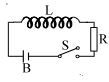
In figure, the switch $S$ is closed so that a current flows in the iron-core inductor which has inductance $L$ and the resistance $R$. When the switch is opened, $a$ spark is obtained in it at the contacts. The spark is due to
A prism of angle $A=1^{\circ}$ has a refractive index $\mu=1.5 .$ A good estimate for the minimum angle of deviation (in degrees) is close to $N/10$ Value of $N$ is......
Radioactive nuclei that are injected into a patient collect at certain sites within its body, undergoing radioactive decay and emitting electromagnetic radiation. These radiations can then be recorded by a detector. This procedure provides an important diagnostic tool called
A triode has a mutual conductance of $2 \times {10^{ - 3}}mho$ and an amplification factor of $50.$  The anode is connected through a resistance of $25 \times {10^3}$ ohms to a $250\, volts$ supply. The voltage gain of this amplifier is
In Thomson experiment of finding e/m for electrons, beam of electron is replaced by that of muons (particle with same charge as of electrons but mass 208 times that of electrons). No deflection condition in this case satisfied if