MCQ
A moving coil galvanometer has $150$ equal divisions. Its current sensitivity is $10$ divisions per milliampere and voltage sensitivity is $2$ divisions per millivolt. In order that each division reads $1\, volt$, the resistance in $ohms$ needed to be connected in series with the coil will be
  • A
    $99995$
  • $9995$
  • C
    ${10^3}$
  • D
    ${10^5}$

Answer

Correct option: B.
$9995$
b
Voltage sensitivity $ = \frac{{{\rm{Current \,sensitivity}}}}{{{\rm{Resistance\, of \,galvanometer}}\,{\rm{G}}}}$

$ \Rightarrow $   $G = \frac{{10}}{2} = 5\,\Omega $.

Here ${i_g} = $ Full scale deflection current $ = \frac{{150}}{{10}} = 15\,mA$.

$V =$ Voltage to be measured $= 150 × 1 = 150 \,V.$

Hence $R = \frac{V}{{{i_g}}} - G = \frac{{150}}{{15 \times {{10}^{ - 3}}}} - 5 = 9995\,\Omega $.

Need a full question paper?

Generate a complete, print-ready paper with questions like this in minutes — across 16+ boards, with answer keys.

Start Generating Free

Similar questions

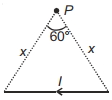
A straight wire of finite length carrying current $l$ subtends an angle of $60^{\circ}$ at point $P$ as shown. The magnetic field at $P$ is
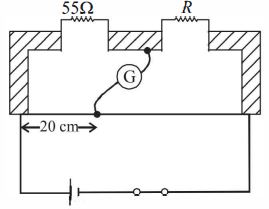
Shown in the figure below is a meter-bridge set up with null deflection in the galvanometer. The value of the unknown resistor $R$ is ............. $\Omega$
Angle of dip is $90^o$ at
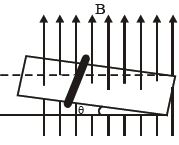
A rod of length $l$, mass $m$, and resistance $R$ slidesn without friction down parallel conducting rails as shown in Fig. The rails are connected together at the bottom. The plane of the rail makes an angle $\theta$ with the horizontal and a uniform vertical magnetic field $B$ exist throughout the region. Then the induced $emf$ in the loop, at the time the rod slides down with a speed $v$, is
Magnitude of pursuit velocity does not depend on :
A long solenoid has $200$ turns per cm and carries a current of $2.5\, amps$. The magnetic field at its centre is $({\mu _0} = 4\pi \times {10^{ - 7}}\,weber/amp{\rm{ - }}m)$
An element has number of proton $= 7.$ Then what will be its atomic number?
A series LCR circuit with inductance $10\,H$, capacitance $10\,\mu F$, resistance $50\,\Omega$ is connected to an ac source of voltage, $V=200 \sin (100 t)$ volt. If the resonant frequency of the LCR circuit is $\nu_{0}$ and the frequency of the ac source is $v$, then:
The graph that correctly represents the relation of frequency n of a particular characteristic X-ray with the atomic number Z of the material is
The magnifying power of a simple microscope can be increased if we use an eyepiece of: