A moving coil galvanometer has resistance $50\,\Omega $ and it indicates full deflection at $4\,mA$ current. A voltmeter is made using this galvanometer and a $5\,k\Omega $ resistance. The maximum voltage, that can be measured using this voltamenter, will be close to ......$V$
JEE MAIN 2019, Medium
Download our app for free and get started
$G=50\, \Omega$
$\mathrm{S}=5000 \,\Omega$
$\mathrm{I}_{\mathrm{g}}=4 \times 10^{-3}$
$\mathrm{V}=\mathrm{i}_{g}(\mathrm{G}+\mathrm{S})$
$V=4 \times 10^{-3}(50+5000)$
$=4 \times 10^{-3}(5050)=20.2$ $volt$

Download our appand get started for free
Experience the future of education. Simply download our apps or reach out to us for more information. Let's shape the future of learning together!No signup needed.*
Similar Questions
- 1There are three voltmeters of the same range but of resistances $10000\,\Omega $, $8000\,\Omega $ and $4000\,\Omega $ respectively. The best voltmeter among these is the one whose resistance is ................ $\Omega $View Solution
- 2View SolutionAn electron is travelling in east direction and a magnetic field is applied in upward direction then electron will deflect in
- 3A long straight wire carries a current along the $x$-axis. Consider the points $A(0, 1, 0), B(0, 1, 1), C(1, 0, 1)$ and $D(1, 1, 1)$. Which of the following pairs of points will have magnetic fields of the same magnitude?View Solution
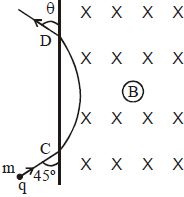
- 4A particle of mass $m = 1.67 \times 10^{-27}\, kg$ and charge $q = 1.6 \times 10^{-19} \, C$ enters a region of uniform magnetic field of strength $1$ $tesla$ along the direction shown in the figure. the time spent by the particle in the magnetic field is......$ns$View Solution
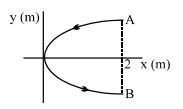
- 5A conducting wire bent in the form of a parabola $y^2 = 2x$ carries a current $i = 2 A$ as shown in figure. This wire is placed in a uniform magnetic field $\vec B = - 4\,\hat k$ $Tesla$. The magnetic force on the wire is (in newton)View Solution
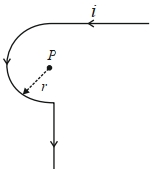
- 6Find the magnetic field at the point $P$ in figure. The curved portion is a semicircle connected to two long straight wires.View Solution
- 7View SolutionThe resistance of an ideal voltmeter is
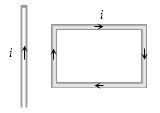
- 8A rectangular loop carrying a current $i$ is situated near a long straight wire such that the wire is parallel to the one of the sides of the loop and is in the plane of the loop. If a steady current $I$ is established in wire as shown in figure, the loop willView Solution
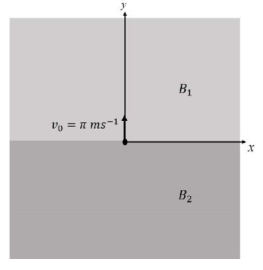
- 9In the xy-plane, the region $y >0$ has a uniform magnetic field $B_1 \hat{k}$ and the region $y<0$ has another uniform magnetic field $B_2 \hat{k}$. A positively charged particle is projected from the origin along the positive $y$-axis with speed $v _0=\pi m s ^{-1}$ at $t =0$, as shown in the figure. Neglect gravity in this problem. Let $t = T$ be the time when the particle crosses the $x$-axis from below for the first time. If $B_2=4 B_1$, the average speed of the particle, in $m s ^{-1}$, along the $x$-axis in the time interval $T$ is. . . . . .View Solution
- 10If current flowing through shell of previous objective is equal to $i$, then energy density at a point distance $2R$ from axis of the shell varies according to the graphView Solution