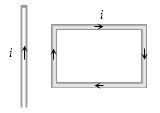
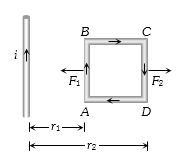
A rectangular loop carrying a current $i$ is situated near a long straight wire such that the wire is parallel to the one of the sides of the loop and is in the plane of the loop. If a steady current $I$ is established in wire as shown in figure, the loop will
AIIMS 2003,IIT 1985, Medium


Download our appand get started for free
Experience the future of education. Simply download our apps or reach out to us for more information. Let's shape the future of learning together!No signup needed.*
Similar Questions
- 1A current carrying wire of length $L$ is transformed into a coil of $N$ turns. To achieve maximum magnetic moment, the coilView Solution
- 2View SolutionThe resultant magnetic moment of neon atom will be
- 3A long straight wire of radius a carries a steady current $i$. The current is uniformly distributed across its cross section. The ratio of the magnetic field at $ a/2$ and $2a$ isView Solution
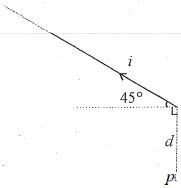
- 4Find the magnitude of magnetic field at point $p$ due to a semi - infinite wire given belowView Solution
- 5A positively charged $(+ q)$ particle of mass $m$ has kinetic energy $K$ enters vertically downward in a horizontal field of magnetic induction $\overrightarrow B $ . The acceleration of the particle is :-View Solution
- 6What is the magnetic field at a distance $R$ from a coil of radius $r$ carrying current $I$ ?View Solution
- 7A galvanometer coil has $500$ turns and each turn has an average area of $3 \times 10^{-4}\, m ^{2}$. If a torque of $1.5\,Nm$ is required to keep this coil parallel to magnetic field when a current of $0.5\, A$ is flowing through it, the strength of the field (in $T )$ isView Solution
- 8The electric current in a circular coil of $2$ turns produces a magnetic induction $B _{1}$ at its centre. The coil is unwound and is rewound into a circular coil of $5$ turns and the same current produces a magnetic induction $B _{2}$ at its centre.The ratio of $\frac{ B _{2}}{ B _{1}}$ is.View Solution
- 9A proton (or charged particle) moving with velocity $v$ is acted upon by electric field $E$ and magnetic field $B$. The proton will move undeflected ifView Solution
- 10A point charge $Q\left(=3 \times 10^{-12} C \right)$ rotates uniformly in a vertical circle of radius $R(=1 \,mm )$. The axis of the circle is aligned along the magnetic axis of the earth. At what value of the angular speed $\omega$, the eff ective magnetic field at the centre of the circle .............. $rad / s$ will be reduced to zero? (Horizontal component of earth's magnetic field is $30 \,\mu T )$View Solution