Question
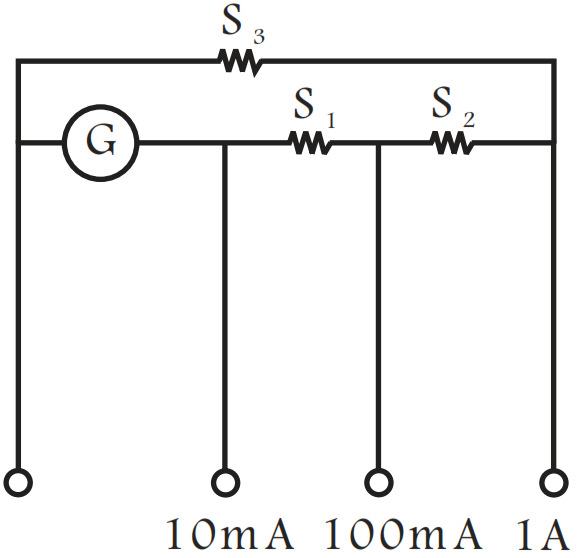
A multirange current meter can be constructed by using a galvanometer circuit as shown in Fig. We want a current meter that can measure 10mA, 100mA and 1A using a galvanometer of resistance 10Ω and that prduces maximum deflection for current of 1mA. Find S1, S2 and S3 that have to be used.
Answer

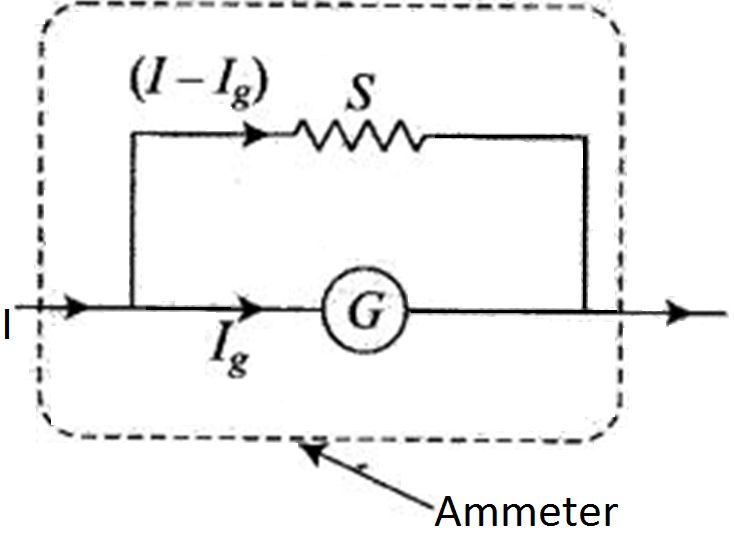
Key concept: A galvanometer can be converted into ammeter by connecting a very low resistance wire (shunt S) connected in parallel with galvanometer. The relationship is given by IgG = (l - Ig) S, where Ig is the range of galvanometer, G is the resistance of galvanometer.

For measuring I1 = 10mA : IG.G = (I1 - IG)(S1 + S2 + S3)

For measuring I2 = 100mA : IG(G + S1) = (I2 - IG)(S2 - S3)

For measuring I3 = 1A : IG(G + S1 + S2) =(I3 - IG)(S3)

Gives S1 = 1Ω, S2 = 0.1Ω and S3 = 0.01Ω.

Need a full question paper?

Generate a complete, print-ready paper with questions like this in minutes — across 16+ boards, with answer keys.

Start Generating Free

Similar questions

A gravitational lens may be assumed to have a varying width of the form
$\text{w}(\text{b})=\text{k}_1\text{ In }\Big(\frac{\text{k}_2}{\text{b}}\Big)\ \ \text{b}_\text{min}<\text{b}<\text{b}_\text{max}$
$=\text{k}_1\text{ In }\Big(\frac{\text{k}_2}{\text{b}_\text{min}}\Big)\ \ \text{b}<\text{b}_\text{min}$
Show that an observer will see an image of a point object as a ring about the center of the lens with an angular radius
$\beta=\sqrt{\frac{(\text{n}-1)\text{k}_1\frac{\text{u}}{\text{v}}}{\text{u}+\text{v}}}$
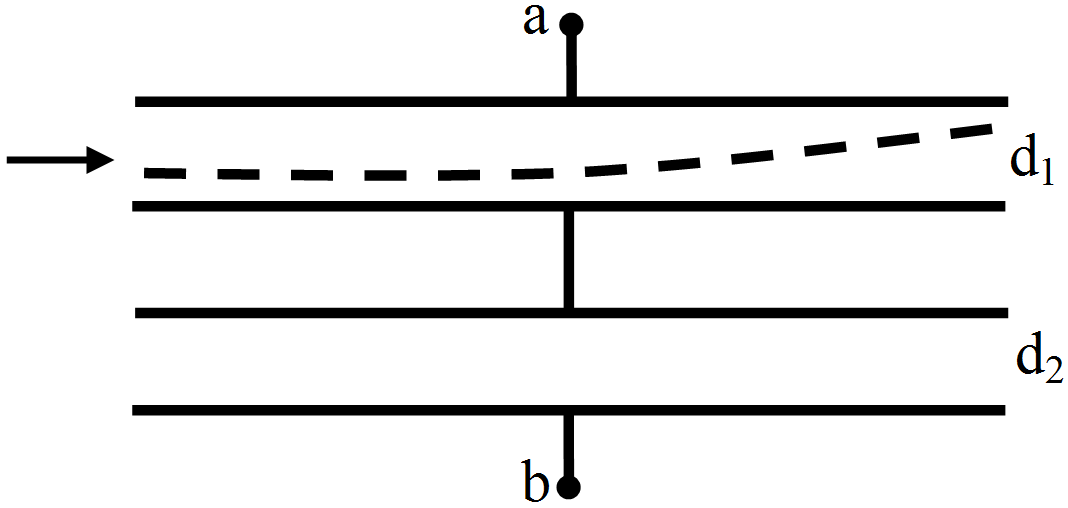
Both the capacitors shown in figure are made of square plates of edge a. The separations between the plates of the capacitors are d1 and d2 as shown in the figure. A potential difference V is applied between the points a and b, An electron is projected between the plates of the upper capacitor along the central line. With what minimum speed should the electron be projected so that it does not collide with any plate? Consider only the electric forces.

A glass vessel measures exactly 10cm × 10cm × 10cm at 0°C. It is filled completely with mercury at this temperature. When the temperature is raised to 10°C, 1.6cm3 of mercury overflows. Calculate the coefficient of volume expansion of mercury. Coefficient of linear expansion of glass = 6.5 × 10⁻⁶ °C.
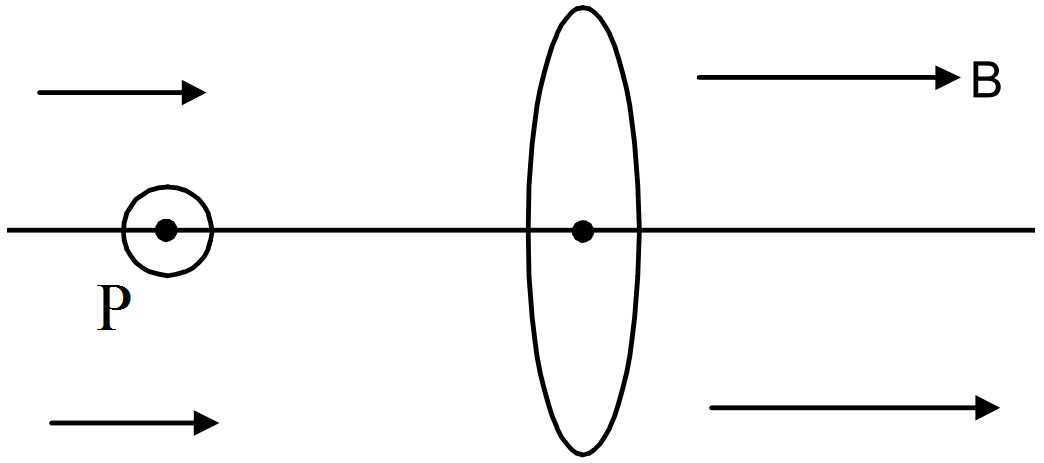
Shows a convex lens of focal length 12cm lying in a uniform magnetic field B of magnitude 1.2T parallel to its principal axis. A particle with charge 2.0 × 10⁻³C and mass 2.0 × 10⁻⁵ kg is projected perpendicular to the plane of the diagram with a speed of 4.8 ms-1. The particle moves along a circle with its centre on the principal axis at a distance of 18cm from the lens. Show that the image of the particle moves along a circle and find the radius of that circle.

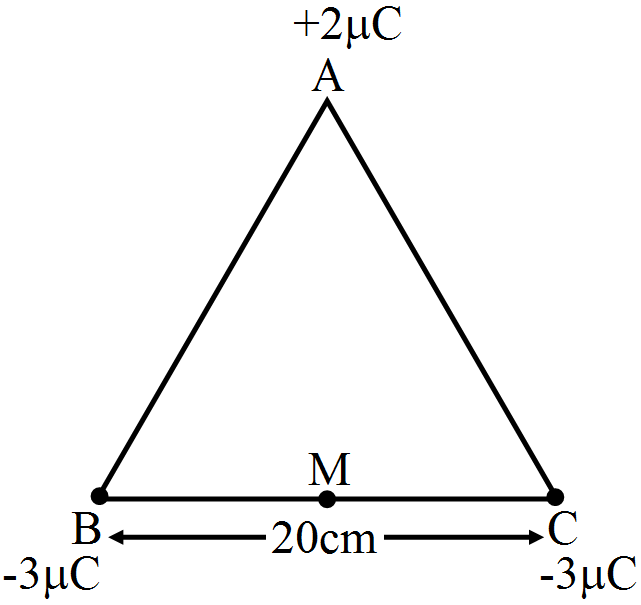
Three point charges of $+2\mu\text{C}, -3\mu\text{C}$ and $-3\mu\text{C}$ are kept at the vertices A, B and C respectively of an equilateral triangle of side 20cm as shown in figure. What should be the sign and magnitude of charge to be placed at the midpoint M of side BC so that charge at A remains in equilibrium?

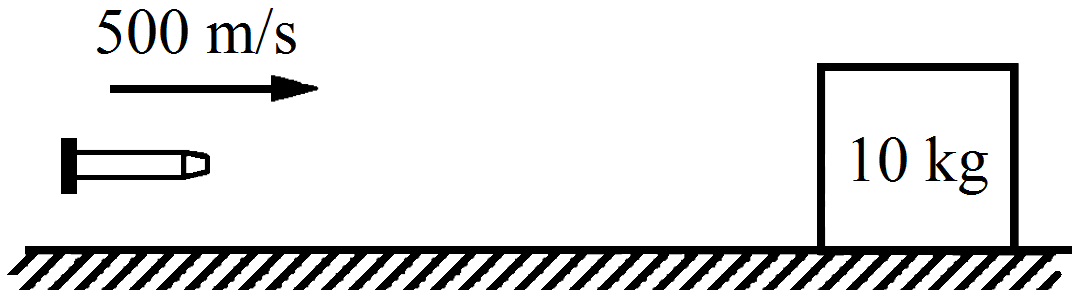
A bullet of mass 20g travelling horizontally with a speed of 500m/s passes through a wooden block of mass 10.0kg initially at rest on a level surface. The bullet emerges with a speed of 100m/s and the block slides 20cm on the surface before coming to rest. Find the friction coefficient between the block and the surface.

White coherent light (400nm - 700nm) is sent through the slits of a Young's double slit experiment (figure.) The separation between the slits is 0.5mm and the screen is 50cm away from the slits. There is a hole in the screen at a point 1.0mm away (along the width of the fringes) from the central line.
  1. Which wavelength (s) will be absent in the light coming from the hole?
  2. which wavelength (s) will have a strong intensity?

Consider the D–T reaction (deuterium–tritium fusion)

$^2_1\text{H}+^3_1\text{H}\rightarrow^4_2\text{He}+\text{n} $

  1. Calculate the energy released in MeV in this reaction from the data:

$\text{m}(^2_1\text{H})=2.014102\text{ u}$

$\text{m}(^3_1\text{H})=3.016049\text{ u}$

  1. Consider the radius of both deuterium and tritium to be approximately 2.0 fm. What is the kinetic energy needed to overcome the coulomb repulsion between the two nuclei? To what temperature must the gas be heated to initiate the reaction? (Hint: Kinetic energy required for one fusion event =average thermal kinetic energy available with the interacting particles = 2(3kT/2); k = Boltzman’s constant, T = absolute temperature.)
A long wire carrying a current i is bent to form a plane angle $\alpha.$ Find the magnetic field B at a point on the bisector of this angle situated at a distance x from the vertex.
In beta decay, an electron (or a positron) is emitted by a nucleus. Does the remaining atom get oppositely charged?