Question
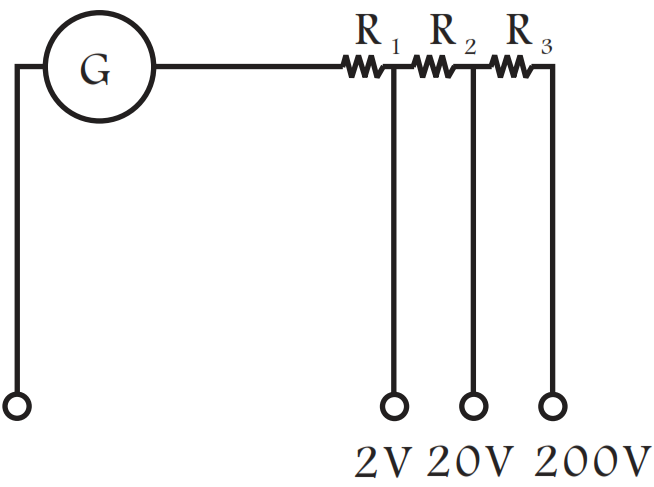
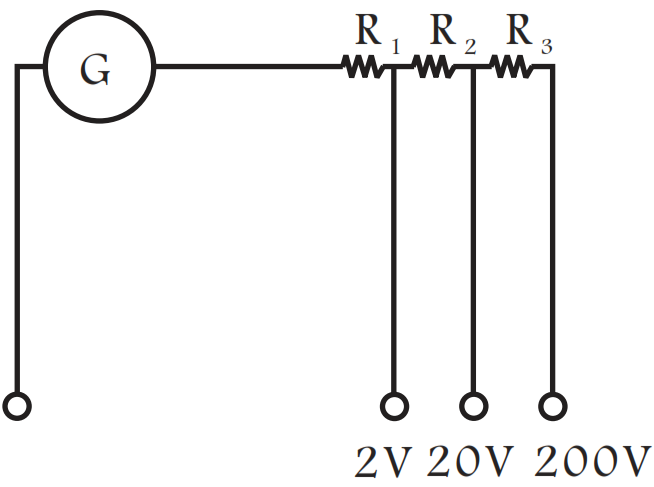
A multirange voltmeter can be constructed by using a galvanometer circuit as shown in Fig. We want to construct a voltmeter that can measure 2V, 20V and 200V using a galvanometer of resistance 10Ω and that produces maximum deflection for current of 1mA. Find R1, R2 and R3 that have to be used.
Answer

Key concept: The galvanometer can also be used as a voltmeter to measure the voltage across a given section of the circuit. For this a very high resistance wire is to be connected in series with galvanometer. The relationship is given by Ig(G + R) where Ig is the range of galvanometer, G is the resistance of galvanometer and R is the resistance of wire connected in series with galvanometer.

Applying expression in different situations

For Ig(G + R1) = 2 for 2V range

For Ig(G + R1 + R2) = 20 for 20V range

And For Ig(G + R1 + R2 + R3) = 200 for 200V range

By solving, we get

R1 = 1990Ω, R2 = 18kΩ and R3 = 180kΩ.

Need a full question paper?

Generate a complete, print-ready paper with questions like this in minutes — across 16+ boards, with answer keys.

Start Generating Free

Similar questions

Find the expression for the energy stored in the capacitor. Also find the energy lost when the charged capacitor is disconnected from the source and connected in parallel with the uncharged capacitor. Where does this loss of energy appear?
A rectangular conducting loop consists of two wires on two opposite sides of length l joined together by rods of length d. The wires are each of the same material but with cross-sections differing by a factor of 2. The thicker wire has a resistance R and the rods are of low resistance, which in turn are connected to a constant voltage source V0. The loop is placed in uniform a magnetic field B at 45° to its plane. Find $\tau$, the torque exerted by the magnetic field on the loop about an axis through the centres of rods.
A satellite is projected vertically upwards from an earth station. At what height above the earth's surface will the force on the satellite due to the earth be reduced to half its value at the earth station? (Radius of the earth is 6400km.)
Two Polaroids are placed 90° to each other and the transmitted intensity is zero. What happens when one more Polaroid is placed between these two bisecting the angle between them. Take intensity of unpolarised light 10.

How will the intensity of transmitted light vary on further rotating the third Polaroid?


Consider the following very rough model of a beryllium atom. The nucleus has four protons and four neutrons confined to a small volume of radius 10-15m. The two 1s electrons make a spherical charge cloud at an average distance of 1.3 × 10⁻¹¹m from the nucleus, whereas the two 2s electrons make another spherical cloud at an average distance of 5.2 × 10⁻¹¹m from the nucleus. Find the electric field at:
  1. A point just inside the 1s cloud.
  2. A point just inside the 2s cloud.
A current of 1.0A exists in a copper wire of cross-section 1.0mm2. Assuming one free electron per atom, calculate the drift speed of the free electrons in the wire. The density of copper is 9000kg/m-3.
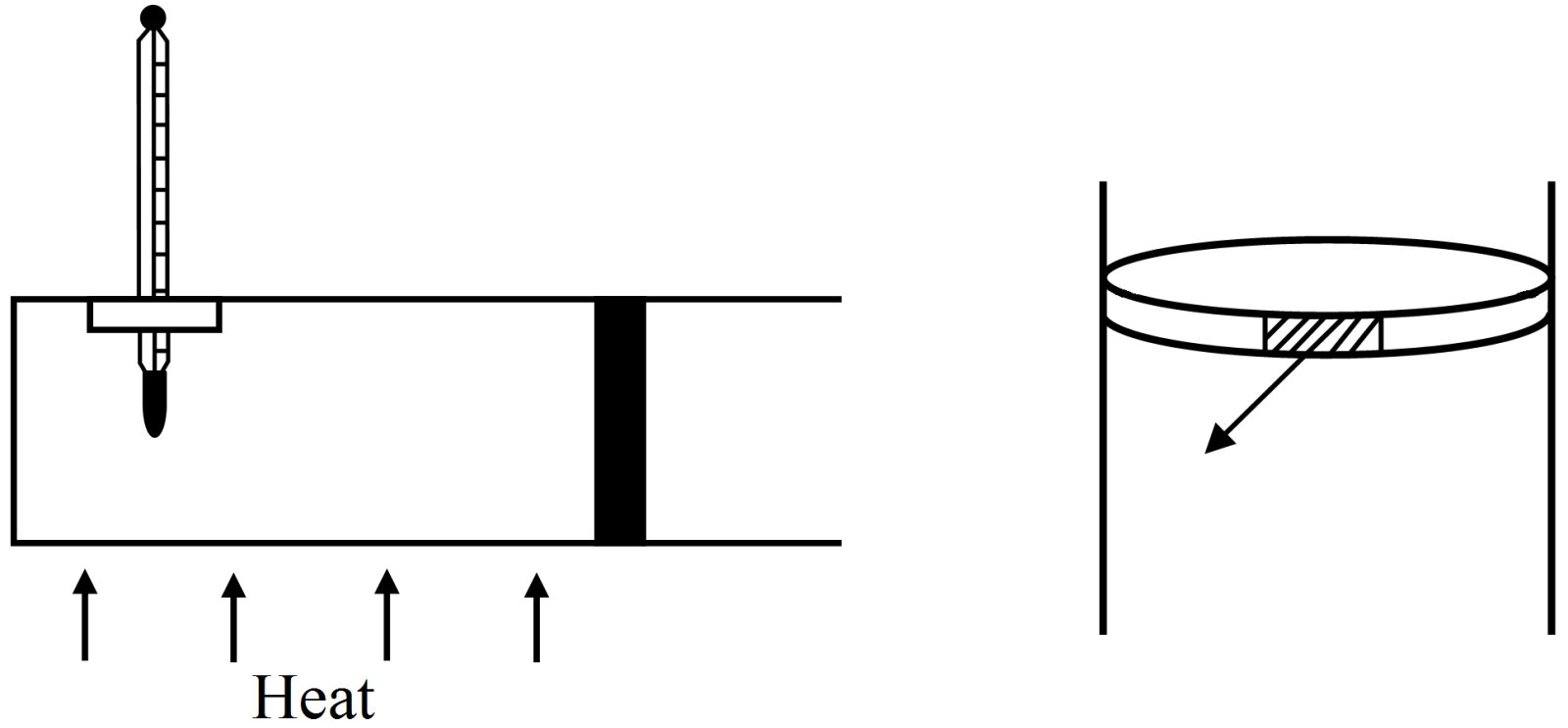
Figure. shows a cylindrical tube of radius 5cm and length 20cm. It is closed by a tight-fitting cork. The friction coefficient between the cork and the tube is 0.20. The tube contains an ideal gas at a pressure of 1 atm and a temperature of 300K. The tube is slowly heated and it is found that the cork pops out when the temperature reaches 600K Let dN denote the magnitude of the normal contact force exerted by a small length dl of the cork along the periphery (see the figure). Assuming that the temperature of the gas is uniform at any instant, calculate $\frac{\text{dN}}{\text{dl}}.$

A hollow sphere of radius 2cm is attached to an 18cm long thread to make a pendulum. Find the time period of oscillation of this pendulum. How does it differ from the time period calculated using the formula for a simple pendulum?
The magnetic field inside a long solenoid having 50 turns/cm is increased from 2·5 × 10.3T to 2.5T when an iron core of cross-sectional area 4cm2 is inserted into it. Find:
  1. The current in the solenoid.
  2. The magnetization I of the core.
  3. The pole strength developed in the core.