Question
A musical scale is constructed by providing intermediate frequencies between a note and its octave which
Answer

A musical scale is constructed by providing intermediate frequencies between a note and its octave which bear a simple ratio with their neighbours.

Need a full question paper?

Generate a complete, print-ready paper with questions like this in minutes — across 16+ boards, with answer keys.

Start Generating Free

Similar questions

The atomic mass of ${ }_6 \mathrm{C}^{12}$ is $12.000000\ \mathrm{u}$ and that of ${ }_6 \mathrm{C}^{13}$ is $13.003354 \ \mathrm{u}$. The required energy to remove a neutron from ${ }_6 \mathrm{C}^{13}$, if mass of neutron is $1.008665 \ \mathrm{u}$, will be :
The momentum $p$ (in $kg m / s )$ of a particle is varying with time $t$ (in $s )$ as $p=2+3 t^2$. The force acting on the particle at $t=3 s$ will be ......... $N$
When two particles collide elastically, then impulsive force can't change
A capacitor of capacitance $C$ is charged to a potential difference $V$ from a cell and then disconnected from it. A charge $+Q$ is now given to its positive plate. The potential difference across the capacitor is now $Q$

 if $V < CV$

Refractive index of air is $1.0003$. The correct thickness of air column which will have one more wavelength of yellow light ($6000 Å$) than in the same thickness in vacuum is
A steel rail of length $5\,m$ and area of cross-section $40\,cm^2$ is prevented from expanding along its length while the temperature rises by $10\,^oC$. If coefficient of linear expansion and Young's modulus of steel are $1.2\times10^{-5}\, K^{-1}$ and $2\times10^{11}\, Nm^{-2}$ respectively, the force developed in the rail is approximately
A point charge of $10\,\mu C$ is placed at the origin. At what location on the $X$-axis should a point charge of $40\,\mu\,C$ be placed so that the net electric field is zero at $x =2\,cm$ on the $X$-axis ?
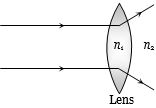
The relation between $n_1$ and $n_2$, if behaviour of light rays is as shown in figure is
Water rises to a height of $16.3 \,cm$ in a capillary of height $18 \,cm$ above the water level. If the tube is cut at a height of $12\, cm$
Oil spreads over the surface of water whereas water does not spread over the surface of the oil, due to