Question
A transverse wave described by$\text{y}=(0.02\text{m})\sin\Big[(1.0\text{m}^{-1})\text{x}+(30\text{s}^{-1})\text{t}\Big]$
propagates on a stretched string having a linear mass density of $1.2 \times 10^{-4}kg/m$. Find the tension in the string.
Answer

m = mass per unit length $=1.2\times10^{-4}\text{kg/mt}$$\text{y}=(0.02\text{m})\sin\Big[(1.0\text{m}^{-1})\text{x}+(30\text{s}^{-1})\text{t}\Big]$
Here, $\text{k}=1\text{m}^{-1}=\frac{2\pi}{\lambda}$$\omega=30\text{s}^{-1}=2\pi\text{f}$
$\therefore\ $velocity of the wave in the stretched string
$\text{v}=\lambda\text{f}=\frac{\omega}{\text{k}}=\frac{30}{\text{I}}=30\text{m/s}$
$\Rightarrow\text{v}=\sqrt{\frac{\text{T}}{\text{m}}}$
$\Rightarrow30\sqrt{\Big(\frac{\text{T}}{1.2}\Big)\times10^{-4}\text{N}}$
$\Rightarrow\text{T}=10.8\times10^{-2}\text{N}$
$\Rightarrow\text{T}=1.08\times10^{-1}\ \text{Newton}$

Need a full question paper?

Generate a complete, print-ready paper with questions like this in minutes — across 16+ boards, with answer keys.

Start Generating Free

Similar questions

Answer the following questions.
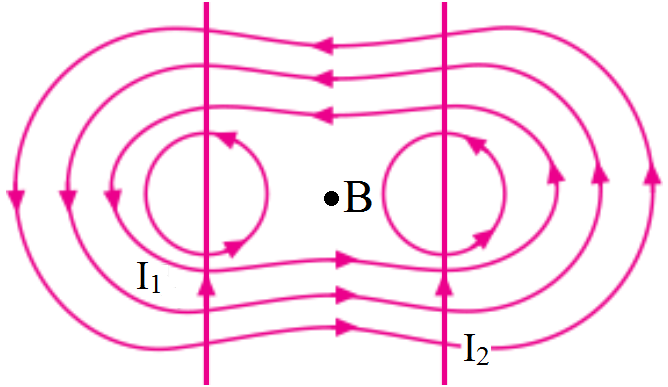
  1. Draw the magnetic field lines due to two straight, long, parallel conductors carrying currents $I_1$ and $I_2$ in the same direction. Write an expression for the force acting per unit length on one conductor due to other. Is this force attractive or repulsive?
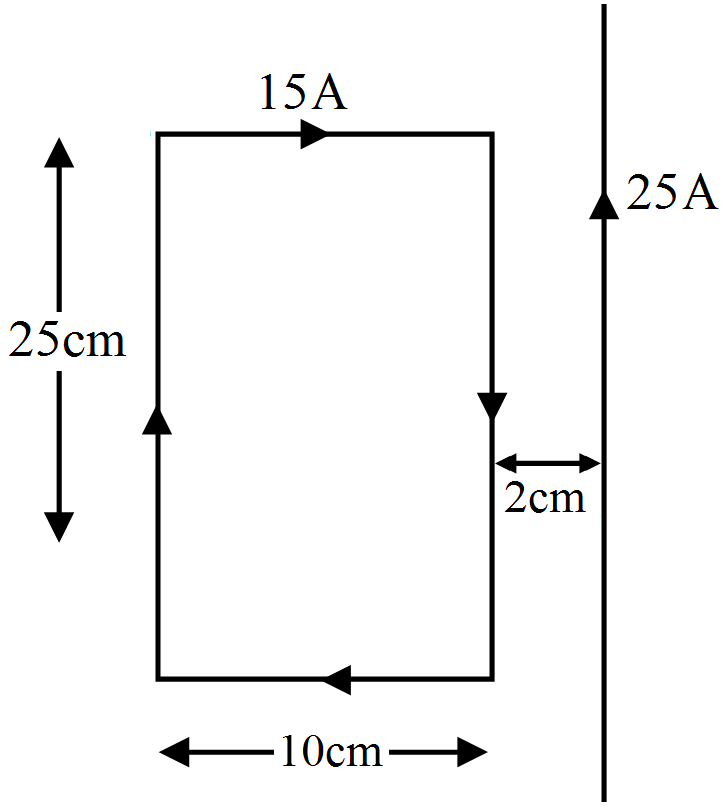
  1. Figure shows a rectangular current-carrying loop placed 2cm away from a long, straight, current-carrying conductor. What is the direction and magnitude of the net force acting on the loop?
Equal masses of air are sealed in two vessels, one of volume $V_0$ and the other of volume $2V_0$. If the first vessel is maintained at a temperature 300K and the other at 600K, find the ratio of the pressures in the two vessels.
Explain internal reflection and total internal reflection and also derive the necessary formula for it.
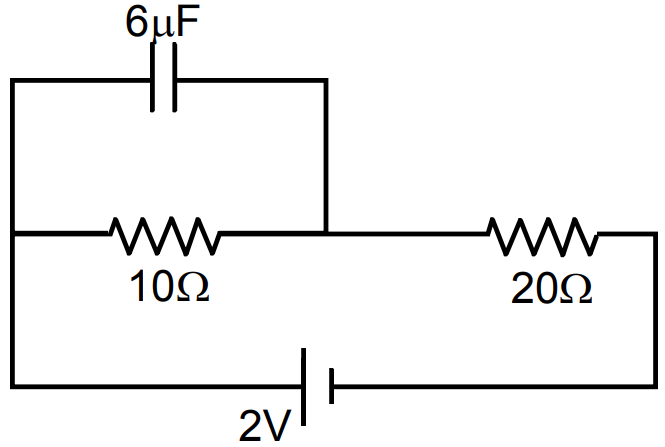
Find the charge on the capacitor shown in figure.
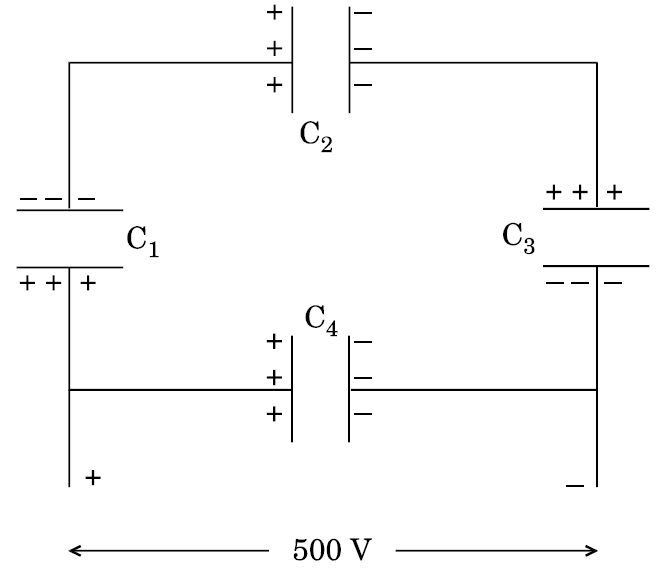
A network of four 10 $\mu$F capacitors is connected to a 500 V supply as shown in the figure. Determine the
  1. equivalent capacitance of the network and
  2. charge on each capacitor
A molecule. of hydrogen contains two protons and two electrons. The nuclear force between these two protons is always neglected while discussing the behaviour of a hydrogen molecule. Why?
Calculate the amount of energy released during the $\alpha - $ decay of $^{238}_{92}\text{U}\to ^{234}_{92}\text{Th} + ^{4} _{2}\text{He}$Given:
  1. Atomic mass of $^{238}_{92}\text{U}= 238.05079u$
  2. Atomic mass of $^{234}_{90}\text{Th}= 234.04363u$
  3. Atomic mass of $^{4}_{2}\text{He}= 4.00260\text{ u}$
$\text{1u} = 931.5 \text{MeV/c}^{2}$
Is this decay spontaneous? Give reason.
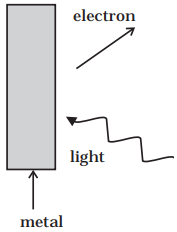
Consider Fig. for photoemission.
How would you reconcile with momentum-conservation? Note light (photons) have momentum in a different direction than the emitted electrons.
i. Define mutual inductance.
ii. A pair of adjacent coils has a mutual inductance of 1.5 H. If the current in one coil changes from 0 to 20 A in 0.5 s, what is the change of flux linkage with the other coil?
A tank is filled with water to a height of 12.5 cm. The apparent depth of a needle lying at the bottom of the tank is measured by a microscope to be 9.4 cm. What is the refractive index of water? If water is replaced by a liquid of refractive index 1.63 up to the same height, by what distance would the microscope have to be moved to focus on the needle again?