Question
✓
Answer
a. Two types of pollination are-
I. Self-pollination
II. Cross-pollination
Differences between the two are given below:-
b. The fusion of the female gamete (ovum or egg) and the male gamete created in the pollen tube by the pollen grains is known as fertilisation. The ovary transforms into the fruit after fertilisation, while the ovary wall transforms into the pericarp.
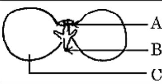
c. i. A: The young shoot of a plant embryo above the cotyledons is called a plumule. It is made up of the epicotyl and frequently immature leaves gives rise to mature shoot.
ii. B: In the course of germination, the radicle is the first component of a seedling to emerge from the seed. The plant's first root, known as a radicle, emerges from the soil downward give rise to future root system.
iii. C: The cotyledon is a crucial component of the embryo inside a plant seed. The cotyledon may develop into the seedling's first embryonic leaves after germination stored food.
I. Self-pollination
II. Cross-pollination
Differences between the two are given below:-
| Self-pollination | Cross-pollination |
| If the transfer of pollen occurs in the same flower, it is referred to as self-pollination. | The pollen is transferred from one flower to another, it is known as crosspollination. |
| It occurs in bisexual flowers. | It occurs in both bisexual and unisexual flowers. |
| It refers to the transfer of pollen grains from anther to stigma of the same flower or to another flower of the same plant. | It refers to the transfer of pollen grains from anther to stigma of flowers belonging to two different plants. |
| It is not necessary to use pollinators. | This transfer of pollen from one flower to another is achieved by agents like wind, water or animals. |
b. The fusion of the female gamete (ovum or egg) and the male gamete created in the pollen tube by the pollen grains is known as fertilisation. The ovary transforms into the fruit after fertilisation, while the ovary wall transforms into the pericarp.
c. i. A: The young shoot of a plant embryo above the cotyledons is called a plumule. It is made up of the epicotyl and frequently immature leaves gives rise to mature shoot.
ii. B: In the course of germination, the radicle is the first component of a seedling to emerge from the seed. The plant's first root, known as a radicle, emerges from the soil downward give rise to future root system.
iii. C: The cotyledon is a crucial component of the embryo inside a plant seed. The cotyledon may develop into the seedling's first embryonic leaves after germination stored food.
Need a full question paper?
Generate a complete, print-ready paper with questions like this in minutes — across 16+ boards, with answer keys.
Explore more
Similar questions
What is an electromagnet? Describe the construction and working of an electromagnet with the help of a labelled diagram.
What is placenta? Mention its role during pregnancy?
Describe some experiment to show that the magnetic field is associated with an electric current.
- Electropositive nature of the element(s) increases down the group and decreases across the period.
- Electronegativity of the element decreases down the group and increases across the period.
- Atomic size increases down the group and decreases across a period (left to right).
- Metallic character increases down the group and decreases across a period.
- Name the most electropositive element among them.
- Name the most electronegative element.
- Name the element with smallest atomic size.
- Name the element which is a metalloid.
- Name the element which shows maximum valency.
Draw the ray diagram in each case to show the position and nature of the image formed when the object is placed:
- At the centre of curvature of a concave mirror.
- Between the pole P and focus F of a concave mirror.
- In front of a convex mirror.
- At 2f of a convex lens.
- In front of a concave lens.
Atomic number of a few elements are given below:
10, 20, 7, 14
10, 20, 7, 14
- Identify the elements.
- Identify the Group number of these elements in the Periodic Table.
- Identify the Periods of these elements in the Periodic Table.
- What would be the electronic configuration for each of these elements?
- Determine the valency of these elements.
Some sugar solution is taken in a test-tube and a little of substance X in powder form is added to it. The mouth of test - tube is closed with a cork and allowed to stand for sometime. On opening the cork, a characteristic smell of substance Y is obtained and a gas Z is also observed to be formed. The gas Z extinguishes a burning matchstick.
- What could be X, Y and Z?
- What is the process of converting sugar into substance Y by the action of X known as?
- What type of respiration is exhibited by X in the above process?
A, B and C are three common STDs. A and C are caused by bacteria whereas B is caused by a virus D. The virus D reduces the immunity of the infected person to such a low level that the person can die of even very mild diseases.
- What could A and C be?
- What is B?
- Name the virus D?
- How can A, B and C be caused?
- Out of A, B and C, which one does not have a definite cure as yet?
The image below shows a developing fetus in the mother's womb. The developing fetus is connected to the placenta by means of umbilical cord. The Umbilical vein and artery run inside the umbilical cord.
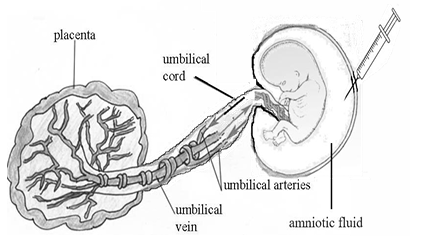
(i) Name two substance that moves through the blood vessels. (1)
(ii) If the placenta has less villi how will it affect the baby's growth? (1)
(iii) Name the region where the embryo develops inside the female body. Explain how this region is adapted for nourishing the baby. (1)
(iv) Some of the fetal cells fall off into the amniotic fluid and can be collected by careful procedure. The cells were screened and found to contain XY chromosome. (2)
(a) What is the sex of the foetus?
(b) How is this prenatal sex determination misused?
(i) Name two substance that moves through the blood vessels. (1)
(ii) If the placenta has less villi how will it affect the baby's growth? (1)
(iii) Name the region where the embryo develops inside the female body. Explain how this region is adapted for nourishing the baby. (1)
(iv) Some of the fetal cells fall off into the amniotic fluid and can be collected by careful procedure. The cells were screened and found to contain XY chromosome. (2)
(a) What is the sex of the foetus?
(b) How is this prenatal sex determination misused?
An element X belongs to group 2 and another element Y belongs to group 15 of the periodic table:
- What is the number of valence electrons in X?
- What is the valency of X?
- What is the number of valence electrons in Y?
- What is the valency of Y? Explain how you have arrived at your answers.