Question
A narrow slit S transmitting light of wavelength $\lambda$ is placed a distance d above a large plane mirror as shown in figure (17-E1). The light coming directly from the slit and that coming after the reflection interfere at a screen $\sum$ placed at a distance D from the slit.
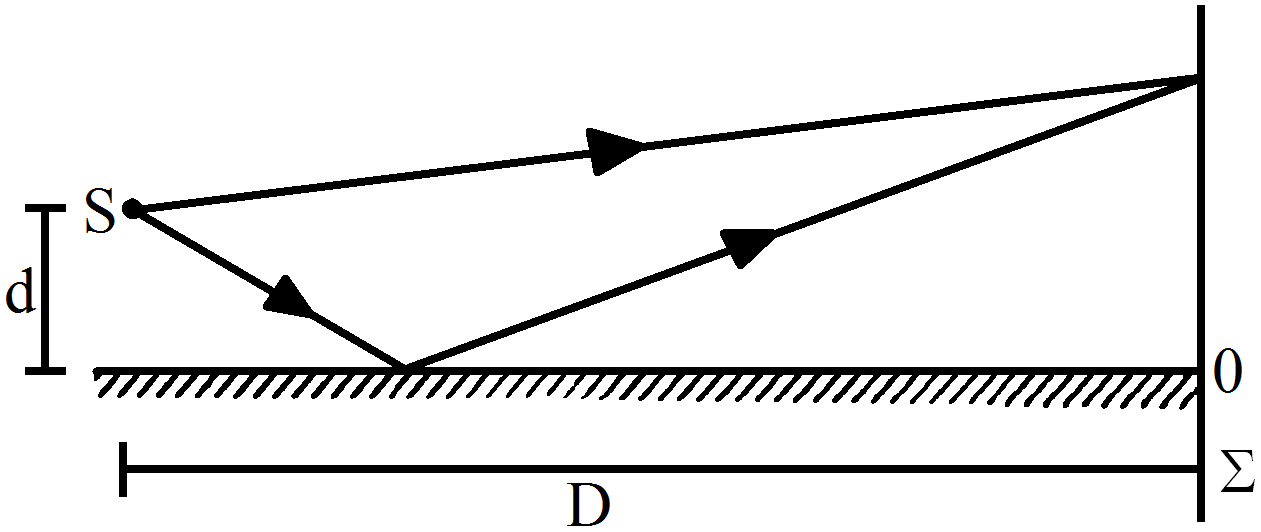
  1. What will be the intensity at a point just above the mirror, i.e., just above O?
  2. At what distance from 0 does the first maximum occur?
Answer

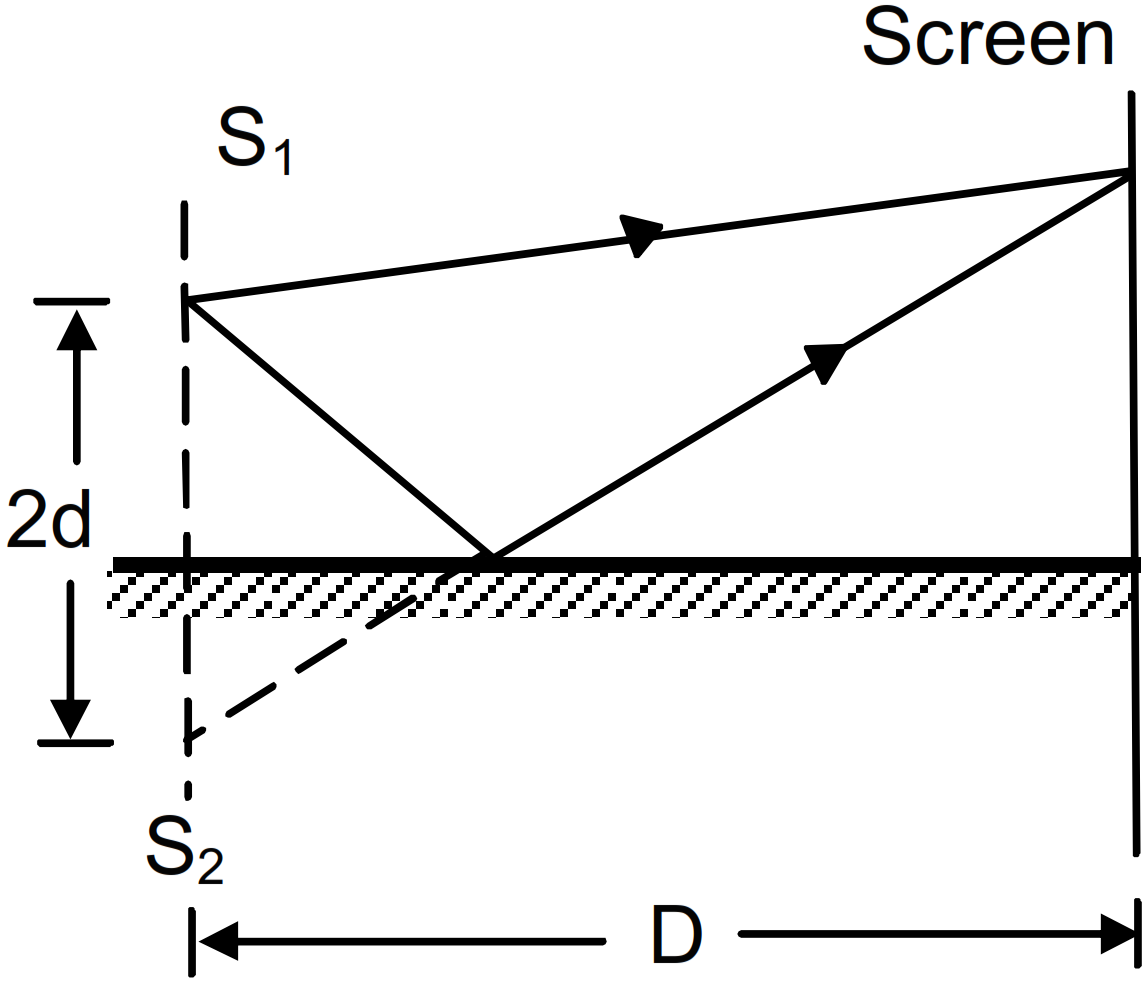
  1. Since, there is a phase difference of $\pi$ between direct light and reflecting light, the intensity just above the mirror will be zero.
  2. Here, 2d = equivalent slit separation

D = Distance between slit and screen.

We know for bright fringe, $\Delta\text{x}=\frac{\text{y}\times2\text{d}}{\text{D}}=\text{n}\lambda$

But as there is a phase reversal of $\frac{\lambda}{2}.$

$\Rightarrow\frac{\text{y}\times2\text{d}}{\text{D}}+\frac{\lambda}{2}=\text{n}\lambda$

$\Rightarrow\frac{\text{y}\times2\text{d}}{\text{D}}=\text{n}\lambda-\frac{\lambda}{2}\Rightarrow\text{y}=\frac{\lambda\text{D}}{4\text{d}}$

Need a full question paper?

Generate a complete, print-ready paper with questions like this in minutes — across 16+ boards, with answer keys.

Start Generating Free

Similar questions

A charged particle having a charge of -2.0 × 10⁻⁶C is placed close to a nonconducting plate having a surface charge density 4.0 × 10⁻⁵Cm-2. Find the force of attraction between the particle and the plate.
What is the basic difference between the atom and molecule of a diamagnetic and a paramagnetic material? Why are elements with even atomic number more likely to be diamagnetic?
A charge of $20\mu\text{C}$ is placed on the positive plate of an isolated parallel-plate capacitor of capacitance $10\mu\text{F}.$ Calculate the potential difference developed between the plates.
Explain the underlying principle of working of a parallel plate capacitor. If two similar plates, each of area A having surface charge densities $+\sigma$ and $ -\sigma$ are separated by a distance d in air, write expressions for.
  1. the electric field at points between the two plates.
  2.  the potnetial difference between the plates.
  3. the capacitance of the capacitor so formed.
If each diode in Fig. has a forward bias resistance of 25Ω and infinite resistance in reverse bias, what will be the values of the current I1, I2, I3 and I4?

  1. Derive the relation between the decay constant and half life of a radioactive substance.
  2. A radioactive element reduces to 25% of its initial mass in 1000 years. Find its half life.
Calculate the energy that can be obtained from 1kg of water through the fusion reaction
2H + 2H → 3H + p.
Assume that 1.5 × 10⁻²% of natural water is heavy water D2O (by number of molecules) and all the deuterium is used for fusion.
Write the definition of wavefront. Using Huygens' principle, draw the shape of a plane wave incident on a convex lens and the refracted wave body.
###
(a) When a wave propagates from a rarer medium to a denser medium, then which characteristic of that wave does not change and why?
(b) The refractive indices of two mediums are $\mu_1$ and $\mu_2$, what will be the ratio of velocities in the wave in them?
By what fraction does the mass of a boy increase when he starts running at a speed of 12km/h?
Comment on the following :(i) Electric conductivity.(ii) Dependence of resistivity and resistance on temperature.