Questions · Page 1 of 2

3 Marks Question

🎯

Test yourself on this topic

50 questions · timed · auto-graded

Question 13 Marks
Light of wavelength 5000 Å falls on a plane reflecting surface. What are the wavelength and frequency of the reflected light? For what angle of incidence is the reflected ray normal to the incident ray?
Answer
Wavelength of incident light, $\lambda$ = 5000 Å = 5000 × 10-10 m
Speed of light, c = 3 × 108 m
Frequency of incident light is given by the relation,
$\text{v}=\frac{\text{c}}{\lambda}$
$=\frac{3\times10^8}{5000\times10^{-10}}=6\times10^{14}\text{Hz}$
The wavelength and frequency of incident light is the same as that of reflected ray.
Hence, the wavelength of reflected light is 5000 Å and its frequency is 6 × 1014 Hz. When reflected ray is normal to incident ray, the sum of the angle of Incidence, $\angle\text{i}$ and angle of reflection, $\angle\text{r}$ is 90°.
According to the law of reflection, the angle of incidence is always equa I to the angle of reflection. Hence, we can write the sum as:
$\angle\text{i}+\angle\text{r}=90$
$\angle\text{i}+\angle\text{i}=90$
$\angle\text{i}=\frac{90}{2}=45^\circ$
Therefore, the angle of incidence for the given condition is 45°.
View full question & answer
Question 23 Marks
A beam of light consisting of two wavelengths, 650 nm and 520 nm, is used to obtain interference fringes in a Young’s double-slit experiment.
  1. Find the distance of the third bright fringe on the screen from the central maximum for wavelength 650 nm.
  2. What is the least distance from the central maximum where the bright fringes due to both the wavelengths coincide?
Answer
Wavelength of the light beam, $\lambda_1$ = 650 nm

Wavelength of another light beam, $\lambda_2$ = 520 nm

Distance of the slits from the screen = D

Distance between the two slits = d

  1. Distance of the nth bright fringe on the screen from the central maximum is given by the relation,

$\text{x}=\text{n}\lambda_1\bigg(\frac{\text{D}}{\text{d}}\bigg)$

For third bright fringe, n = 3

$\therefore\ \text{x}=3\times650\frac{\text{D}}{\text{d}}=1950\bigg(\frac{\text{D}}{\text{d}}\bigg)\ \text{nm}$

  1. Let the nth bright fringe due to wavelength, $\lambda_2$ and (n - 1)th bright fringe due to wavelength $\lambda_1$ coincide on the screen. We can equate the conditions for bright fringes as:

$\text{n}\lambda_2=\big(\text{n}-1\big)\lambda_1$

520n = 650n - 650

650 = 130n

$\therefore\ \text{n}=5$

Hence, the least distance from the central maximum can be obtained by the relation:

$\text{x}=\text{n}\lambda_2\frac{\text{D}}{\text{d}}$

$=5\times520\frac{\text{D}}{\text{d}}=2600\frac{\text{D}}{\text{d}}\text{nm}$

Note: The value of d and Dare not given in the question.

View full question & answer
Question 33 Marks
Answer the following question:
Two students are separated by a 7 m partition wall in a room 10 m high. If both light and sound waves can bend around obstacles, how is it that the students are unable to see each other even though they can converse easily.
Answer
The size of the obstacle or aperture should be comparable to the wavelength for diffraction of waves by obstacles, through a large angle.
This follows from $\text{sin}\theta=\frac{\lambda}{\text{a}}.$
For light waves,
Wavelength, $\lambda=10^{-7} \text{m and},$
Size of the wall, a = 10 m
$\therefore\ \text{sin}\theta=\frac{10^{-7}}{10}=10^{-8}$
This implies, $\theta\ \rightarrow\ 0$
That is, light goes almost unbent and hence, the students are unable to see each other.
For sound waves,
Frequency, $\nu$ = 1000 Hz
$\text{i.e}\ \frac{\text{c}}{\nu}=\frac{330}{1000}=0.33\ \text{m}$
$\therefore\ \text{sin}\theta=\frac{\lambda}{\text{a}}=\frac{0.33}{10}=0.033\ \text{m}$
Here, $\theta$ has a definite value and the waves will bend around the partition. Hence, students can converse easily.
View full question & answer
Question 43 Marks
For sound waves, the Doppler formula for frequency shift differs slightly between the two situations: (i) source at rest; observer moving, and (ii) source moving; observer at rest. The exact Doppler formulas for the case of light waves in vacuum are, however, strictly identical for these situations. Explain why this should be so. Would you expect the formulas to be strictly identical for the two situations in case of light travelling in a medium?
Answer
Sound waves require a medium for propagation. Thus, even though both the situations may correspond to the same relative motion (between the source and the observer), they are not identical physically since, the motion of the observer, relative to the medium is different in the two situations. Therefore, we cannot expect Doppler formulas for sound to be identical for (i) and (ii).
For light waves in vacuum, there is clearly nothing to distinguish between two cases given. Here only the relative motion between the source and the observer counts and the relativistic Doppler formula is the same for both cases. For light propagation in a medium, once again like for sound waves, the two situations are not identical and we should expect the Doppler formulas for this case to be different for the two situations (i) and (ii).
View full question & answer
Question 53 Marks
In a Young’s double-slit experiment, the slits are separated by 0.28 mm and the screen is placed 1.4 m away. The distance between the central bright fringe and the fourth bright fringe is measured to be 1.2 cm. Determine the wavelength of light used in the experiment.
Answer
Distance between the slits, d = 0.28 mm = 0.28 × 10-3 m
Distance between the slits and the screen, D = 1.4 m
Distance between the central fringe and the fourth (n = 4) fringe,
u = 1.2 cm = 1.2 × 10-2 m
In case of a constructive interference, we have the relation for the distance between the two fringes as:
$\text{u}=\text{n}\lambda\frac{\text{D}}{\text{d}}$
Where,
n = Order of fringes = 4
$\lambda$ = Wavelength of light used
$\therefore\ \lambda=\frac{\text{ud}}{\text{nD}}$
$=\frac{1.2\times10^{-2}\times0.28\times10^{-3}}{4\times1.4}$
$=6\times10^{-7}$
= 600 nm
Hence, the wavelength of the light is 600 nm.
View full question & answer
Question 63 Marks
Explain how Corpuscular theory predicts the speed of light in a medium, say, water, to be greater than the speed of light in vacuum. Is the prediction confirmed by experimental determination of the speed of light in water? If not, which alternative picture of light is consistent with experiment?
Answer
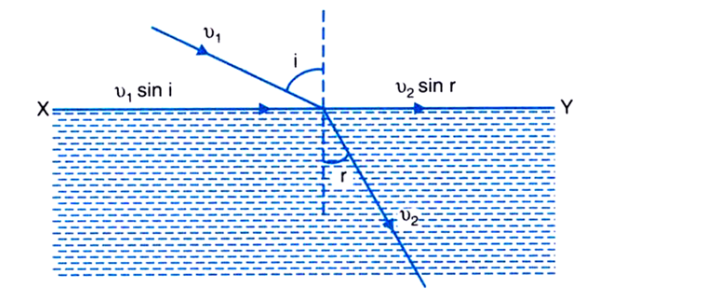
According to Newton's Corpuscular theory of light, when corpuscles of light strike the interface XY, separating a denser medium from a rarer medium, the component of their velocity along XY remains the same.

If v1 is velocity of light in rarer medium (air),

v2 is velocity of light in denser medium (water),

i is angle of incidence, and

r is angle of refraction then,

Component of v1 along XY = v1 sin i

Component of v2 along XY = v2 sin r

As, v1 sin i = v2 sin r

$\therefore\ \frac{\text{v}_2}{\text{v}_1}=\frac{\text{sin i}}{\text{sin r}}=\mu$

$\text{Since},\ \mu>1$

$\therefore\ \text{v}_2>\text{v}_1$

i.e., light should travel faster in water than in air.

This prediction of Newtons theory is opposite to the experimental result.

Huygens wave theory predicts that v2 < v1 which is consistent with experimental conclusion.

View full question & answer
Question 73 Marks
You have learnt in the text how Huygens’ principle leads to the laws of reflection and refraction. Use the same principle to deduce directly that a point object placed in front of a plane mirror produces a virtual image whose distance from the mirror is equal to the object distance from the mirror.
Answer
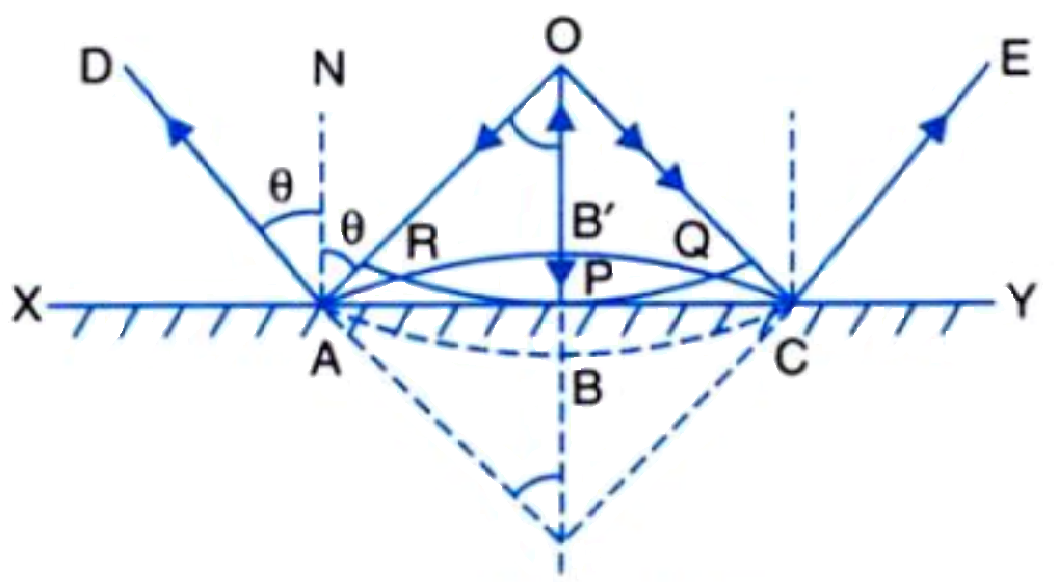
We are given a plane mirror XV and let, 0 be a point object at a distane OP, in front of the plane mirror. A part RPQ of the wavefront touches the plane mirror at P and from this point spherical wavefronts start emanating.

Whereas disturbance from Rand Q continue moving forward, along the normal rays OR and OQ, that reflects back v. When, disturbances from R, P and Q reach the mirror at A, B'and C respectively, reflected spehrical wavefront is formed.

The reflected wavefront AB'C, appears to start from I. Hence, I becomes virtual image for O as real point object. Draw AN normal to XV, hence parallel to OP.

Now, OA is the incident ray (being normal to incident wavefront ABC) and AD is reflected ray (being normal to reflected wavefront AB'C).

Thus, $\angle\text{OAN}=\angle\text{DAN}=\text{e}\ \ [\text{i}=\text{r}]$

$\text{But},\ \angle\text{OAN}=\text{alternate}\ \angle\text{AIP}$

$\therefore\ \angle\text{AOP}=\angle\text{AIP}$

Now, in $\triangle\text{AIP}$ and $\triangle\text{AOP}$

$\angle\text{AIP}=\angle\text{AOP}\ (\text{each e})$

$\angle\text{API}=\angle\text{APO}=90^\circ\ \text{each}\ 90^\circ$

AP is common to both

$\triangle_\text{s}$ become congruent

Hence, Pl = PQ

i.e., normal distance of image from the mirror = normal distance of object from the mirror.

Thus, virtual image is formed as much behind the mirror as the object in front of it.

View full question & answer
Question 83 Marks
  1. The refractive index of glass is 1.5. What is the speed of light in glass? (Speed of light in vacuum is 3.0 × 108 ms–1).
  2. Is the speed of light in glass independent of the colour of light? If not, which of the two colours red and violet travels slower in a glass prism?
Answer
  1. Refractive index of glass, µ = 1.5

Speed of light, c = 3 × 108 m/s

Speed of light in glass is given by the relation,

$\text{v}=\frac{\text{c}}{\mu}$

$=\frac{3\times10^8}{1.5}=2\times10^8\ \text{m/s}$

Hence, the speed of light in glass is 2 × 108 m/s.

  1. The speed of light in glass is not independent of the colour of light.

The refractive index of a violet component of white light is greater than the refractive index of a red component. Hence, the speed of violet light is less than the speed of red light in glass. Hence, violet light travels slower than red light in a glass prism.

View full question & answer
Question 93 Marks
What is the shape of the wavefront in each of the following cases:
  1. Light diverging from a point source.
  2. Light emerging out of a convex lens when a point source is placed at its focus.
  3. The portion of the wavefront of light from a distant star intercepted by the Earth.
Answer
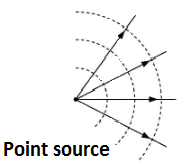
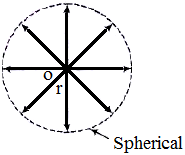
  1. The shape of the wavefront in case of a light diverging from a point source is spherical. The wavefront emanating from a point source is shown in the given figure.

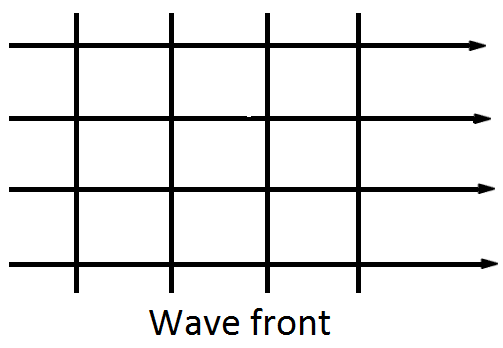
  1. The shape of the wavefront in case of a light emerging out of a convex lens when a point source is placed at its focus is a parallel grid. This is shown in the given figure.

  1. The portion of the wavefront of light from a distant star intercepted by the Earth is a plane.
View full question & answer
Question 103 Marks
  1. States law of Malus.
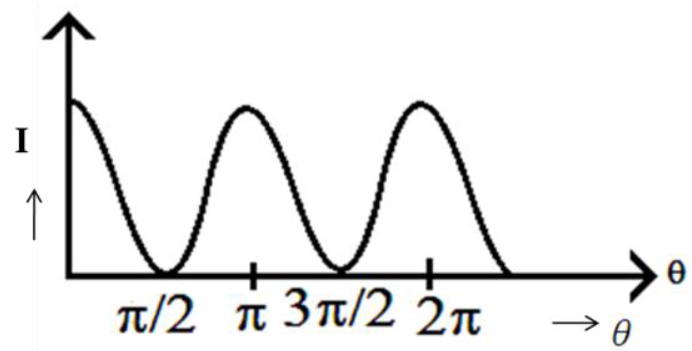
  2. Draw a graph showing the variation of intensity (I) of polarised light transmitted by an with angle $(\theta)$between polariser and analyser.
  3. What is the value of refractive index of a medium of polarising angle 60o?
Answer
  1. When the pass axis of a polaroid makes an angle $\theta$ with the plane of polarisation of polarised light of intensity Io incident on it, then the intensity of the transmitted emergent light is given by $\text{I} = \text{I}_{o}\cos^{2}\theta.$
  2. $\mu = \tan\text{i}_{\beta}$

$ =\tan60^{o} =\sqrt{3} = 1.7.$

View full question & answer
Question 113 Marks
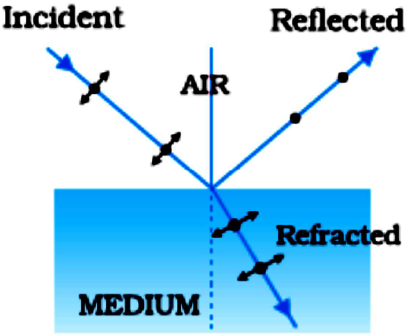
  1. Show, giving a suitable diagram, how unpolarized light can be polarised by reflection.
  2. Two polaroids P1 and P2  are placed with their pass axes perpendicular to each other. Unpolarised light of intensity Io is incident on P1 A third polaroid P3 is kept in between P1 and P2 such that its pass axis makes an angle of $60^{\circ}$with that of P1. Determine the intensity of light transmitted through P1, P2 and P3.
Answer
  1. When unpolarised light is incident on the boundary between two transparent media, the reflected light gets plane polarized with its electric vector perpendicular to the plane of incidence.

The polarization is complete when the reflected and refracted rays are at right angles to each other. This condition occurs for an angle of incidence, ip, where tan ip = $\mu$

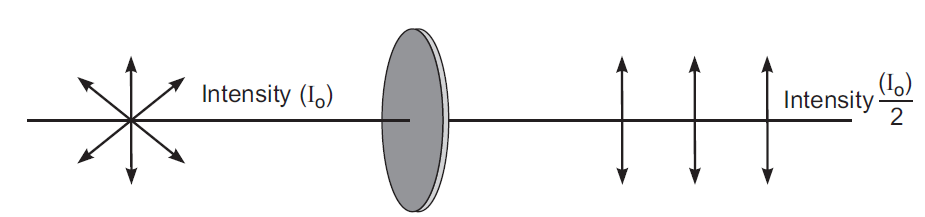
  1. Intensity of light through $\text{P}_1=\frac{I_0}{2}$

Intensity of light through $\text{P}_2=\frac{I_0}{2}\cos^260$

$\frac{I_0}{2}.\bigg(\frac{1}{2}\bigg)^2=\frac{I_0}{8}$

Intensity of light through $ \text{P}_3=\frac{I_0}{8}\cos^230=\frac{I_0}{8}\times\bigg(\frac{\sqrt{3}}{2}\bigg)^2=\frac{3I_0}{32}$

View full question & answer
Question 123 Marks
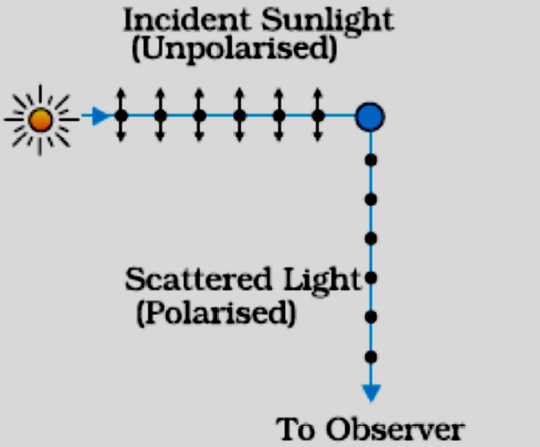
  1. Show, with the help of a diagram, how unpolarised sunlight gets polarised due to scattering.
  2. Two polaroids P1 and P2 are placed with their pass axes perpendicular to each other. Unpolarised light of intensity Io is incident on P1. A third polaroid P3 is kept in between Pand P2 such that its pass axis makes an angle of $45^{\circ}$ with that of P1. Determine the intensity of light transmitted through P1, P2 and P3.
Answer
  1.  

Alternate Answer

The acceleration, of the charges, in the scattering molecules, due to the electric field of the incident radiation, can be in two mutually perpendicular directions.

The observer, however, receives the scattered light, corresponding to only one of these two sets of the accelerated charges.

This causes scattered light to get polarised. Alternatively: The observer receives scattered light corresponding to only one of the two sets of accelerated charges i.e. electrons oscillating perpendicular to the direction of propagation

  1. Intensity of light through $\text{P}_1=\frac{I_0}{2}$

Intensity of light through $\text{P}_2=\frac{I_0}{2}\cos^245$

$\frac{I_0}{2}.\frac{1}{2}=\frac{I_0}{4}$

Intensity of light through $\text{P}_3=\frac{I_0}{4}\cos^245=\frac{I_0}{4}\times\frac{1}{2}=\frac{I_0}{8}$

View full question & answer
Question 133 Marks
In Young’s double slit experiment, the two slits are separated by a distance of 1·5 mm and the screen is placed 1 m away from the plane of the slits. A beam of light consisting of two wavelengths 650 nm and 520 nm is used to obtain interference fringes. Find.
  1. The distance of the third bright fringe for$\lambda = 520$ nm on the screen from the central maximum.
  2. The least distance from the central maximum where the bright fringes due to both the wavelengths coincide.
Answer
  1. Distance of third bright fringe $ - \text{y}_{3} = \frac{\text{n}\lambda\text{D}}{\text{d}}$

$ = \frac{3 \times 520 \times10^{−9}\times 1}{1.5 \times 10^{−3}}$

$ = 1.04 \times 10^{−3}\text{𝑚}\simeq1\text{ 𝑚𝑚}$.

  1. Let nth maxima of 650𝑛𝑚 coincides with the (n + 1)th maxima of 520 nm.

 $\therefore \text{𝑛} \times 650 \times10^{−9} =(\text{ n} + 1 )520 \times 10^{−9}$

$\Rightarrow\text{n} = 4$

$\therefore$ The least distance of the point is given by

$\text{y} =\frac{\text{nD}\lambda_{1}}{\text{d}}$

$ = \frac{4\times 1 \times 650 \times 10^{−9}}{1.5 \times 10^{−3}}\text{m} = 1.733 \times 10^{−3}\text{𝑚}\simeq 1.7\text{𝑚𝑚}$.

View full question & answer
Question 143 Marks
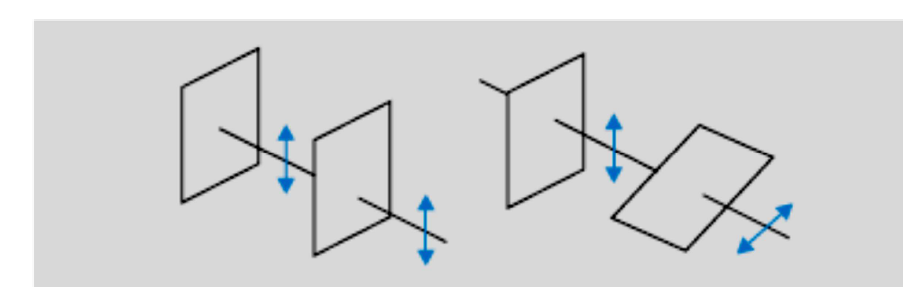
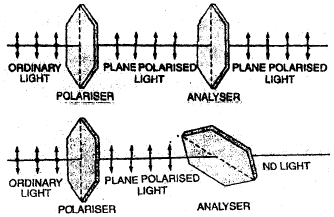
  1. Using the phenomenon of polarisation, show how transverse nature of light can be demonstrated.
  2. Two polaroids P1 and P2 are placed with their pass axes perpendicular to each other. Unpolarised light of intensity Io is incident on P1. A third polaroid P3 is kept in between P1 and P2 such that its pass axis makes an angle of 300 with that of P1. Determine the intensity of light transmitted through P1, P2 and P3.
Answer
  1.  

Light from the sodium lamp passing through the single Polaroid sheet ( P1) does not show any variation in intensity when this sheet is rotated. However, if the light, transmitted by P1, is made to pass through another Polaroid sheet (P2) the light intensity, coming out of P2, varies from a maximum to zero, and again to maximum, when P2 is rotated. These observations are consistent only with the transverse nature of light waves.

  1. Intensity of light transmitted through P1 = I0 / 2.

Intensity of light transmitted through P3 = (I0 / 2) x cos300.

= 3 I0 / 8

Intensity of light transmitted through $\text{P}_{2} = \frac{3}{8}\text{I}_{o}\cos^{2}60^{o}$

$=\frac{3}{32}\text{I}_{o}.$

View full question & answer
Question 153 Marks
  1. What is linearly polarized light? Describe briefly using a diagram how sunlight is polarised.
  2. Unpolarised light is incident on a polaroid. How would the intensity of transmitted light change when the polaroid is rotated?
View full question & answer
Question 163 Marks
How does an unpolarised light get polarised when passed through a polaroid?
Two polaroids are set in crossed positions. A third polaroid is placed between the two making an angle θ with the pass axis of the first polaroid. Write the expression for the intensity of light transmitted from the second polaroid. In what orientations will the transmitted intensity be (i) minimum and (ii) maximum?
Answer
A polaroid consists of long chain molecules aligned in a particular direction. The electric vectors (associated with the propagating light wave) along the direction of the aligned molecules get absorbed. Thus, if an unpolarised light wave is incident on such a polaroid, then the light wave will get linearly polarised with the electric vector oscillating along a direction perpendicular to the aligned molecules.
Expression for the intensity transmitted through second Polaroid:
$\text{l} = \text{(I}_{0}\cos^{2}\theta)\cos^{2}(90^{0} - \theta) = \text{I}_{0}(\cos\theta\sin\theta)^{2} = \text{I}_{0}\sin^{2}2 \theta/ 4 $
Where I0 is the intensity of the polarized light after passing through the first polaroid.
Intensity will be maximum when θ = 45° and minimum when θ = 0°
View full question & answer
Question 173 Marks
In Young’s double slit experiment, the two slits 0.15 mm apart are illuminated by monochromatic light of wavelength 450 nm. The screen is 1.0 m away from the slits.
  1. Find the distance of the second (i) bright fringe, (ii) dark fringe from the central maximum.
  2. How will the fringe pattern change if the screen is moved away from the slits?
Answer
Distance of nth maxima from central maxima

$\text{X}_{n} = \frac{\text{n}\lambda\text{D}}{\text{d}}$

Given: n = 2, d = 0.15 mm, λ = 450 nm and D = 1.0 m

$\text{x}_{2} = \frac{2\times450\times10^{-9}\times1.0}{0.15\times10^{-3}} = 6 \times10^{-3}\text{m} = 6\text{mm}$

Distance of nth minima from central maxima

$\text{y}_{2} = \frac{(2\text{n} - 1 )\lambda\text{D}}{2\text{d}} = \frac{(2\times2-1)450\times10^{-9}\times1}{2\times0.15\times10^{-3}} = 4.5\times10^{-3}\text{m} = 4.5\text{mm}$

When the screen is moved away from the slits fringes become farther apart.
(Fringe width α distance of screen.)

View full question & answer
Question 183 Marks
In Young’s double slit experiment, monochromatic light of wavelength 630 nm illuminates the pair of slits and produces an interference pattern in which two consecutive bright fringes are separated by 8.1 mm. Another source of monochromatic light produces the interference pattern in which the two consecutive bright fringes are separated by 7.2 mm. Find the wavelength of light from the second source.
What is the effect on the interference fringes if the monochromatic source is replaced by a source of white light?
Answer
$\beta =\frac{\lambda\text{D}}{\text{d}}$
$\therefore\beta_{1}\bigg/\beta_{2} = \lambda_{1}\bigg/\lambda_{2}$
$\therefore\lambda_{2} = \lambda_{1}\beta_{2}\bigg/\beta_{1}$
= 630 × 7.2 / 8.1 = 560 nm
Effect on fringe:
The central fringe is white and there are a few coloured fringes on either side of the central fringe. 
View full question & answer
Question 193 Marks
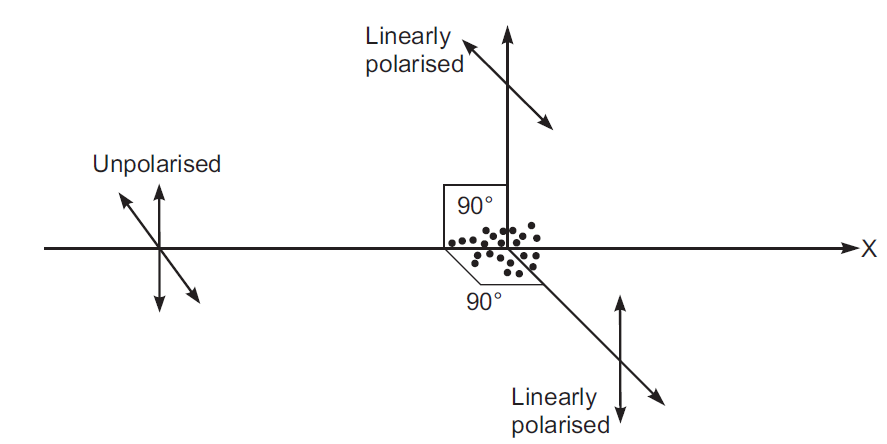
Distinguish between unpolarised and plane polarised light. An unpolarised light is incident on the boundary between two transparent media. State the condition when the reflected wave is totally plane polarised. Find out the expression for the angle of incidence in this case.
Answer
Unpolarised light: Vibrations are symmetrically distributed in all direction

Polarised light: Vibrations are restricted to one plane only.

Condition: $\tan\text{i}_{p} = \mu$

Alternate Answer

Reflected and refracted rays should be perpendicular to each other.

Alternate Answer

Light should be incident at polarizing angle.

$\text{Derivation:}\mu = \frac{\sin\text{i}_{p}}{\sin\text{r}} =\frac{\sin\text{i}}{\sin\bigg(\frac{\pi}{2} - \text{i}_{p}\bigg)}$

$\tan\text{i}_{p}.$

View full question & answer
Question 203 Marks
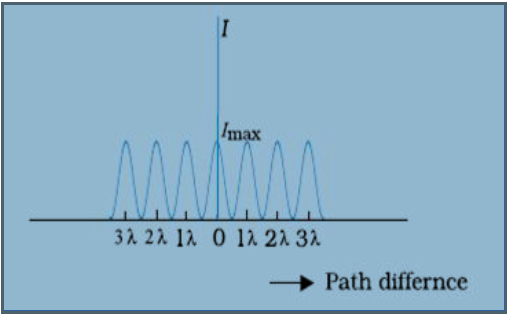
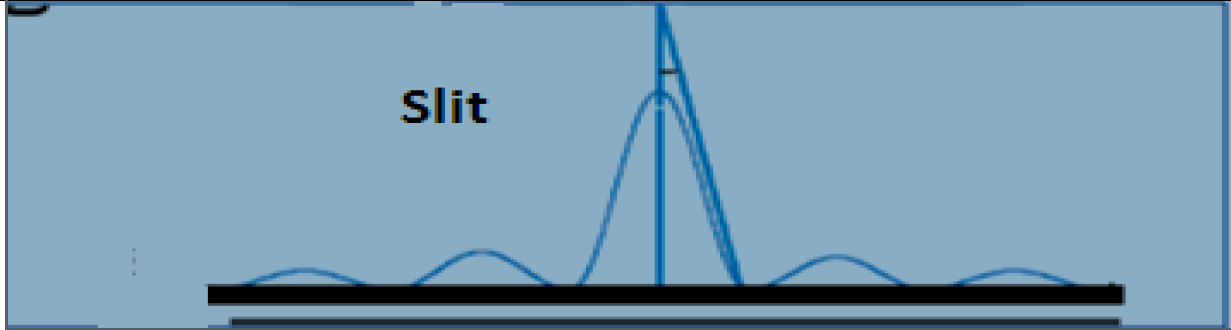
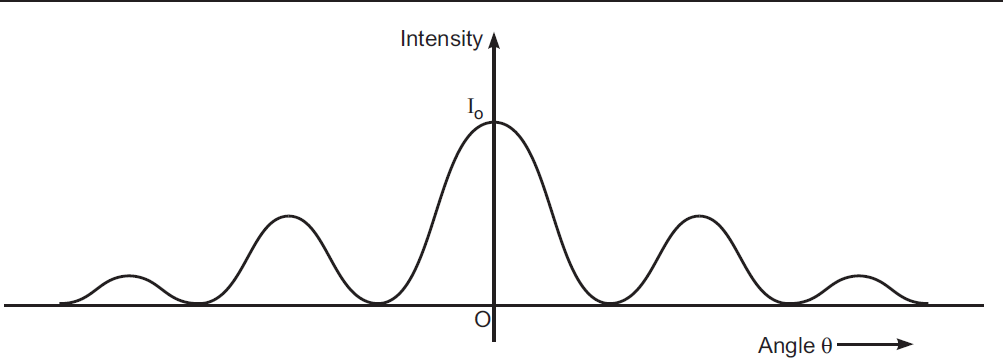
Draw the intensity distributions for (i) the fringes produced in interference, and (ii) the diffraction bands produced due to single slit. Write two points of difference between the phenomena of interference and diffraction.
View full question & answer
Question 213 Marks
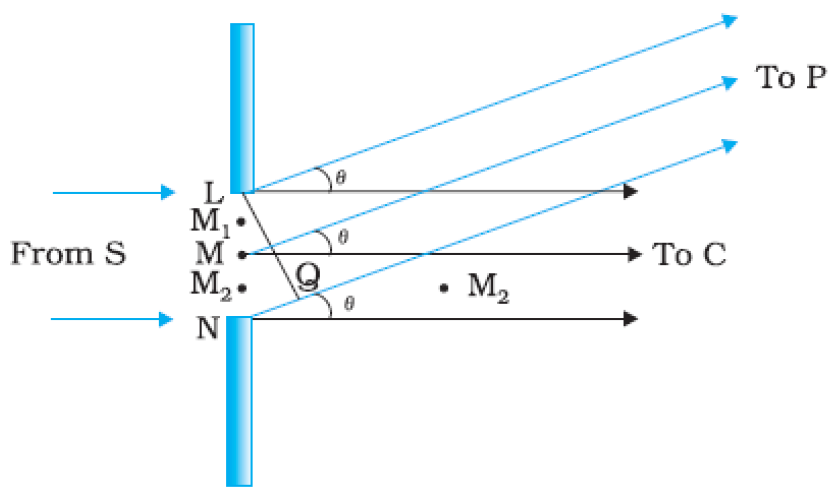
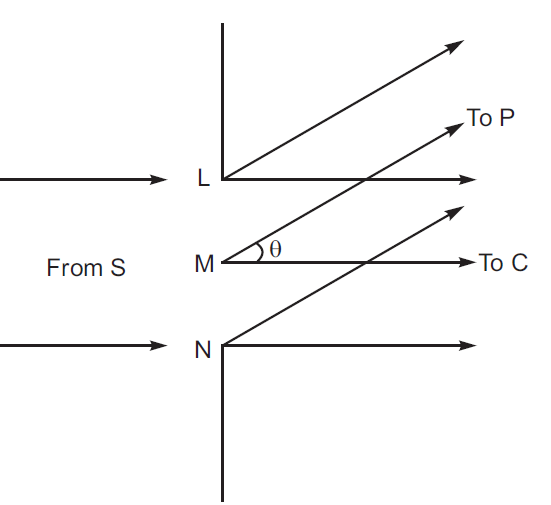
A monochromatic light of wavelength $\lambda$ is incident normally on a narrow slit of width ‘a’ to produce a diffraction pattern on the screen placed at a distance D from the slit. With the help of a relevant diagram, deduce the conditions for obtaining maxima and minima on the screen. Use these conditions to show that angular width of central maximum is twice the angular width of secondary maximum.
Answer

The path difference
𝑁𝑃 − 𝐿𝑃 = 𝑁𝑄
= 𝑎 sin 𝜃 ≃ 𝑎𝜃
By dividing the slit into an appropriate number of parts, we find that points P for which
  1. $\theta=\frac{n\lambda}{a}$ are points of minima.
  2. $\theta=\big(n+\frac{1}{2}\big)\frac{\lambda}{a}$ are points of maxima
Angular width of central maxima, $\theta=\theta_1-\theta_{-1}$
$=\frac{\lambda}{a}-\big(-\frac{\lambda}{a}\big)$
$\theta=\frac{2\lambda}{a}$
Angular width of secondary maxima $=\theta_2-\theta_1$
$=\frac{2\lambda}{a}-\frac{\lambda}{a}=\frac{\lambda}{a}$
$=\frac{1}{2}\text{X}$ Angular width of central maxima
View full question & answer
Question 223 Marks
Answer the following questions:
  1. In a double slit experiment using light of wavelength 600 nm, the angular width of the fringe formed on a distant screen is 0.1o. Find the spacing between the two slits.
  2. Light of wavelength 5000 Å. Propagating in air gets partly reflected from the surface of water. How will the wavelengths and frequencies of the reflected and refracted light be affected?
Answer
  1. Angular width of fringes

$\theta =\lambda/\text{d},$  where d = separation between two slits

Here $\theta = 0.1^{\circ} = 0.1\times\frac{\pi}{180}\text{radian}$

$\therefore\text{d} = \frac{600\times10^{-9}\times180}{0.1\times\pi}$

 = 3.43 X 10⁻⁴ m

= 0.34 m

  1. For Reflected light:  avelength remains same. Frequency remains same.

For Refracted light: Wavelength decreases½ Frequency remains same.

View full question & answer
Question 233 Marks
  1. In what way is diffraction from each slit related to the interference pattern in a double slit experiment?
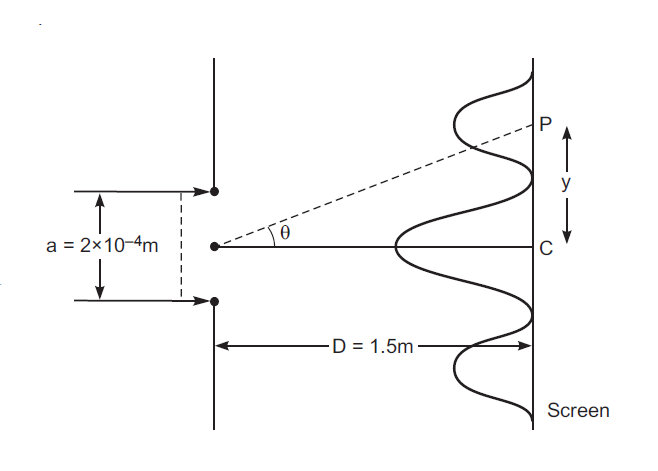
  2. Two wavelengths of sodium light 590 nm and 596 nm are used, in turn, to study the diffraction taking place at a single slit of aperture 2 × 10⁻⁴ m. The distance between the slit and the screen is 1.5 m. Calculate the separation between the positions of the first maxima of the diffraction pattern obtained in the two cases.
View full question & answer
Question 243 Marks
  1. Why are coherent sources necessary to produce a sustained interference pattern?
  2. In Young's double slit experiment using monochromatic light of wavelength$\lambda,$ the intensity of light at a point on the screen where path difference is$\lambda,$ is K units. Find out the intensity of light at a point where path difference is $\lambda/3.$
Answer
  1. Coherent sources are needed to ensure that the positions of maxima and minima do not change with time.

Alternate Answer

Coherent sources have constant phase difference and, therefore, produce a sustained interference pattern.

  1. $\text{I} = \text{I}_{1} + \text{I}_{2} + 2 \sqrt{\text{I}_{1}\text{I}_{2}}\cos\theta$

For path difference $\lambda,$ phase difference

$\Phi = 2\pi$

$\text{Hence}, \text{k} = 4\text{I}_{0}\cos^{2}\pi =4 \text{ I}_{0}$

For path difference $\lambda\big/3$

Phase difference $\Phi = 2\pi\big/3$

Intensity

$\text{I}' = 4\text{I}_{0}\cos^{2}\pi\big/3$

$ = 4\text{I}_{0}\bigg(\frac{1}{2}\bigg)^{2} = \text{I}_{0}$

Therefore, $\text{I}' = \frac{\text{k}}{4}.$

View full question & answer
Question 253 Marks
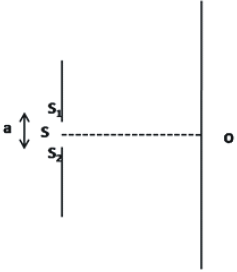
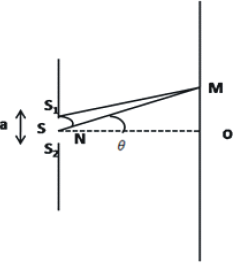
Use Huygens's principle to explain the formation of diffraction pattern due to a single slit illuminated by a monochromatic source of light.
When the width of the slit is made double the original width, how would this affect the size and intensity of the central diffraction band?
Answer
Explanation:
As per Huygen's Principle
Net effect at any point

= sum total of contribution of all wavelets with proper phase difference

At the central Point (O)

Contribution from each half in SS1 is in phase with that from the corresponding
part in SS2.Hence, O is a maxima

At the point M where SM-SM1= $\lambda$/2

Phase difference between each wavelet from SS1 and corresponding

wavelet from SS2 = $\lambda$/2

Hence, M would be a minima.

All such points (path difference =n $\lambda$/2) are also minima.

Similarly, all points, for which path difference = (2n+1) $\lambda$/2, are maxima but with decreasing intensity.

From the figure

 Half angular width of central maxima= $\lambda$/a
$\therefore$, Size of central maxima will be reduced to half

and intensity of central maxima will be four times.

View full question & answer
Question 263 Marks
  1. Describe briefly, with the help of suitable diagram, how the transverse nature of light can be demonstrated by the phenomenon of polarization.
  2. When unpolarized light passes from air to a transparent medium, under what condition does the reflected light get polarized?
View full question & answer
Question 273 Marks
What is an unpolarized light? Explain with the help of suitable ray diagram how an unpolarized light can be polarized by reflection from a transparent medium. Write the expression for Brewster angle in terms of the refractive index of denser medium.
Answer
In an unpolarised light the vibrations of electric field vector are in every plane perpendicular to the direction of propagation of light.

When unpolarised light is incident on the boundary between two transparent media, the reflected light is polarised with its electric vector perpendicular to the plane of incidence when the refracted and reflected rays make a right angle with each other.

Brewster angle: $\mu =\tan\text{i}_{p}.$

View full question & answer
Question 283 Marks
In a single slit diffraction experiment, when a tiny circular obstacle is placed in the path of light from a distant source, a bright spot is seen at the centre of the shadow of the obstacle. Explain why?

State two points of difference between the interference pattern obtained in Young’s double slit experiment and the diffraction pattern due to a single slit.

Answer
Explanation: Waves diffracted at the edge of circular obstacle interfere constructively at the centre of the shadow producing a bright spot.
Points of Differences:
  1. In interference, All bright fringes are of equal intensity, while in diffraction intensity of secondary maxima keeps on decreasing.
  2. Width of all fringes are equal in interference pattern but, in diffraction the width of central maximum and  the secondary maxima are different.
View full question & answer
Question 293 Marks
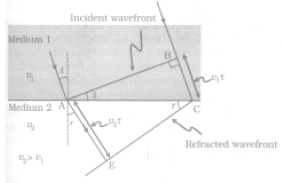
How is a wavefront defined? Using Huygen’s construction draw a figure showing the propagation of a plane wave refracting at a plane surface separating two media. Hence verify Snell’s law of refraction.
Answer
  1. A surface of constant phase/A locus of points which oscillate in same phase.
  2.  


  1. $\sin\text{i} = \frac{\text{BC}}{\text{AC}}$

$\sin\text{r} = \frac{\text{AE}}{\text{AC}}$

$\therefore \frac{\sin\text{i}}{\sin\text{r}} = \frac{\text{BC}}{\text{AE}}$

$ = \frac{c_1\text{t}}{c_2\text{t}} = \frac{c_1}{\text{c}_{2}} = n =\text{ constant}$

View full question & answer
Question 303 Marks
  1. If one of two identical slits producing interference in Young’s experiment is covered with glass, so that the light intensity passing through it is reduced to 50%, find the ratio of the maximum and minimum intensity of the fringe in the interference pattern.
  2. What kind of fringes do you expect to observe if white light is used instead of monochromatic light?
Answer
  1. $\text{I}_1=\frac{\text{I}}{2}$

$\text{I}_2=\text{I}$

$\frac{\text{I}_{\text{max}}}{\text{I}_{\text{min}}}=\bigg(\frac{\sqrt{\text{I}_1}+\sqrt{\text{I}_2}}{\sqrt{\text{I}_1}-\sqrt{\text{I}_2}}\bigg)^2$

$=\Bigg(\frac{\sqrt{\frac{\text{I}}{2}}+\sqrt{\text{I}}}{\sqrt{\frac{\text{I}}{2}}-\sqrt{\text{I}}}\Bigg)^2$

$=\bigg(\frac{1+\sqrt{2}}{1-\sqrt{2}}\bigg)^2$

$=\frac{2+1+2\sqrt{2}}{2+1-2\sqrt{2}}$

$=\frac{3+2\sqrt{2}}{3-2\sqrt{2}}$

  1. If we use white light, central fringe will be white, then there will be colourful fringes on both sides, starting from violet to red (fringe width $\propto$ wavelength) and then there will be general illumination of screen.
View full question & answer
Question 313 Marks
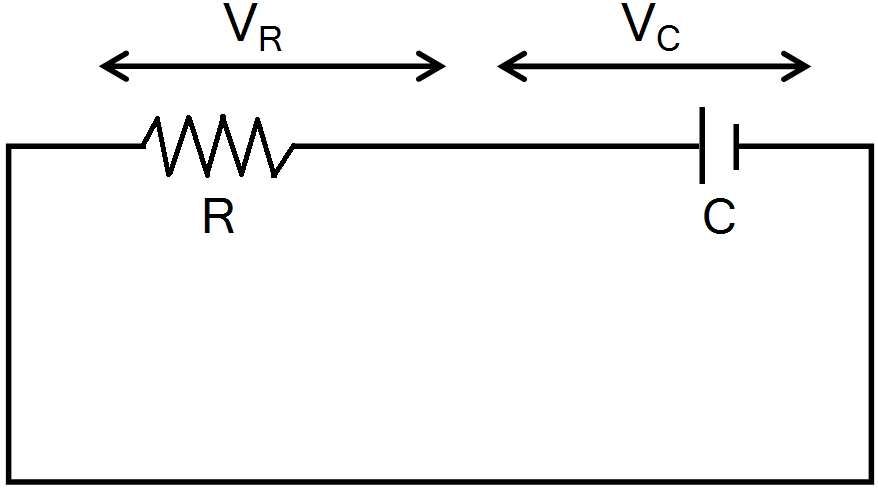
A resistance R and a capacitor C are connected in series to an ac source $\text{V}=\text{V}_0\sin\omega\text{t}.$
  1. Obtain the expression for the instantaneous current (I) in the circuit.
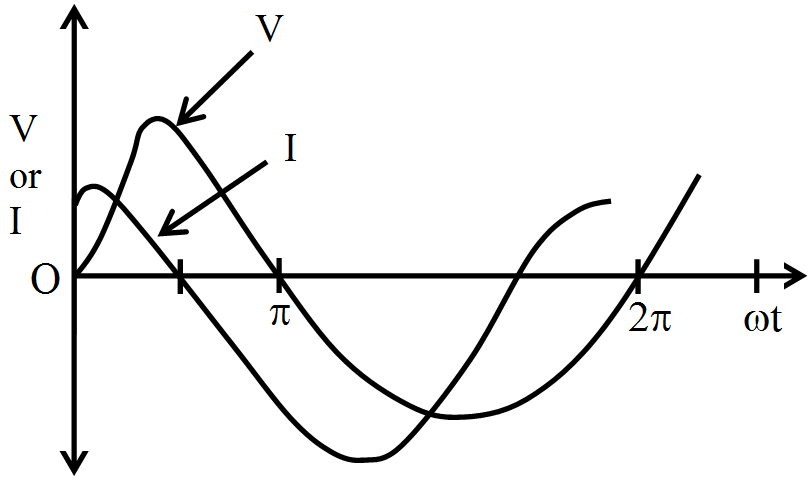
  2. Show graphically variations of V and I as a function of $\omega\text{t}.$
Answer
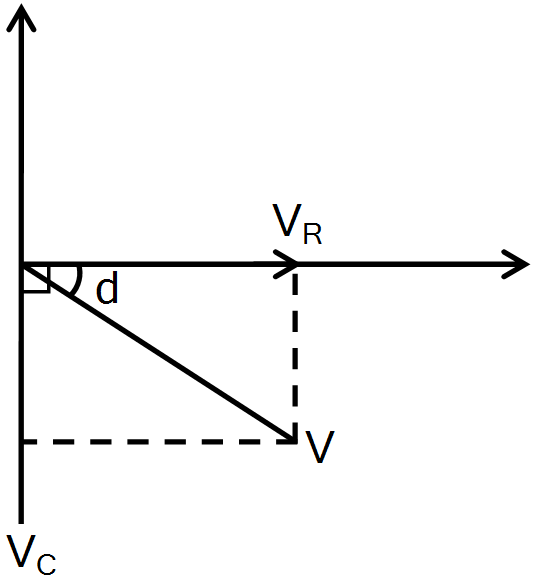
  1. $\text{z}=\sqrt{\text{R}^2+\text{X}^2\text{C}}=\text{impedance}$

$\therefore\text{I}=\frac{\text{V}}{\text{Z}}=\frac{\text{v}_1\sin\omega\text{t}}{\sqrt{\text{R}^2+\text{X}^2_\text{C}}}$

$\text{V}_\text{R}=\text{IR}$

$\text{V}_\text{C}=\text{IX}_\text{C}$

In phase of 1 lags I by $\frac{\pi}{2}$

$\text{V}=\sqrt{\text{V}^2\text{R}+\text{V}^2_\text{C}}$

$=\sqrt{(\text{IR})^2+(\text{IX}_\text{C})^2}$

$\Rightarrow\text{I}=\frac{\text{V}}{\sqrt{\text{R}^2+\text{X}^2_\text{C}}}=\frac{\text{r}_0\sin\omega\text{t}}{\sqrt{\text{R}^2+\text{X}^2_\text{C}}}$

$\phi=$ phase diff bet V & I

$\tan\phi=\frac{\text{V}_\text{C}}{\text{V}_\text{R}}=\frac{\text{X}_\text{C}}{\text{R}}$

  1.  

View full question & answer
Question 323 Marks
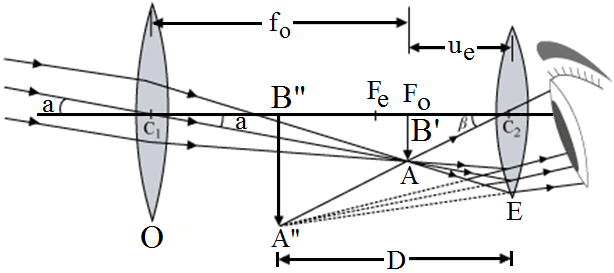
Draw a labelled ray diagram of an astronomical telescope in the near point adjustment position.
A giant refracting telescope at an observatory has an objective lens of focal length 15m and an eyepiece of focal length 1.0cm. If this telescope is used to view the Moon, find the diameter of the image of the Moon formed by the objective lens. The diameter of the Moon is 3.48 × 10⁶m, and the radius of lunar orbit is 3.8 × 10⁸m.
Answer

When the final image is formed at the least distance of distinct vision

Magnifying power, $\text{M}=\frac{\beta}{\alpha}$

$\alpha$ and $\beta$ are small.

$\therefore\text{M}=\frac{\tan\beta}{\tan\alpha}\ ...(\text{i})$

In $\triangle\text{A}'\text{B}'\text{C}_2,$

$\tan\beta=\frac{\text{A}'\text{B}'}{\text{C}_2\text{B}'}$

In $\triangle\text{A}'\text{B}'\text{C}_1,$

$\tan\alpha=\frac{\text{A}'\text{B}'}{\text{C}_1\text{B}'}$

From equation (i), we have:

$\text{M}=\frac{\text{A}'\text{B}'}{\text{C}_2\text{B}'}\times\frac{\text{C}_1\text{B}'}{\text{A}'\text{B}'}$

$\text{M}=\frac{\text{C}_1\text{B}'}{\text{C}_2\text{B}'}$

Here,

$\text{C}_1\text{B}'=+\text{f}_0$

$\text{C}_2\text{B}'=-\text{u}_\text{e}$

$\text{M}=\frac{\text{f}_0}{-\text{u}_\text{e}}\ ...(\text{ii})$

Using the lens equation $\Big(\frac{1}{\text{v}}-\frac{1}{\text{u}}=\frac{1}{\text{f}}\Big)$ for the eyepieces, we get

$\frac{1}{-\text{D}}-\frac{1}{-\text{u}_\text{e}}=\frac{1}{\text{f}_\text{e}}$

$-\frac{1}{\text{D}}+\frac{1}{\text{u}_\text{e}}=\frac{1}{\text{f}_\text{e}}$

$\Rightarrow\frac{1}{\text{u}_\text{e}}=\frac{1}{\text{f}_\text{e}}+\frac{1}{\text{D}}$

$\frac{\text{f}_0}{\text{u}_\text{e}}=\frac{\text{f}_0}{\text{f}_\text{e}}\Big(1+\frac{\text{f}_\text{e}}{\text{D}}\Big)$

$\frac{-\text{f}_0}{\text{u}}=\frac{-\text{f}_0}{\text{f}}\Big(1+\frac{\text{f}_\text{e}}{\text{D}}\Big)$

$\text{M}=-\frac{\text{f}_0}{\text{f}_\text{e}}\Big(1+\frac{\text{f}_\text{e}}{\text{D}}\Big)$

Angular magnification is given by,

$\text{m}_0=\Big|\frac{\text{f}_0}{\text{f}_\text{e}}\Big|=\Big|\frac{1500}{1}\Big|=1500$

where, f is the focal length of the objective lens, and fe is the focal length of the eye-piece.

Given, the diameter of the moon = 3.48 × 106m

The radius of the lunar orbit = 3.8 × 108m

The diameter of the image of the moon formed by the objective lens is given by, $\text{d}= \alpha\text{f}_₀$

$\text{d}=\frac{\text{Diameter}\ \text{of}\ \text{the}\ \text{moon}}{\text{Radius}\ \text{of}\ \text{the}\ \text{lunar}\ \text{orbit}}\times\text{f}_0$

$\text{d}=\frac{3.48\times10^6}{3.8\times10^8}\times15=13.74\text{cm}$

View full question & answer
Question 333 Marks
In a single slit diffraction experiment, light of wavelength $\lambda$ illuminates the slit of width ‘a’ and the diffraction pattern is observed on a screen.
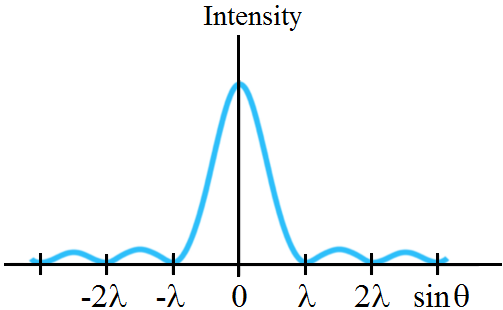
  1. Show the intensity distribution in the pattern with the angular position $\theta.$
  2. How are the intensity and angular width of central maxima affected when,
  1. Width of slit is increased,
  2. Separation between slit and screen is decreased?
Answer
  1.  

  1.  
  1. Intensity increases, angular width decreases.
  2. Intensity increases, no effect on angular width.
View full question & answer
Question 343 Marks
What is the effect on the interference fringes in Young’s double slit experiment due to each of the following operations? Justify your answers.
  1. The screen is moved away from the plane of the slits.
  2. The separation between slits is increased.
  3. The source slit is moved closer to the plane of double slit.
Answer
  1. Linear fringe width increases $\beta=\frac{\lambda\text{D}}{\text{d}}$

$\Rightarrow\beta\propto\text{D}$

No effect on angular fringe width $\Big(\text{Q}=\frac{\lambda}{\text{d}}\Big).$

  1. Both linear fringe width & angular fringe width decrease $\Big(\beta\propto\frac{1}{\text{d}},\text{Q}\propto\frac{1}{\text{d}}\Big).$
  2. If condition $\frac{\text{s}}{\text{S}}<\frac{\lambda}{\text{d}}$ is satisfied, interference will be obtained otherwise, no interference will be obtained.
View full question & answer
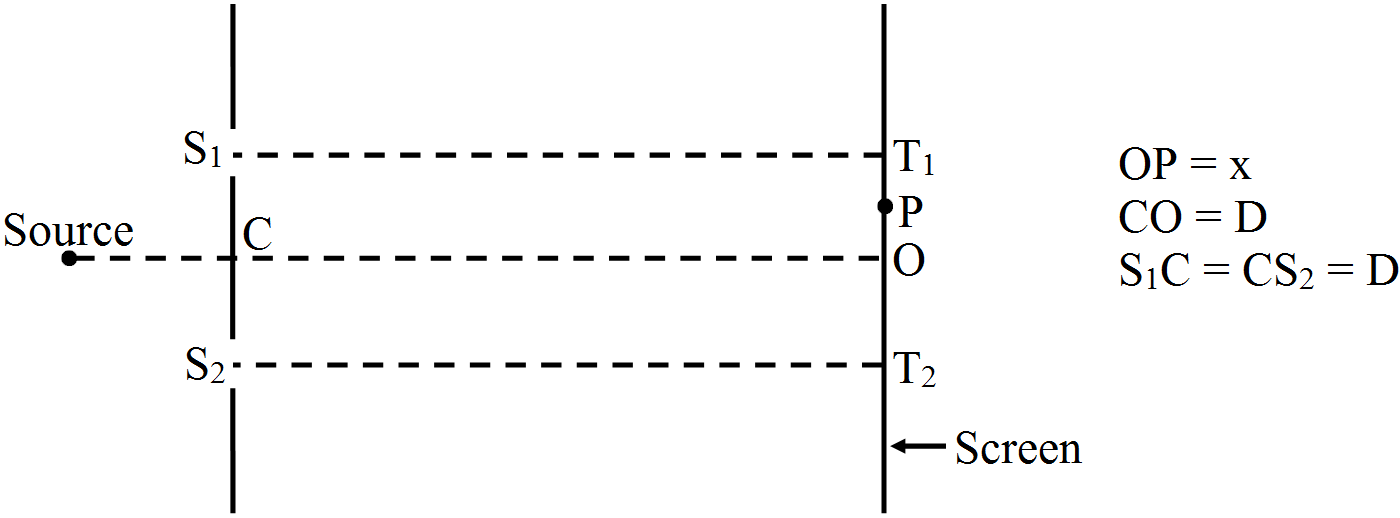
Question 353 Marks
Answer
$\text{T}_2\text{P}=\text{D}+\text{x},\text{T}_1\text{P}=\text{D}-\text{x}$
$\text{S}_1\text{P}=\sqrt{(\text{S}_1\text{T}_1)^2+(\text{P}\text{T}_1)^2}=[\text{D}^2+(\text{D}-\text{x}^2)]^\frac{1}{2}$
$\text{S}_2\text{P}=[\text{D}^2+\text{(D+x)}^2]^\frac{1}{2}$
Minima will occur when:
$[\text{D}^2+(\text{D}+\text{x})^2]^\frac{1}{2}-[\text{D}^2+(\text{D}-\text{x})^2]^\frac{1}{2}=\frac{\lambda}{2}$
$\text{if}\text{ x}=\text{D},(\text{D}^2+4\text{D}^2)^\frac{1}{2}-\text{D}=\frac{\lambda}{2}$
$\Rightarrow \text{D}(\sqrt5-1)=\frac{\lambda}{2}\Rightarrow\text{D}=\frac{\lambda}{2(\sqrt5-1)}$
View full question & answer
Question 363 Marks
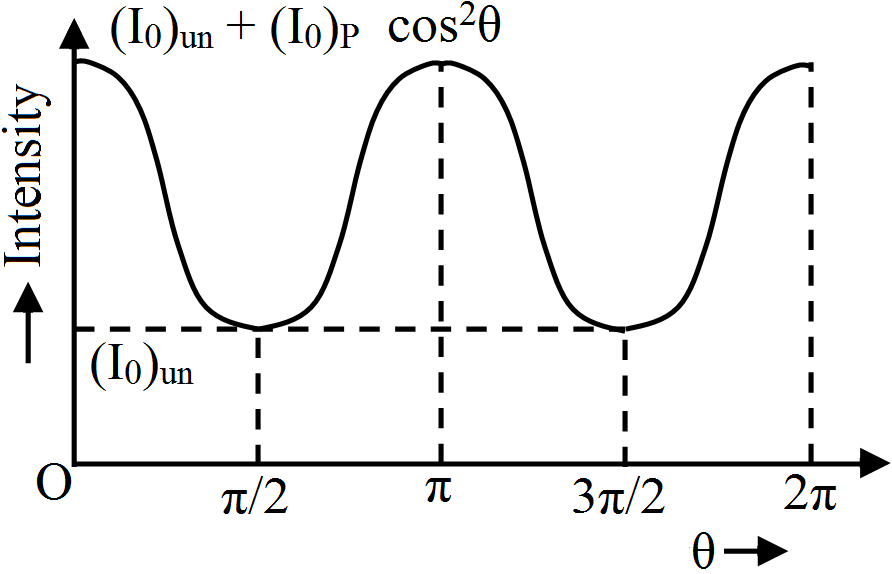
A partially plane polarised beam of light is passed through a Polaroid. Show graphically the variation of the transmitted light intensity with angle of rotation of the Polaroid.
Answer
The partially polarised beam consists of unpolarised plus polarised light. The intensity of unpolarised part varies according to.

$\text{I}_\text{p}=\text{(I}_0)_\text{p}\cos^2\theta$

$\therefore\text{I}=\text{(I}_0)_\text{un}+\text{(I}_0)_\text{p}\cos^2\theta$

The graph from $\theta=0\text{ to }\theta=2\pi$ (full rotation) is shown in fig.

View full question & answer
Question 373 Marks
The human eye has an approximate angular resolution of $\phi=5.8\times10^{-4}$ rad and a typical photoprinter prints a minimum of 300dpi (dots per inch, 1inch = 2.54cm). At what minimal distance z should a printed page be held so that one does not see the individual dots.
Answer
We are given that, angular resolution of human eye $(\phi)=5.8\times10^{-4}$ red.
The printer prints 300 dots per inch.
The linear distance (l) between two dots can be calculated as $\frac{2.54}{300}\text{cm.}$
$=0.84\times10^{-2}\text{cm}$
Now, at a distance of z cm, this subtends an angle, $\phi=\frac{\text{l}}{\text{Z}}$
Substituting $(\phi)=5.8\times10^{-4}\text{ red and }=0.84\times10^{-2}\text{cm}$, we get
$\text{Z}=\frac{0.84\times10^{-2}\text{cm}}{5.8\times10^{-4}}=14.5\text{cm}.$
View full question & answer
Question 383 Marks
Find the range of frequency of light that is visible to an average human being $(400\text{nm}<\lambda<700\text{nm}).$
Answer
Given that, $400\text{nm}<\lambda<700\text{nm}.$
$\frac{1}{700\text{nm}}<\frac{1}{\lambda}<\frac{1}{400\text{nm}}$
$\Rightarrow\frac{1}{7\times10^{-7}}<\frac{1}{\lambda}<\frac{1}{4\times10^{-7}}$ $\Rightarrow\frac{3\times10^8}{7\times10^{-7}}<\frac{\text{c}}{\lambda}<\frac{3\times10^8}{4\times10^{-7}}$ (Where, c = speed of light = 3 × 10⁸m/s)
$\Rightarrow4.3\times10^{14}<\frac{\text{c}}{\lambda}<7.5\times10^{14}$
$\Rightarrow4.3\times10^{14}\text{Hz}<\text{f}<7 .5\times10^{14}\text{Hz}.$
View full question & answer
Question 393 Marks
How does the resolving power of a compound microscope get affected on:
  1. Decreasing the diameter of its objective?
  2. Increasing the focal length of its objective?
Answer
Resolving limit of microscope $=\frac{\lambda}{2\text{n}\sin\theta} $
Resolving power $\alpha\frac{1}{\text{Resolving limit}}$
i.e., Resolving power $=\frac{2\text{n}\sin\theta}{\lambda}$
  1. When diameter of objective lens decreases, θ and hence sinθ decreases; so the resolving power decreases.
  2. The focal length of objective lens has no effect on resolving power of microscope.
View full question & answer
Question 403 Marks
Two identical coherent waves, each of intensity I, are producing an interference pattern. Find the value of the resultant intensity at a point of:
  1. Constructive interference.
  2. Destructive interference.
Answer
Resultant intensity at any point having a phase difference $\varphi$ is

$\text{I}_\text{R}=\text{I}_1+\text{I}_2+2\sqrt{\text{I}_1\text{I}_2}\cos\phi$

Here, $\text{I}_1=\text{I}_2=\text{I}$

$\therefore\text{I}_\text{R}=\text{I}_1+\text{I}_2+2\sqrt{\text{I}.\text{I}.}\cos\varphi=2\text{I}+2\text{I}\cos\varphi$

  1. At a point of constructive interference:

$\varphi=2\text{n}\pi(\text{n}=0,1,2,\dots)\Rightarrow\cos\varphi=1$

$\therefore\text{I}_\max=2\text{I}+2\text{I}=4\text{I}$

  1. At a point of denstructive interference:

$\Rightarrow\cos\varphi=0 $ 

$\therefore \text { I}_\min=\text{2I}-\text{2I}=0$

View full question & answer
Question 413 Marks
Suppose white light falls on a double slit but one slit is covered by a violet filter (allowing $\lambda=400\text{nm}$). Describe the nature of the fringe pattern observed.
Answer
The violet filter will allow only violet light to pass through it. Now, if the double slit experiment is performed with the white light and violet light, the fringe pattern will not be the same as obtained by just using white light as the source. To have interference pattern, the light waves entering from the slits should be monochromatic. So, in this case, the violet light will superimpose with only violet light (of wavelength 400nm) in such a way that the bright bands will be of violet colour and the minima will be completely dark.
View full question & answer
Question 423 Marks
If the separation between the slits in a Young's double slit experiment is increased, what happens to the fringe-width? If the separation is increased too much, will the fringe pattern remain detectable?
Answer
The fringe width in Young's double slit experiment depends on the separation of the slits.
$\text{x}=\frac{\lambda\text{D}}{\text{d}},$
where
$\lambda$ = wavelength
x = fringe width
D = distance between slits and screen
d = separation between slits
On increasing d, fringe width decreases. If the separation is increased too much, the fringes will merge with each other and the fringe pattern won't be detectable.
View full question & answer
Question 433 Marks
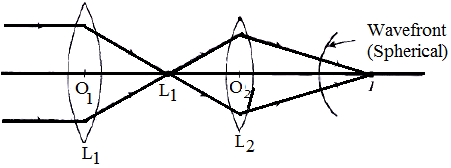
Consider a point at the focal point of a convergent lens. Another convergent lens of short focal length is placed on the other side. What is the nature of the wavefronts emerging from the final image?
Answer

Consider the ray diagram in which the point image I1 due to L1 is at the focal point. Now, we placed one more convergent lens of short focal length on the other side of lens L1. Let the final image formed is I which is also a point image. Hence, the wavefront for this image will be of spherical symmetry.
View full question & answer
Question 443 Marks
Is Huygen’s principle valid for longitudunal sound waves?
Answer

The point source propagates light in all directions symmetrically. Similarly, in case of any point source of sound wave, the disturbance due to the source propagates in spherical symmetry that is in all directions. The formation of wavefront is in accordance with Huygen's principle.
Hence, Huygen's principle is valid for longitudinal sound waves.
View full question & answer
Question 453 Marks
Can we perform Young's double slit experiment with sound waves? To get a reasonable "fringe pattern", what should be the order of separation between the slits? How can the bright fringes and the dark fringes be detected in this case?
Answer
Young's double slit experiment can be performed with sound waves, as the sound waves also show interference pattern. To get a reasonable 'fringe pattern", the separation of the slits should be of the order of the wavelength of the sound waves used.
In this experiment, the bright and dark fringes can be detected by measuring the intensity of sound using a microphone or any other detector.
View full question & answer
Question 463 Marks
A parallel beam of light of wavelength 600nm is incident normally on a slit of width ‘a’. If the distance between the slit and the screen is 0.8 and the distance of 2nd order maximum from the centre of the screen is 1.5mm, calculate the width of the slit.
Answer
Given: $\lambda=600\text{nm}=600\times10^{-9}\text{m}=6.0\times10^{-7}\text{m},\text{D}=0.8\text{m,}$
$\text{y}_2=1.5\text{mm}=1.5\times10^{-3}\text{m},\text{n}=2,\text{a=?}$
Position of nth maximum in diffraction of a single slit
$\text{y}_n=\text{(n}+\frac{1}{2})\frac{\lambda\text{D}}{\text{a}}\Rightarrow\text{a}=(\text{n}+\frac{1}{2})\frac{\lambda\text{D}}{\text{y}_\text{n}}$
Substituting given value $\text{a}=(2+\frac{1}{2})\frac{6.0\times10^{-7}\times0.8}{1.5\times10^{-3}}$
$\frac{5}2\times4.0\times0.8\times10^{-4}\text{m}=0.8\times10^{-3}=0.8\text{mm}.$
View full question & answer
Question 473 Marks
Two coherent waves of equal amplitude produce interference pattern in Young’s double slit experiment. What is the ratio of intensity at a point where phase difference is $\frac{\pi}{2}$ to intensity at centre?
Answer
$\text{I}_\frac{\pi}{2}=\text{a}^2_1+\text{a}^2_2+\text{2a}_1\text{a}_2\cos\varphi$
$=\text{a}^2+\text{a}^2+2\text{a}^2\cos\frac{\pi}{2}=2\text{a}^2$
$\text{I}_\max=(\text{a}_2+\text{a}_2)^2=(\text{a}+\text{a})^2=4\text{a}^2$
$\therefore\frac{\text{I}_\frac{\pi}{2}}{\text{I}_\max}=\frac{2\text{a}^2}{\text{4a}^2}=\frac{1}{2}.$
View full question & answer
Question 483 Marks
Two narrow slits emitting iight in phase are separated by a distance of 1.0cm. The wavelength of the light is 5.0 × 10⁻⁷m. The interference pattern is observed on a screen placed at a distance of 1.0m.
  1. Find the separation between the consecutive maxima. Can you expect to distinguish between these maxima?
  2. Find the separation between the sources which will give a separation of 1.0mm between the consecutive maxima.
Answer
Given that, d = 1cm = 10-2m, $\lambda=5\times10^{-7}\text{m}$ and D = 1m

  1. Separation between two consecutive maxima is equal to fringe width.

So, $\beta=\frac{\lambda\text{D}}{\text{d}}=\frac{5\times10^{-7}\times1}{10^{-2}}\text{m}=5\times10^{-5}\text{m}=0.05\text{mm}.$

  1. When, $\lambda=1\text{mm}=10^{-3}\text{m}$

$10^{-3}\text{m}=\frac{5\times10^{-7}\times1}{\text{D}}\Rightarrow\text{D}=5\times10^{-4}\text{m}=0.50\text{mm}.$

View full question & answer
Question 493 Marks
Why is the diffraction of sound waves more evident in daily experience than that of light wave?
Answer
The frequencies of sound waves lie between 20Hz to 20kHz, their wavelength ranges between 15m to 15mm. The diffraction occurs if the wavelength of waves is nearly equal to slit width.
The wavelength of light waves is 7000 × 10-10m to 4000 × 10-10m. For observing diffraction of light we need very narrow slit width. In daily life experience we observe the slit width very near to the wavelength of sound waves as compared to light waves. Thus, the diffraction of sound waves is more evident in daily life than that of light waves.
View full question & answer
Question 503 Marks
Find the ratio of intensities at two points on a screen in Young’s double slit experiment when waves from the two slits have a path difference of (i) 0 and (ii) $\frac{\lambda}{4}.$
Answer
Intesity $\text{I}=\text{a}^2_1+\text{a}^2_2+2\text{a}_1\text{a}_2\cos\varphi$
Let $\text{a}_1=\text{a}_2=\text{a}$ say, then
$\text{I}=\text{a}^2+\text{a}^2+2\text{a}^2\cos\varphi=2\text{a}^2(1+\cos\varphi)$
$\frac{\text{I}_1}{\text{I}_2}=\frac{1+\cos\phi_1}{1+\cos\phi_2}$
When path difference is 0, phase difference $\varphi_1=0$
When path difference $\frac{\lambda}{4},$ is phase difference $\phi_2=\frac{2\pi}{\lambda}\times\frac{\lambda}{4}=\frac{\pi}{2} $
$\therefore\frac{\text{I}_1}{\text{I}_2}\frac{1+\cos\phi_1}{1+\cos\frac{\pi}{2}}=\frac{1+1}{1}=\frac{2}{1}.$
View full question & answer
3 Marks Question - Physics STD 12 Science Questions - Vidyadip