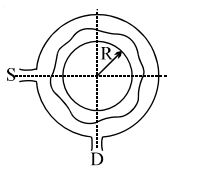
A narrow tube is bent in the form of a circle of radius $R,$ as shown in the figure. Two small holes $S$ and $D$ are made in the tube at the positions right angle to each other. A source placed at $S$ generated a wave of intensity $I_0$ which is equally divided into two parts : One part travels along the longer path, while the other travels along the shorter path. Both the part waves meet at the point $D$ where a detector is placed The maximum value of $\lambda$ to produce a minima at $D$ is given by
Advanced
Download our app for free and get started
Net path difference between the waves travelling through path I and II, $x =$
$\frac{3}{4} 2 \pi R-\frac{1}{4} 2 \pi R$
$\Rightarrow x=\pi R$
Let $\lambda$ be the wavelength of the waves.
Now for minima to occur at D, path difference $=\left( n +\frac{1}{2}\right) \lambda \quad$ where $n =$
$0,1,2, \ldots \ldots \ldots$
Thus $\frac{(2 n+1) \lambda}{2}=\pi R \Rightarrow \lambda=\frac{2 \pi R}{2 n+1}$
Now wavelength is maximum for $n =0$
Thus $\lambda_{\max }=2 \pi R$

Download our appand get started for free
Experience the future of education. Simply download our apps or reach out to us for more information. Let's shape the future of learning together!No signup needed.*
Similar Questions
- 1A standing wave is formed by the superposition of two waves travelling in opposite directions. The transverse displacement is given by $y\left( {x,t} \right) = 0.5\sin\, \left( {\frac{{5\pi }}{4}x} \right)\,\cos\, \left( {200\,\pi t} \right)$. What is the speed of the travelling wave moving in the positive $x$ direction .... $m/s$ ? ($x$ and $t$ are in meter and second, respectively.)View Solution
- 2View SolutionIf you set up the seventh harmonic on a string fixed at both ends, how many nodes and antinodes are set up in it
- 3View SolutionThe ratio of speed of sound in hydrogen gas to the speed of sound in oxygen gas at the same temperature is
- 4View SolutionThe particles of a medium vibrate about their mean positions whenever a wave travels through that medium. The phase difference between the vibrations of two such particles
- 5A man stands in front of a hillock and fires a gun. He hears an echo after $1.5\, sec$. The distance of the hillock from the man is ...... $m$ (velocity of sound in air is $330\, m/s$)View Solution
- 6The fundamental frequency of a closed organ pipe of length $20\; cm$ is equal to the second overtone of an organ pipe open at both the ends. The length of organ pipe open at both the ends is ...... $cm$View Solution
- 7A string is clamed at both the ends and it is vibrating in its $4^{th}$ harmonic. The equation of the stationary wave is $Y =0.3\,sin\,(0.157\,x) \,cos\,(200\pi t)$. The length of the string is ..... $m$ (all quantities are in $SI$ units)View Solution
- 8Two waves having equationsView Solution
${x_1} = a\sin (\omega \,t + {\phi _1})$, ${x_2} = a\sin \,(\omega \,t + {\phi _2})$
If in the resultant wave the frequency and amplitude remain equal to those of superimposing waves. Then phase difference between them is
- 9A car sounding a horn of frequency $ 1000 Hz$ passes an observer. The ratio of frequencies of the horn noted by the observer before and after passing of the car is $11 : 9$. If the speed of sound is v, the speed of the car isView Solution
- 10Regarding speed of sound in gas match the followingView Solution
$(A)$ Temperature of gas is made $4$ times and pressure $2$ times $(P)$ speed becomes $2\sqrt 2$ times $(B)$ Only pressure is made $4$ times without change in temperature $(Q)$ speed become $2$ times $(C)$ Only temperature is changed to $4$ times $(R)$ speed remains unchanged $(D)$ Molecular mass of the gas is made $4$ times $(S)$ speed remains half