A string is clamed at both the ends and it is vibrating in its $4^{th}$ harmonic. The equation of the stationary wave is $Y =0.3\,sin\,(0.157\,x) \,cos\,(200\pi t)$. The length of the string is ..... $m$ (all quantities are in $SI$ units)
JEE MAIN 2019, Medium
Download our app for free and get started
$4^{\text {th }}$ harmonic
$4 \frac{\lambda}{2}=\ell \quad ; 2 \lambda=\ell$
From equation $\frac{2 \pi}{\lambda}=0.157$
$\lambda=40 ; \quad \ell=2 \lambda=80 \mathrm{m}$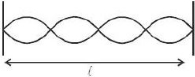

Download our appand get started for free
Experience the future of education. Simply download our apps or reach out to us for more information. Let's shape the future of learning together!No signup needed.*
Similar Questions
- 1The two interfering waves have intensities in the ratio $9 : 4$. The ratio of intensities of maxima and minima in the interference pattern will beView Solution
- 2A stationary sound source $'s'$ of frequency $334\,\, Hz$ and a stationary observer $'O'$ are placed near a reflecting surface moving away from the source with velocity $2\,\, m/sec$ as shown in the figure. If the velocity of the sound waves is air is $V = 330\,\, m/sec$, the apparent frequency of the echo is ... $Hz$View Solution

- 3Two waves are given by ${y_1} = a\sin (\omega t - kx)$ and ${y_2} = a\cos (\omega \,t - kx)$ The phase difference between the two waves isView Solution
- 4A pipe $17\, cm$ long is closed at one end. Which harmonic mode of the pipe resonates a $1.5\, kHz$ source ?View Solution
(Speed of sound in air $= 340\, m\, s^{-1}$) - 5The speed of a wave in a medium is $760\, m/s$. If $3600 $ waves are passing through a point, in the medium in $2$ minutes, then its wavelength is ...... $m$View Solution
- 6A tuning fork $A$ produces $4$ beats/sec with another tuning fork $B$ of frequency $320 Hz$. On filing the fork $A$, $4$ beats/sec are again heard. The frequency of fork $A$, after filing is ....$Hz$View Solution
- 7A stationary source is emitting sound at a fixed frequency $\mathrm{f}_0$, which is reflected by two cars approaching the source. The difference between the frequencies of sound reflected from the cars is $1.2 \%$ of $f_0$. What is the difference in the speeds of the cars (in $\mathrm{km}$ per hour) to the nearest integer? The cars are moving at constant speeds much smaller than the speed of sound which is $330 \mathrm{~ms}^{-1}$.View Solution
- 8Two sitar strings, $A$ and $B,$ playing the note $'Dha'$ are slightly out of tune and produce beats and frequency $5\,Hz.$ The tension of the string $B$ is slightly increased and the beat frequency is found to decrease by $3\,Hz$ . If the frequency of $A$ is $425\,Hz,$ the original frequency of $B$ is ... $Hz$View Solution
- 9A tuning fork $A$ of unknown frequency produces $5\, beats/s$ with a fork of known frequency $340\, Hz$. When fork $A$ is filed, the beat frequency decreases to $2\, beats/s.$ What is the frequency of fork $A$ ? (in $Hz$)View Solution
- 10View SolutionAt nodes in stationary waves