MCQ
A neutron makes a head-on elastic collision with a stationary deuteron. The fractional energy loss of the neutron in the collision is
  • A
    $16/81$
  • $8/9$
  • C
    $8/27$
  • D
    $2/3$

Answer

Correct option: B.
$8/9$
b
(b)Fractional decrease in kinetic energy of neutron
=$1 - {\left( {\frac{{{m_1} - {m_2}}}{{{m_1} + {m_2}}}} \right)^2}$[As $m_1=1$ and $m_2 = 2$]
$ = 1 - {\left( {\frac{{1 - 2}}{{1 + 2}}} \right)^2}$$ = 1 - {\left( {\frac{1}{3}} \right)^2} = 1 - \frac{1}{9} = \frac{8}{9}$

Need a full question paper?

Generate a complete, print-ready paper with questions like this in minutes — across 16+ boards, with answer keys.
Start Generating Free

Similar questions

If $\lambda_{ m }$ denotes the wavelength at which the radioactive emission from a black body at a temperature $T \;K$ is maximum, then
A missile is fired in horizontal direction from a height of $20\,m$ at a speed of $1000\, m/s.$ At what distance of ground will the missile land ?
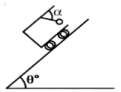
A trolley is falling freely on inclined plane as shown in the figure. The angle of string of pendulum with the ceiling of trolley is $(\alpha)$ equal to ..........
A particle of mass $m$ moves in a circular orbit under the central potential field, $U ( r )=\frac{- C }{ r }$, where $C$ is a positive constant

The correct radius - velocity graph of the particle's motion is:
A body projected along a frictionless inclined plane of angle of inclination $30^o$ covers a distance of $40\, m$ along the plane. If the body is projected with the same speed at angle of $30^o$ with the ground, it will have a range of : (Take $g = 10\, m/s^2$)
The damping force on an oscillator is directly proportional to the velocity.The units of the constant of proportionality are
If two waves having amplitudes $2A$ and $A$ and same frequency and velocity, propagate in the same direction in the same phase, the resulting amplitude will be
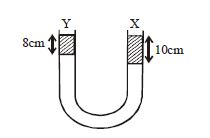
A liquid $X$ of density $3.36\  g/cm^3$ is poured in a $U-$ tube, which contains $Hg$. Another liquid $Y$ is poured in left arm with height $8\  cm$, upper levels of $X$ and $Y$ are same. What is density of $Y$ .......... $g/cc$
An overhead tank having some water possesses $..........$ energy.
To find the distance $d$ over which a signal can be seen clearly in foggy conditions, a railways engineer uses dimensional analysis and assumes that the distance depends on the mass density $\rho$ of the fog, intensity (power/area) $S$ of the light from the signal and its frequency $f$. The engineer find that $d$ is proportional to $S ^{1 / n}$. The value of $n$ is: