Question
A neutron moving with a speed $υ$ strikes a hydrogen atom in ground state moving towards it with the same speed. Find the minimum speed of the neutron for which inelastic $($completely or partially$)$ collision may take place. The mass of neutron $=$ mass of hydrogen $= 1.67 \times 10^{-27}kg$.
Answer

Energy of the neutron is $\frac{1}{2}\text{mv}^2$
The condition for inelastic collision is,
$\frac{1}{2}\text{mv}^2>2\Delta\text{E}$
$\Delta\text{E}=\frac{1}{2}\text{mv}^2$
$\Delta\text{E}$ is the energy absorbed.
Energy required for first excited state is $10.2ev.$
$\therefore\ \Delta\text{E}<10.2\text{ev}$
$\therefore10.2\text{ev}<\frac{1}{2}\text{mv}^2$
$\text{V}_\text{min}=\sqrt{\frac{4\times10.2}{\text{m}}}\text{ev}$
$\therefore\text{v}=\sqrt{\frac{10.2\times1.6\times10^{-19}\times4}{1.67\times10^{-27}}}=6\times10^4\text{m/sec}$

Need a full question paper?

Generate a complete, print-ready paper with questions like this in minutes — across 16+ boards, with answer keys.

Start Generating Free

Similar questions

Consider a wire of length $4m$ and cross$-$sectional area $1\ mm^2$ carrying a current of $2A$. If each cubic metre of the material contains $10^{29}$ free electrons, find the average time taken by an electron to cross the length of the wire.
Three bulbs, each with a resistance of $180\Omega,$ are connected in parallel to an ideal battery of emf 60V. Find the current delivered by the battery when.
(a) all the bulbs are switched on, (b) two of the bulbs are switched on and (c) only one bulb is switched on.
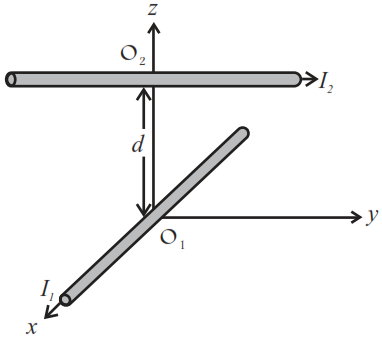
Two long wires carrying current $I_1$ and $I_2$ are arranged as shown in Fig. The one carrying current $I_1$ is along is the $x-$axis. The other carrying current $I_2$ is along a line parallel to the $y-$axis given by $x = 0$ and $z = d.$ Find the force exerted at $O_2$  because of the wire along the $x-$axis.
What will be the energy corresponding to the first excited state of a hydrogen atom if the potential energy of the atom is taken to be $10eV$ when the electron is widely separated from the proton? Can we still write $\text{E}_\text{n}=\frac{\text{E}_1}{\text{n}^2}?\text{ r}_\text{n}=\text{a}_0\text{n}^2?$
Two charges $2.0 \times 10^{-6}C$ and $1.0 \times 10^{-6}C$ are placed at a separation of $10\ cm$. Where should a third charge be placed such that it experiences no net force due to these charges?
Source of magnetic field is not only electric current generated due to flow of charge but also rate of change of displacement vector or electric field vector with time. Justify the statement and prove that$i=i_c+i_d=i_c+\epsilon_0 \frac{d \phi_{E}}{d t}$
Consider a non-conducting plate of radius r and mass m that has a charge q distributed uniformly over it. The plate is rotated about its axis with an angular speed $\omega.$ Show that the magnetic moment $\mu$ and the angular momentum of the plate are related as $\mu=\frac{\text{q}}{2\text{m}}\text{l}.$
The radius of a gold nucleus $(Z = 79)$  is about $7.0 \times 10^{-15}m$. Assume that the positive charge is distributed uniformly throughout the nuclear volume. Find the strength of the electric field at:
  1. The surface of the nucleus.
  2. At the middle point of a radius. Remembering that gold is a conductor, is it justified to assume that the positive charge is uniformly distributed over the entire volume of the nucleus and does not come to the outer surface
Two monochromatic beams $A$ and $B$ of equal intensity I, hit a screen. The number of photons hitting the screen by beam A is twice that by beam $B$. Then what inference can you make about their frequencies?