Question
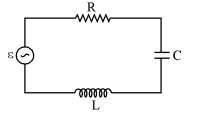
✓
Answer
Given : $L =5.0 H , C =80 \mu F=80 \times 10^{-6} F$$R =40 \Omega, E _{ rms }=230 V$
(a) Frequency f of the source which will cause reso-nance in the circuit
$f=f_r=\frac{1}{2 \pi \sqrt{ LC }}$
$f=f_r=\frac{1 \times 7}{2 \times 22 \sqrt{5.0 \times 80 \times 10^{-6}}}$
$=\frac{7}{2 \times 22 \times 20 \times 10^{-3}}$
$=\frac{7000}{880}=\frac{175}{22} Hz$
Hence, $\quad \omega_r=2 \pi f_r$
$=2 \times \frac{22}{7} \times \frac{175}{22}=50 rad s ^{-1}$
(b) Let the impedance at resonance be $Z$.
$Z=\sqrt{R^2+\left(\omega L-\frac{1}{\omega C}\right)^2}$
At resonance, $\omega=\omega_r$
and$\omega L=\frac{1}{\omega C}$
$\therefore \quad Z=R=40 \Omega$
$I_{ rms }=\frac{E_{ rms }}{Z}=\frac{E_{ rms }}{R}=\frac{230}{40}=5.75 A$
Amplitude of current at resonant frequency
$I_{rms}=\frac{I_0}{\sqrt{2}}$
$\therefore \quad I _0= I _{ rms } \sqrt{2}$
$=5.75 \times \sqrt{2} A$
$=8.13 A=8.1 A$.
(c) Potential drop across the ends of resistor
$V_R=I_{r m s} R$
$=5.75 \times 40=230 V$
Potential drop across the ends of L
$V_{r m s}=I_{r m s} X_L$
$= I _{ rms } \times \omega_{,} L$
$=5.75 \times 50 \times 5.0$
$V _{ rms }=1437.5 V$
In the same way, potential drop across the ends of capacitor
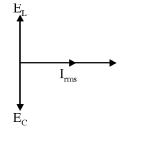
$= I _{ rms } \times X _{ C }$
$= I _{ rms } \times \frac{1}{\omega_r C }$"
$=5.75 \times \frac{1}{50 \times 80 \times 10^{-6}}$
$V _{ rms }=1437.5 V$
Potential drop across the ends of C = Potential difference across the endsL. $E _{ L }$ of and $E _{ C }$ are equal and opposite.
Hence magnitude of potential drop across the combination of LC combination is zero at resonant frequency.
(a) Frequency f of the source which will cause reso-nance in the circuit
$f=f_r=\frac{1}{2 \pi \sqrt{ LC }}$
$f=f_r=\frac{1 \times 7}{2 \times 22 \sqrt{5.0 \times 80 \times 10^{-6}}}$
$=\frac{7}{2 \times 22 \times 20 \times 10^{-3}}$
$=\frac{7000}{880}=\frac{175}{22} Hz$
Hence, $\quad \omega_r=2 \pi f_r$
$=2 \times \frac{22}{7} \times \frac{175}{22}=50 rad s ^{-1}$
(b) Let the impedance at resonance be $Z$.
$Z=\sqrt{R^2+\left(\omega L-\frac{1}{\omega C}\right)^2}$
At resonance, $\omega=\omega_r$
and$\omega L=\frac{1}{\omega C}$
$\therefore \quad Z=R=40 \Omega$
$I_{ rms }=\frac{E_{ rms }}{Z}=\frac{E_{ rms }}{R}=\frac{230}{40}=5.75 A$
Amplitude of current at resonant frequency
$I_{rms}=\frac{I_0}{\sqrt{2}}$
$\therefore \quad I _0= I _{ rms } \sqrt{2}$
$=5.75 \times \sqrt{2} A$
$=8.13 A=8.1 A$.
(c) Potential drop across the ends of resistor
$V_R=I_{r m s} R$
$=5.75 \times 40=230 V$
Potential drop across the ends of L
$V_{r m s}=I_{r m s} X_L$
$= I _{ rms } \times \omega_{,} L$
$=5.75 \times 50 \times 5.0$
$V _{ rms }=1437.5 V$
In the same way, potential drop across the ends of capacitor
$= I _{ rms } \times X _{ C }$
$= I _{ rms } \times \frac{1}{\omega_r C }$"
$=5.75 \times \frac{1}{50 \times 80 \times 10^{-6}}$
$V _{ rms }=1437.5 V$
Potential drop across the ends of C = Potential difference across the endsL. $E _{ L }$ of and $E _{ C }$ are equal and opposite.
Hence magnitude of potential drop across the combination of LC combination is zero at resonant frequency.
Need a full question paper?
Generate a complete, print-ready paper with questions like this in minutes — across 16+ boards, with answer keys.
Explore more
Similar questions
Write the mathematical relation for the resistivity of a material in terms of relaxation time, number density, mass and charge of charge carriers in it. Explain using this relation, why the resistivity of a metal increases and that of a semiconductor decreases with rise in temperature.
The bob of a simple pendulum has a mass of $40g$ and a positive charge of $4.0 \times 10^{-6}C$. It makes $20$ oscillations in $45s$. A vertical electric field pointing upward and of magnitude $2.5 \times 10^4NC^{-1}$ is switched on. How much time will it now take to complete $20$ oscillations?
→An electric kettle used to prepare tea, takes $2$ minutes to boil $4$ cups of water $(1$ cup contains $200cc$ of water$)$ if the room temperature is $25C.$
→- If the cost of power consumption is $Rs. 1.00$ per unit $(1$ unit $- 1000$ watt$-$hour$),$ calculate the cost of boiling $4$ cups of water.
- What will be the corresponding cost if the room temperature drops to $5^\circ C?$
A circular coil of 200 turns has a radius of 10cm and carries a current of 2.0A.
→- Find the magnitude of the magnetic field. B at the centre of the coil.
- At what distance from the centre along the axis of the coil will the field B drop to half its value at the centre? $\big(\sqrt[3]{4}=1.5874\ ...\big)$
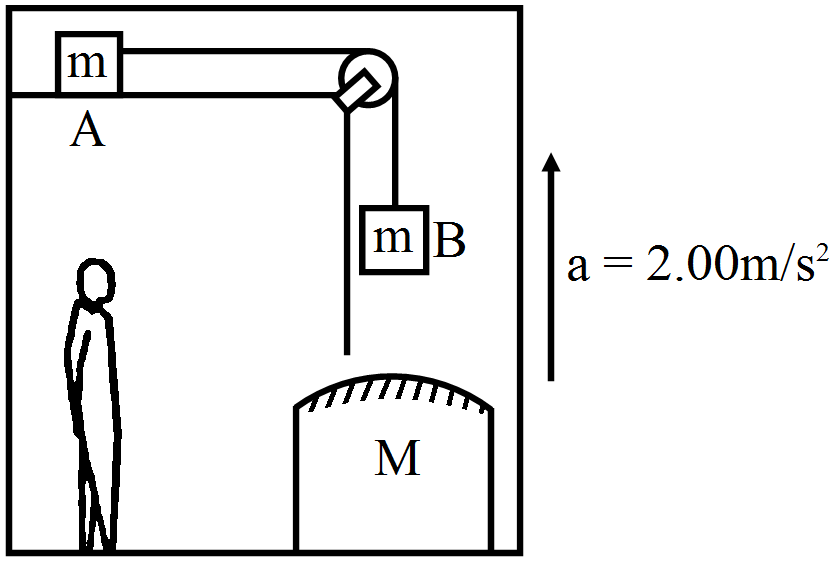
Consider the situation shown in figure. The elevator is going up with an acceleration of $2.00m/s^2$ and the focal length of the mirror is $12.0\ cm$. All the surfaces are smooth and the pulley is light. The mass$-$pulley system is released from rest $($with respect to the elevator$)$ at $t = 0$ when the distance of $B$ from the mirror is $42.0\ cm$. Find the distance between the image of the block $B$ and the mirror at $t = 0.200s$. Take $g = 10m/s^2.$
→Answer the following Questions.
An electric dipole is held in a uniform electric field. (i) Using suitable diagram show that it does not undergo any translatory motion, and (ii) derive an expression for torque acting on it and specify its direction.
→- Find expressions for the force and torque on an electric dipole kept in a uniform electric field.
An electric dipole is held in a uniform electric field. (i) Using suitable diagram show that it does not undergo any translatory motion, and (ii) derive an expression for torque acting on it and specify its direction.
- Derive an expression for the work done in rotating a dipole from the angle $\theta_0$ to $\theta_1$ in a uniform electric field E.
- Define torque acting on a dipole of dipole moment $\vec{\text{p}}$ placed in a uniform electric field $\vec{\text{E}}.$ Express it in the vector form and point out the direction along which it acts.
- What happens if the field is non-uniform?
- What would happen if the external field $\vec{\text{E}}$ is increasing (i) parallel to $\vec{\text{p}}$ and (ii) anti-parallel to $\vec{\text{p}}?$
Differentiate between interference and diffraction.
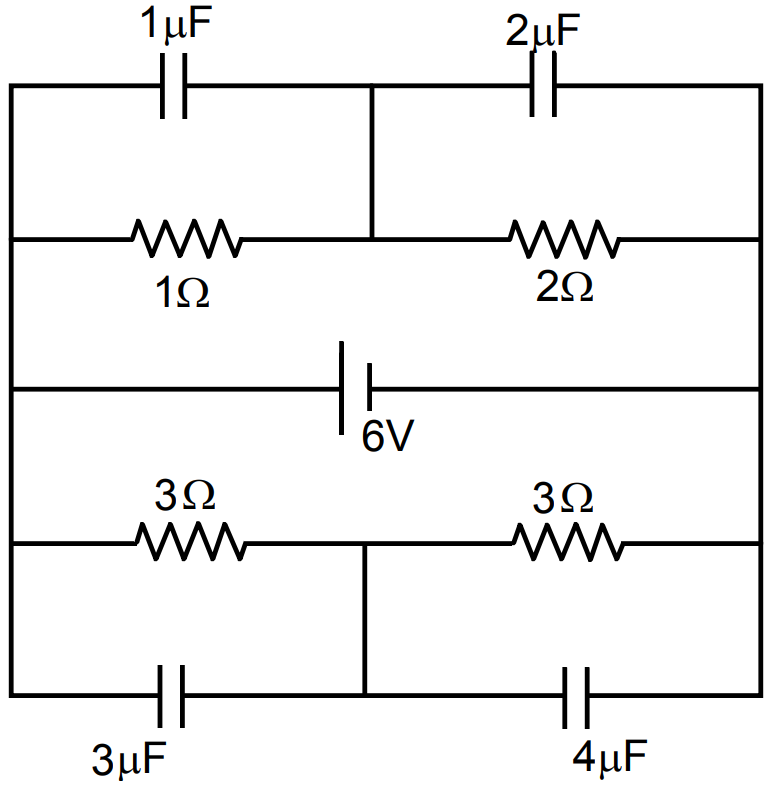
Find the charges on the four capacitors of capacitances $1\mu\text{F},2\mu\text{F},3\mu\text{F}$ and $4\mu\text{F}$ shown in the figure.
→A person with a normal near point (25 cm) using a compound microscope with objective of focal length 8.0 mm and an eyepiece of focal length 2.5 cm can bring an objective placed at 9.0 mm from the objective in sharp focus. What is the separation between the two lenses? Calculate the magnifying power of the microscope.
$a.$ Draw the diagram of a device which is used to decrease high ac voltage into a low ac voltage and state its working principle. Write four sources of energy loss in this device.
$b.$ A small town with a demand of $1200 \ kW$ of electric power at $220 \ V$ is situated $20 \ km$ away from an electric plant generating power at $440 \ V$ . The resistance of the two wire line carrying power is $0.5 \Omega\text{ per \ km}$. The town gets the power from the line through a $4000-220 V$ step $-$ down transformer at a sub$-$station in the town. Estimate the line power loss in the form of heat
→$b.$ A small town with a demand of $1200 \ kW$ of electric power at $220 \ V$ is situated $20 \ km$ away from an electric plant generating power at $440 \ V$ . The resistance of the two wire line carrying power is $0.5 \Omega\text{ per \ km}$. The town gets the power from the line through a $4000-220 V$ step $-$ down transformer at a sub$-$station in the town. Estimate the line power loss in the form of heat