MCQ
A $p-$type semiconductor is:
  • A
    Positively charged.
  • B
    Negatively charged.
  • Uncharged.
  • D
    Uncharged at $0K$ but charged at higher ternperatures.

Answer

Correct option: C.
Uncharged.

A $p-$type semiconductor is formed by doping a pure semiconductor with a $p-$type material. As impurity atoms take the position of the germanium atom in a germanium crystal, three electrons of a $p-$type material form covalent bonds by sharing electrons with three neighbouring germanium atoms. However, the fourth covalent bond is left incomplete, with a want of one electron. This creates a hole. As the atom as a whole is neutral, the $p-$type material is also neutral.

Need a full question paper?

Generate a complete, print-ready paper with questions like this in minutes — across 16+ boards, with answer keys.
Start Generating Free

Similar questions

Coulomb's Law is true for:
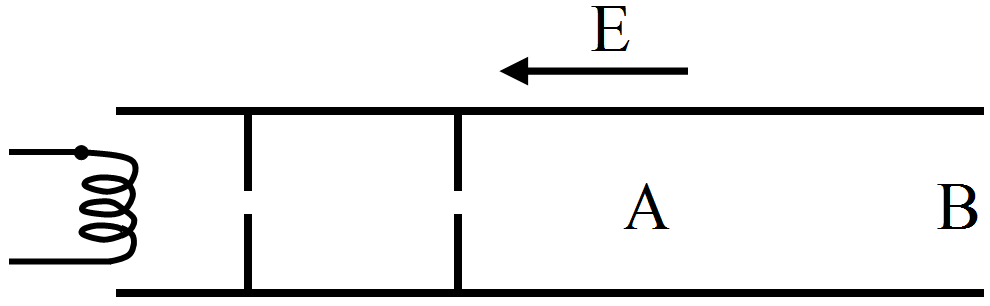
Electrons are emitted by a hot filament and are accelerated by an electric field, as shown in the figure. The two stops at the left ensure that the electron beam has a uniform cross-section.
Two long straight wires are placed along $x$-axis and $y$-axis. They carry current $I_1$ and $I_2$ respectively. The equation of locus of zero magnetic induction in the magnetic field produced by them is
When a lamp is connected in series with capacitor, then
This question has Statement $-1$ and Statement $-2$. Of the four choices given after the Statements, choose the one that best describes the two Statements.

Statement $1$ : Very large size telescopes are reflecting telescopes instead of refracting telescopes.

Statement $2$ : It is easier to provide mechanical support to large size mirrors than large size lenses.

Time taken by light to travel in two different materials $A$ and $B$ of refractive indices $\mu_{A}$ and $\mu_{B}$ of same thickness is $t_{1}$ and $t_{2}$ respectively. If $t_{2}-t_{1}=5 \times 10^{-10}$ s and the ratio of $\mu_{A}$ to $\mu_{B}$ is $1: 2$. Then the thickness of material, in meter is: (Given $v_{A}$ and $v_{B}$ are velocities of light in $A$ and $B$ materials respectively).
In a photoelectric experiment ultraviolet light of wavelength $280\, {nm}$ is used with lithium cathode having work function $\phi=2.5\, {eV}$. If the wavelength of incident light is switched to $400\, {nm}$, find out the change in the stopping potential (in ${V}$).

$\left({h}=6.63 \times 10^{-34}\, {J} \cdots\right.$, $\left.{c}=3 \times 10^{8} \,{ms}^{-1}\right)$ 

For goldplating on a copper chain, the substance required in the form of solution is
Two infinitely long parallel wires carry equal current in same direction. The magnetic field at a mid point in between the two wires is
For two statements are given-one labelled Assertion $(A)$ and the other labelled Reason $(R)$. Select the correct answer to these questions from the codes $(a), (b), (c)$ and $(d)$ as given below.
Assertion $(A)$: If a point charge q is placed in front of an infinite grounded conducting plane surface, the point charge will experience a force.
Reason $(R)$: This force is due to the induced charge on the conducting surface which is at zero potential.