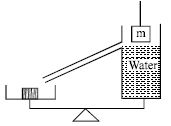
A pan balance has a container of water with an overflow spout on the right-hand pan as shown. It is full of water right up to the overflow spout. A container on the left-hand pan is positioned to catch any water that overflows. The entire apparatus is adjusted so that it’s balanced. A brass weight on the end of a string is then lowered into the water, but not allowed to rest on the bottom of the container. What happens next ?
Medium


Download our appand get started for free
Experience the future of education. Simply download our apps or reach out to us for more information. Let's shape the future of learning together!No signup needed.*
Similar Questions
- 1A ball of mass $m$ and radius $ r $ is gently released in a viscous liquid. The mass of the liquid displaced by it is $m' $ such that $m > m'$. The terminal velocity is proportional toView Solution
- 2An object is located at $2\, km$ beneath the surface of the water. If the fractional compression $\frac{\Delta V }{ V }$ is $1.36\, \%,$ the ratio of hydraulic stress to the corresponding hydraulic strain will be ......... . [Given : density of water is $1000\, kg m ^{-3}$ and $\left. g =9.8 \,ms ^{-2} .\right]$View Solution
- 3A small drop of water falls from rest through a large height $h$ in air; the final velocity is ................View Solution
- 4$A U-$ tube having horizontal arm of length $20$ $cm$, has uniform cross-sectional area $=1\ cm^2$. It is filled with water of volume $60$ $cc$. What volume of a liquid of density $4$ $g/cc$ should be poured from one side into the $U -$ tube so that no water is left in the horizontal arm of the tube ........ $cc$ ?View Solution
- 5Force in Column - $\mathrm{I}$ and its use is in Column - $\mathrm{II}$ are given. Match them appropriately.View Solution
Column - $\mathrm{I}$ Column - $\mathrm{II}$ $(a)$ Cohesive force $(i)$ Useful for writing by chalk on blackboard. $(b)$ Adhesive force $(ii)$ Useful in soldering. $(iii)$Useful for formation of spherical drops of liquid. - 6Two solids $A$ and $ B$ float in water. It is observed that $A$ floats with $\frac{1}{2}$ of its body immersed in water and $ B$ floats with $\frac{1}{4}$ of its volume above the water level. The ratio of the density of $ A$ to that of $B$ isView Solution
- 7There is a hole of area $A$ at the bottom of cylindrical vessel. Water is filled up to a height $ h$ and water flows out in $ t $ second. If water is filled to a height $4h,$ it will flow out in time equal toView Solution
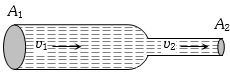
- 8A liquid flows in a tube from left to right as shown in figure. ${A_1}$ and ${A_2}$ are the cross-sections of the portions of the tube as shown. Then the ratio of speeds ${v_1}/{v_2}$ will beView Solution
- 9A small metal sphere of radius $a$ is falling with a velocity $v$ through a vertical column of a viscous liquid. If the coefficient of viscosity of the liquid is $\eta $ , then the sphere encounters an opposing force ofView Solution
- 10A cyclindrical vessel of cross-sectional area $1000$ $cm^2$, is fitted with a frictionless piston of mass $10$ $kg$, and filled with water completely.A small hole of cross-sectional area $10$ $mm^2$ is opened at a point $50$ $cm$ deep from the lower surface of the piston. The velocity of efflux from the hole will be ........... $m/s$View Solution