Question
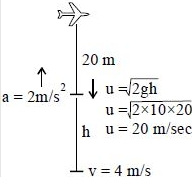
A parachutist after bailing out falls $20\,\,m$ without friction. When parachute opens, it decelerates at $2\,\,m/s^2.$  He reached the ground with a speed with a speed of $4\,\,m/s.$  At what height, did he bail out ?......$m$

Answer

$\mathrm{h}=\frac{\mathrm{u}^{2}-\mathrm{v}^{2}}{2 \mathrm{a}}$

$\mathrm{h}=\frac{400-16}{4}=\frac{384}{4}$

$h=96 \mathrm{m}$

$\mathrm{H}=20+96=116 \mathrm{m}$
Need a full question paper?

Generate a complete, print-ready paper with questions like this in minutes — across 16+ boards, with answer keys.

Start Generating Free

Similar questions

The minimum kinetic energy needed by an alpha particle to cause the nuclear reaction ${ }_7^{16} N +{ }_2^4 He \rightarrow{ }_1^1 H +{ }_8^{19} O$ in a laboratory frame is $n$ (in $MeV$. Assume that ${ }_7^{16} N$ is at rest in the laboratory frame. The masses of ${ }_7^{16} N ,{ }_2^4 He ,{ }_1^1 H$ and ${ }_8^{19} O$ can be taken to be $16.006 u, 4.003 u$, $1.008 u$ and $19.003 u$, respectively, where $1 u=930 MeVc ^{-2}$. The value of $n$ is. . . . .
Two identical cylindrical vessels are kept on the ground and each contain the same liquid of density $d.$ The area of the base of both vessels is $S$ but the height of liquid in one vessel is $x_{1}$ and in the other, $x_{2}$. When both cylinders are connected through a pipe of negligible volume very close to the bottom, the liquid flows from one vessel to the other until it comes to equilibrium at a new height. The change in energy of the system in the process is
In the following sequence of reactions :

Toluene $\xrightarrow{{KMn{O_4}}}A\xrightarrow{{SOC{l_2}}}$ $B\xrightarrow[{BaS{O_4}}]{{{H_2}/Pd}}C$

the product $C$ is :
When a glass rod is rubbed with silk, it
A particle of charge $1\  \mu C\  \&\  mass$ $1\  gm$ moving with a velocity of $4\  m/s$ is subjected to a uniform electric field of magnitude $300\  V/m$ for $10\  sec$. Then it's final speed cannot be.......$m/s$
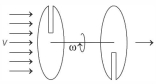
Two parallel discs are connected by a rigid rod of length $L=0.5 \,m$ centrally. Each disc has a slit oppositely placed as shown in the figure. A beam of neutral atoms are incident on one of the discs axially at different velocities $v$, while the system is rotated at angular speed of $600 \,rev / second$, so that atoms only with a specific velocity emerge at the other end. Calculate the two largest speeds (in metre/second) of the atoms that will emerge at the other end.
Which one of the following have minimum wavelength
The two vectors $\vec A$ and $\vec B$ that are parallel to each other are
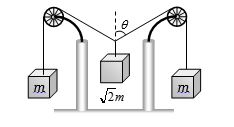
The pulleys and strings shown in the figure are smooth and of negligible mass. For the system to remain in equilibrium, the angle $\theta $should be ........ $^o$
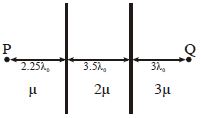
An electromagnetic wave of wavelength $\lambda_0$ (in vacuum) passes from $P$ towards $Q$ crossing three different media of refractive index $\mu, 2 \mu$ and $3 \mu$ respectively as shown in figure. $\phi_P$ and $\phi_Q$ be the phase of the wave at points $P$ and $Q$. Find the phase difference $\phi_Q - \phi_P$. [Take : $\mu =1$]