MCQ
Which one of the following have minimum wavelength
  • A
    Ultraviolet rays
  • Cosmic rays
  • C
    X-rays
  • D
    $\gamma - $rays

Answer

Correct option: B.
Cosmic rays
b
(b) cosmic Rays $10^{-14} \mathrm{m}$ to $10^{-12} \mathrm{m}$

$\gamma$ Rays $10^{-12} m$ to $10^{-10} m$

$x$ Rays $10^{-10} \mathrm{m}$ to $10^{-09} \mathrm{m}$

Ultraviolet Rays $10^{-07} \mathrm{m}$ to $4 \times 10^{-07} \mathrm{m}$

Hence, cosmic Rays have smallest wavelength.

Need a full question paper?

Generate a complete, print-ready paper with questions like this in minutes — across 16+ boards, with answer keys.
Start Generating Free

Similar questions

A convex lens and a concave lens, each having same focal length of $25\,\, cm,$ are put in contact to form a combination of lenses. The power in diopters of the combination is 
As a result of interference of two coherent sources of light, energy is
Two monochromatic light waves of amplitudes $3A$ and $2A$ interfering at a point have a phase difference of $60^o$. The intensity at that point will be proportional to.......$A^2$
Seven capacitors each of capacity $2\,\mu F$ are to be so connected to have a total capacity $\frac{{10}}{{11}}\,\mu F$. Which will be the necessary figure as shown
The quantities which have the same dimensions as those of solid angle are:
A block slides down an inclined plane of slope of angle $\theta $ with a constant velocity. It is then projected up the plane with an initial velocity $u$. The distance upto which it will rise before coming to rest is
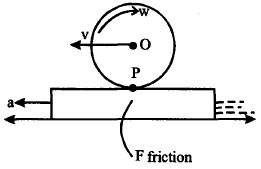
Consider a cylinder of mass $M$ resting on a rough horizontal rug that is pulled out from under it with acceleration $'a'$ perpendicular to the axis of the cylinder. What is $F_{friction}$ at point $P$ ? It is assumed that the cylinder does not slip
Moment of inertia of a square plate of side $l$ about the axis passing through one of the corner and perpendicular to the plane of square plate is given by
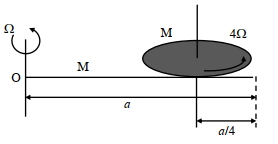
A thin rod of mass $M$ and length $a$ is free to rotate in horizontal plane about a fixed vertical axis passing through point $O$. A thin circular disc of mass $M$ and of radius $a / 4$ is pivoted on this rod with its center at a distance $a / 4$ from the free end so that it can rotate freely about its vertical axis, as shown in the figure. Assume that both the rod and the disc have uniform density and they remain horizontal during the motion. An outside stationary observer finds the rod rotating with an angular velocity $\Omega$ and the disc rotating about its vertical axis with angular velocity $4 \Omega$. The total angular momentum of the system about the point $O$ is $\left(\frac{ M a^2 \Omega}{48}\right) n$. The value of $n$ is. . . . .
Which sequence represents the best synthesis of hexanal ?

$\underset{Hexanal}{\mathop{C{{H}_{3\text{ }}}C{{H}_{2}}C{{H}_{2}}C{{H}_{2}}C{{H}_{2}}CH=O}}\,$