A parallel beam of light of 500 nm falls on a narrow slit and the resulting diffraction pattern is observed on a screen 1 m away. It is observed that the first minimum is at a distance of 2.5 mm from the centre of the screen. Calculate the width of the slit.
CBSE OUTSIDE DELHI - SET 1 2013
Download our app for free and get started
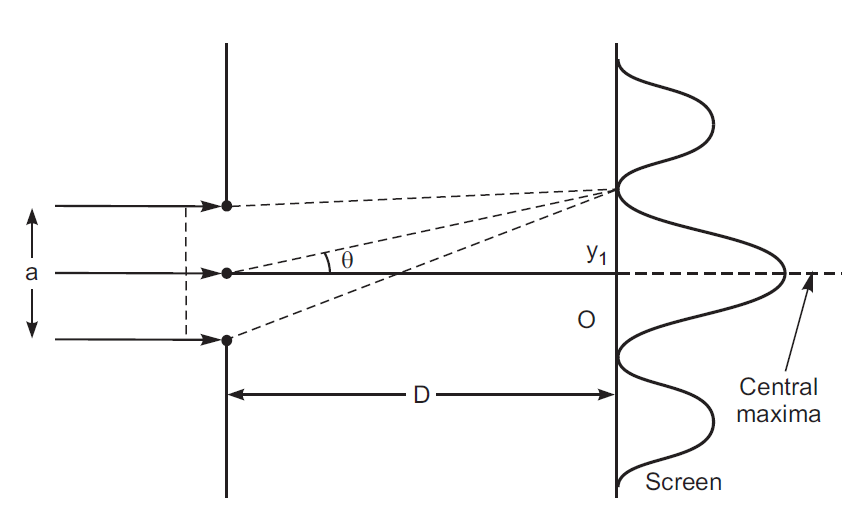
Hint: From condition of diffraction, $\sin\theta = \text{n}\lambda\text{ (for minima) }$ $ = \bigg(\text{n} + \frac{1}{2}\bigg)\lambda\text{ for maxima}$ Provided n =1, 2, 3... and n =0 for central maxima,From condition of minima
$\text{a}\sin\theta = \lambda$ (n =1)
Since the value of $\lambda$ is of nm, so $\text{a},\theta = \lambda$ $\text{a}.\frac{\text{y}}{\text{D}} = \lambda$ $\bigg[\text{angle} = \frac{\text{arc}}{\text{radius}}\bigg]$ $\therefore\text{a} = \frac{\lambda\text{D}}{\text{y}}$ $\text{a} =\frac{500\times10^{-9}\times1}{2.5\times10^{-3}}\text{m} =2x10^{-4}\ m.$

Download our appand get started for free
Experience the future of education. Simply download our apps or reach out to us for more information. Let's shape the future of learning together!No signup needed.*
Similar Questions
- 1View SolutionIf we put a cardboard (say 20cm × 20cm) between a light source and our eyes, we can't see the light. But when we put the same cardboard between a sound source and our ear, we hear the sound almost clearly. Explain.
- 2View SolutionDefine the term ‘linearly polarised light’.
When’ does the intensity of transmitted light become maximum, when a polaroid sheet is rotated between two crossed polaroids? - 3View SolutionThe separation between the consecutive dark fringes in a Young's double slit experiment is 1.0mm. The screen is placed at a distance of 2.5m from the slits and the separation between the slits is 1.0mm. Calculate the wavelength of light used for the experiment.
- 4View SolutionIn double-slit experiment using light of wavelength 600 nm, the angular width of a fringe formed on a distant screen is 0.1º. What is the spacing between the two slits?
- 5View SolutionA source emitting light of wavelengths 480nm and 600nm is used in. a double slit interference experiment. The separation between the slits is 0.25mm and the interference is observed on a screen placed at 150cm from the slits. Find the linear separation between the first maximum (next to the central maximum) corresponding to the two wavelengths.
- 6An equilateral glass prism has a refractive index 1.6 in air. Calculate the angle of minimum deviation of the prism, when kept in a medium of refractive index $\frac{4\sqrt2}{5}.$View Solution
- 7View SolutionA parallel beam of light of wavelength 500 nm falls on a narrow slit and the resulting diffraction pattern is observed on a screen 1 m away. It is observed that the first minimum is at a distance of 2.5 mm from the centre of the screen. Find the width of the slit.
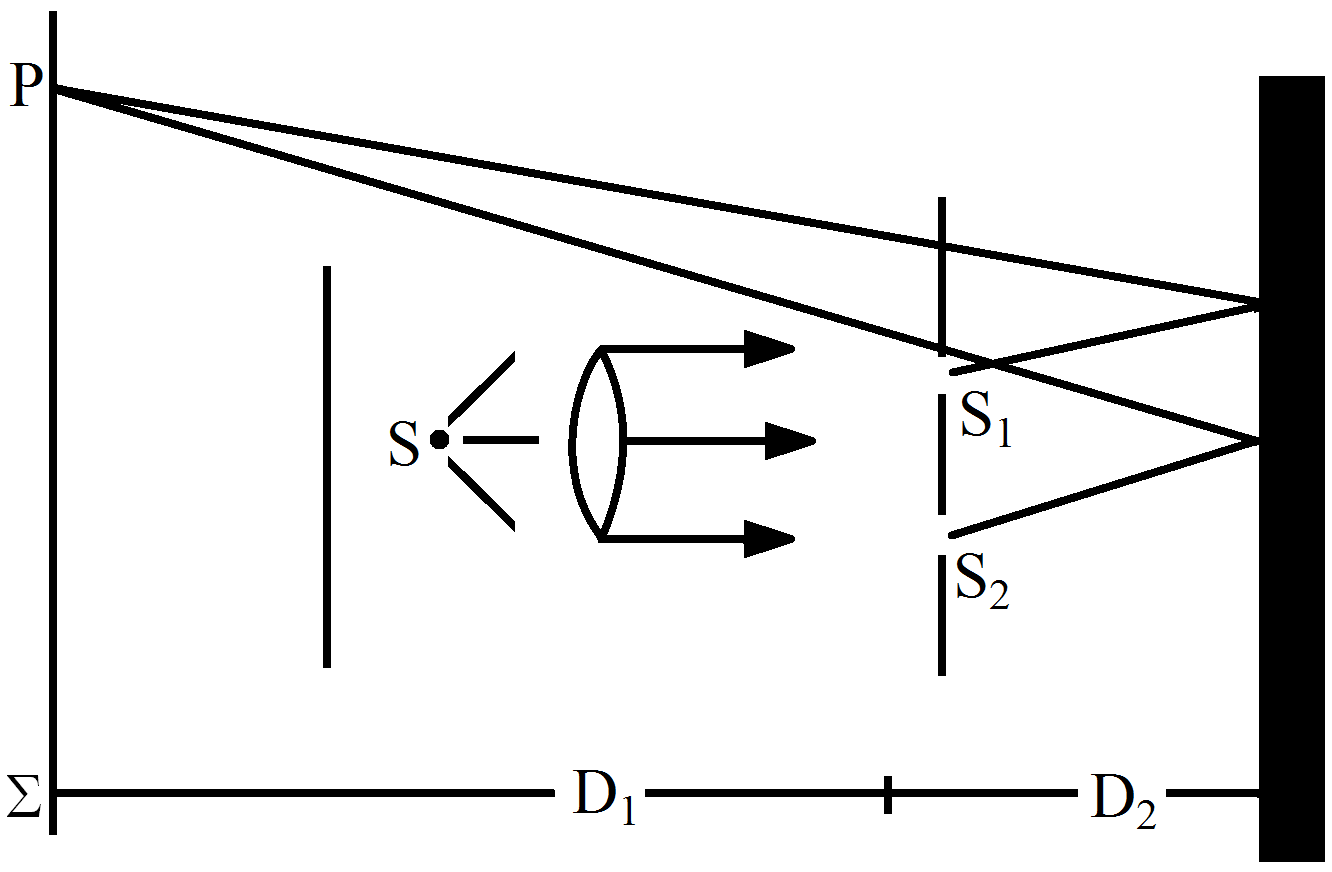
- 8A double slit $S_1-S_2$ is illuminated by a coherent light of wavelength $\lambda$. The slits are separated by a distance $d$. A plane mirror is placed in front of the double slit at a distance $D_1$ from it and a screen $\sum$ is placed behind the double slit at a distance $D_2$ from it (figure $17-E_2$ ). The screen E receives only the light reflected by the mirror. Find the fringe-width of the interference pattern on the screen.View Solution
- 9View SolutionA parallel beam of monochromatic light falls normally on a single narrow slit. How does the angular width of the principal maximum in the resulting diffraction pattern depend on the width of the slit?
- 10View SolutionDiscuss the intensity of transmitted light when a polaroid sheet is rotated between two crossed polaroids?