A source emitting light of wavelengths 480nm and 600nm is used in. a double slit interference experiment. The separation between the slits is 0.25mm and the interference is observed on a screen placed at 150cm from the slits. Find the linear separation between the first maximum (next to the central maximum) corresponding to the two wavelengths.
Download our app for free and get started
We know that, the first maximum (next to central maximum) occurs at $\text{y}=\frac{\lambda\text{D}}{\text{d}}$
Given that, $\lambda_1=480\text{nm},\lambda_2=600\text{nm},$ $D = 150cm = 1.5m$ and $d = 0.25mm = 0.25 × 10^{-3}\ m$
So, $\text{y}_1=\frac{\text{D}\lambda_1}{\text{d}}=\frac{1.5\times480\times10^{-9}}{0.25\times10^{-3}}=2.88\text{mm}$
$\text{y}_2=\frac{1.5\times600\times10^{-9}}{0.25\times10^{-3}}=3.6\text{mm}.$
So, the separation between these two bright fringes is given by,
$\therefore$ separation $= y_2- y_1= 3.60 - 2.88 = 0.72mm.$
Given that, $\lambda_1=480\text{nm},\lambda_2=600\text{nm},$ $D = 150cm = 1.5m$ and $d = 0.25mm = 0.25 × 10^{-3}\ m$
So, $\text{y}_1=\frac{\text{D}\lambda_1}{\text{d}}=\frac{1.5\times480\times10^{-9}}{0.25\times10^{-3}}=2.88\text{mm}$
$\text{y}_2=\frac{1.5\times600\times10^{-9}}{0.25\times10^{-3}}=3.6\text{mm}.$
So, the separation between these two bright fringes is given by,
$\therefore$ separation $= y_2- y_1= 3.60 - 2.88 = 0.72mm.$

Download our appand get started for free
Experience the future of education. Simply download our apps or reach out to us for more information. Let's shape the future of learning together!No signup needed.*
Similar Questions
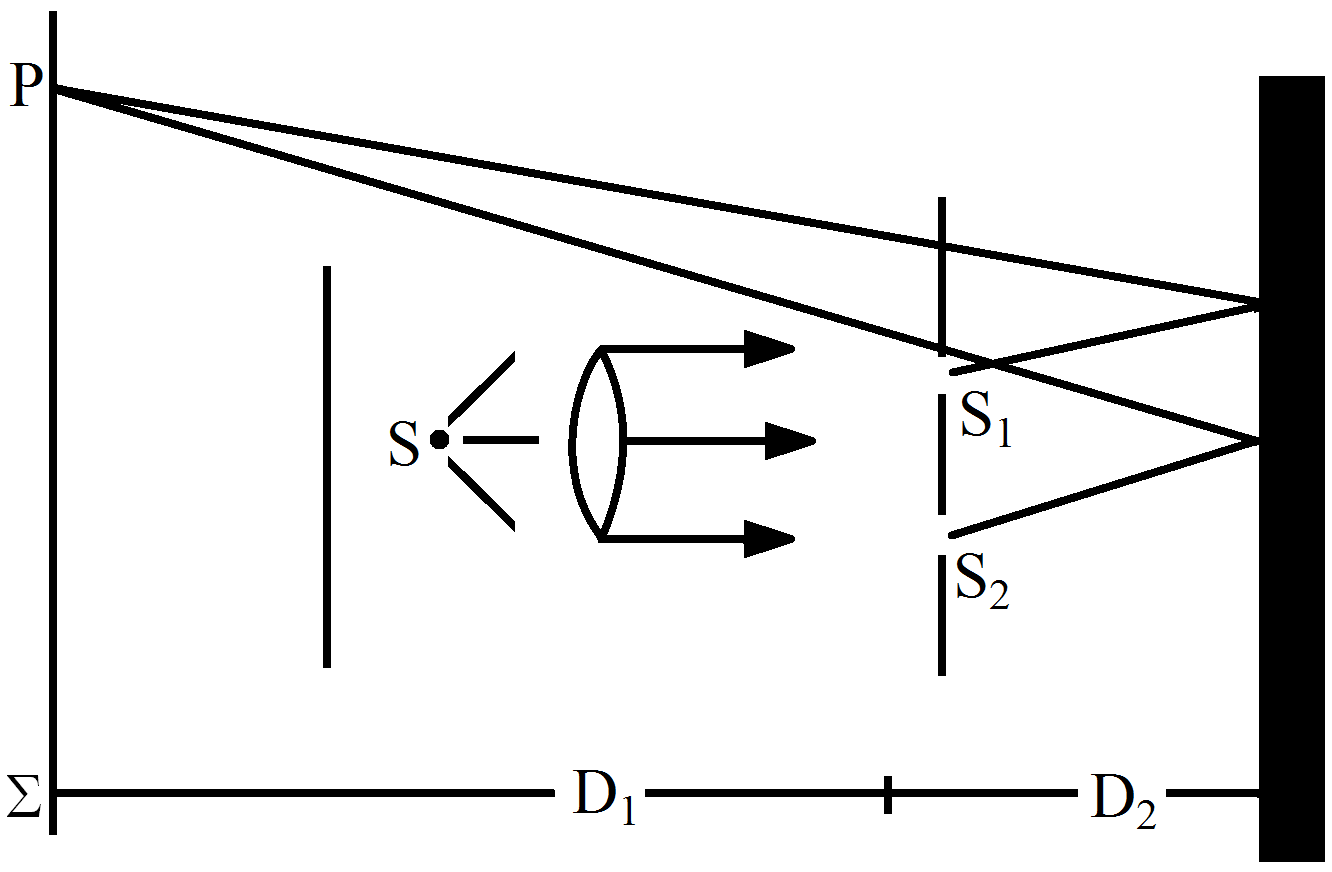
- 1A double slit $S_1-S_2$ is illuminated by a coherent light of wavelength $\lambda$. The slits are separated by a distance $d$. A plane mirror is placed in front of the double slit at a distance $D_1$ from it and a screen $\sum$ is placed behind the double slit at a distance $D_2$ from it (figure $17-E_2$ ). The screen E receives only the light reflected by the mirror. Find the fringe-width of the interference pattern on the screen.View Solution
- 2View SolutionIn a double-slit experiment the angular width of a fringe is found to be 0.2° on a screen placed 1 m away. The wavelength of light used is 600 nm. What will be the angular width of the fringe if the entire experimental apparatus is immersed in water? Take refractive index of water to be 4/3.
- 3View SolutionIn double-slit experiment using light of wavelength 600 nm, the angular width of a fringe formed on a distant screen is 0.1º. What is the spacing between the two slits?
- 4White light is used in a Young's double slit experiment. Find the minimum order of the violet fringe $(\lambda=400\text{nm}),$ which overlaps with a red fringe $(\lambda=700\text{nm}).$View Solution
- 5View Solution
- When a wave is propagating from a rarer to a denser medium, which characteristic of the wave does not change and why?
- What is the ratio of the velocity of the wave in the two media of refractive indices $\mu_{1}$ and $\mu_{2}$?
- 6View SolutionA parallel beam of light of wavelength 500 nm falls on a narrow slit and the resulting diffraction pattern is observed on a screen 1 m away. It is observed that the first minimum is at a distance of 2.5 mm from the centre of the screen. Find the width of the slit.
- 7View SolutionCan we conclude from the interference phenomenon whether light is a transverse wave or a longitudinal wave?
- 8View SolutionDiscuss the intensity of transmitted light when a polaroid sheet is rotated between two crossed polaroids?
- 9The short wavelength limit for the Lyman series of the hydrogen spectrum is 913·4 $\mathring{\text{A}}$ Calculate the short wavelength limit for Balmer series of the hydrogen spectrum.View Solution
- 10View SolutionAnswer the following question:
Ray optics is based on the assumption that light travels in a straight line. Diffraction effects (observed when light propagates through small apertures/slits or around small obstacles) disprove this assumption. Yet the ray optics assumption is so commonly used in understanding location and several other properties of images in optical instruments. What is the justification?