Question
A parallel beam of monochromatic light falls normally on a single narrow slit. How does the angular width of the principal maximum in the resulting diffraction pattern depend on the width of the slit?

Answer

Width of central maximum, $\beta=\frac{2\lambda\text{D}}{\text{a}}\alpha \frac{1}{\text{a}},$ where a is width of the slit. That is angular width of principal maximum decreases with increase of width of the slit.

Need a full question paper?

Generate a complete, print-ready paper with questions like this in minutes — across 16+ boards, with answer keys.
Start Generating Free

Similar questions

Protons with kinetic energy K emerge from an accelerator as a narrow beam. The beam is bent by a perpendicular magnetic field, so that it just misses a plane target kept at a distance l in front of the accelerator. Find the magnetic field.
Is it true that the reaction of a gravitational force is always gravitational, of an electromagnetic force is always electromagnetic and so on?
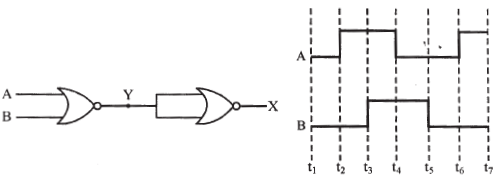
Draw the output waveform at X, using the given inputs A and B for the logic circuit shown below. Also, identify the logic operation performed by this circuit.
Define power of lens, obtain its equation and write its unit.
Answer the following questions:
Why is choke coil needed in the use of fluorescent tubes with acmains? Why can we not use an ordinary resistor instead of the choke coil?
(a) An em wave is travelling in a medium with a velocity $\vec{v}=v\hat{i}$. Draw a sketch showing the propagation of the em wave, indicating the direction of oscillating electric and magnetic fields. (b) How are the magnitudes of the electric and magnetic fields related to the velocity of em wave.
The refractive index of a material is. What is the angle of refraction if the unpolarised light is incident on it at the polarising angle of the medium?
Derive $D_m=A\left(n_{21}-1\right)$ for thin lens.
A hydrogen atom in a state having a binding energy of 0.85eV makes transition to a state with excitation energy 10.2eV (a) Identify the quantum numbers n of the upper and the lower energy states involved in the transition. (b) Find the wavelength of the emitted radiation.
Explain frequency modulation.