Question 12 Marks
Answer the following question:
Ray optics is based on the assumption that light travels in a straight line. Diffraction effects (observed when light propagates through small apertures/slits or around small obstacles) disprove this assumption. Yet the ray optics assumption is so commonly used in understanding location and several other properties of images in optical instruments. What is the justification?
AnswerTypical sizes of the apertures involved in ordinary optical instruments are much large than the wavelength of light. Henceforth, the diffraction effects of light waves are negligibly small in these instruments and is of negligible or no significance. Thus, the assumption that light travels in straight lines can be safely used in the optical instruments.
View full question & answer→Question 22 Marks
A parallel beam of light of wavelength $500\ nm$ falls on a narrow slit and the resulting diffraction pattern is observed on a screen $1 m$ away. It is observed that the first minimum is at a distance of $2.5\ mm$ from the centre of the screen. Find the width of the slit.
AnswerGiven,
Distance of the screen from the slit, $D = 1 m$
Distance of the first minimum when the centre of screen, $x = 2.5\ mm = 2.5 \times 10^{-3} m$
$n = 1$ is the first minimum.
Wavelength of light, $\lambda = 500\ nm = 500 \times 10^{-9} m$
$= 5 \times 10^{-7} m$
Using formula, $\text{x}=\text{n}\frac{\lambda\text{D}}{\text{d}}$
we have $d=\text{n}\frac{\lambda\text{D}}{\text{x}}$
$\Rightarrow\ \text{d}=\frac{1\times5\times10^{-7}\times1}{2.5\times10^{-3}}$
$= 2 \times 10^{-4} m$
$= 0.2\ mm$
is the required width of the slit.
View full question & answer→Question 32 Marks
Answer the following question: As you have learnt in the text, the principle of linear superposition of wave displacement is basic to understanding intensity distributions in diffraction and interference patterns. What is the justification of this principle?
AnswerSuperposition principle is in accordance with the linear character of the differential equation governing wavemotion. If, $y_1$ and $y_2$ are solutions of the wave equation, then any linear combination of $y_1$ and $y_2$ is also a solution of the waveequation. When amplitudes are large $($e.g., high intensity laser beams$)$ and non$-$linear effects are important, the situation is for more complicated.
View full question & answer→Question 42 Marks
What is the Brewster angle for air to glass transition? (Refractive index of glass = 1.5.)
AnswerRefractive index of glass, $\mu=1.5$
Brewster angle = $\theta$
Brewster angle is related to refractive index as:
$\text{tan}\theta=\mu$
$\theta=\text{tan}^{-1}(1.5)=56.31^\circ$
Therefore, the Brewster angle for air to glass transition is 56.31°.
View full question & answer→Question 52 Marks
The $6563 \mathring A \ \text{H}\alpha$ line emitted by hydrogen in a star is found to be redshifted by $15 \mathring A .$ Estimate the speed with which the star is receding from the Earth.
AnswerGiven,
Wavelength of $\text{H}\alpha$ line, $\lambda = 15 \mathring A = 15 \times 10^{-10 }m$
Redshift, $\lambda'-\lambda = 15 \mathring A = 15 \times 10^{-10} m$
Now, according to the formula,
$\lambda'-\lambda=\frac{\text{v}_\text{s}\lambda}{\text{c}}$
we have, $\text{V}_\text{s}=\frac{\text{C}}{\lambda}\big(\lambda'-\lambda\big)$
$=\frac{3.0\times10^8}{6563\times10^{-10}}\times15\times10^{-10}$
$= 6.8566 \times 10^5 ms^{-1}$
i.e., $V_s = 6.86 \times 10^5 ms^{-1}.$
Therefore, the start is receding from the earth at a speed of $6.86 \times 10^5 m/s.$
View full question & answer→Question 62 Marks
Estimate the distance for which ray optics is good approximation for an aperture of $4 \ mm$ and wavelength $400 \ nm.$
AnswerFresnel's distance $(Z_F)$ is the distance for which the ray optics is a good approximation. It is given by the relation,
$\text{Z}_\text{F}=\frac{\text{a}^2}{\lambda}$
Where,
Aperture width, $a = 4 \ mm = 4 \times 10^{-3} m$
Wavelength of light, $\lambda = 400 \ nm = 400 \times 10^{-9} m$
$\text{Z}_\text{F}=\frac{\big(4\times10^{-3}\big)^2}{400\times10^{-9}}=40\text{m}$
Therefore, the distance for which the ray optics is a good approximation is $40 m.$
View full question & answer→Question 72 Marks
In deriving the single slit diffraction pattern, it was stated that the intensity is zero at angles of $\text{n}\lambda/\text{a}.$ Justify this by suitably dividing the slit to bring out the cancellation.
AnswerLet the slit width 'a' be divided into n equal parts of width 'a' so that,
$\text{a}'=\frac{\text{a}}{\text{n}}$
i.e., a = na'
Then,
$\text{Angle},\ \theta=\frac{\text{n}\lambda}{\text{a}}=\frac{\text{n}\lambda}{\text{na}'}$
$\text{i.e.},\ \theta=\frac{\lambda}{\text{a}'}$
At this derived angle, each slit will make first diffraction minimum. Hence, the resultant intensity for all slits will be zero at an angle of $\frac{\text{n}\lambda}{\text{a}}.$
View full question & answer→Question 82 Marks
Answer the following question:
In a single slit diffraction experiment, the width of the slit is made double the original width. How does this affect the size and intensity of the central diffraction band?
AnswerWidth of central diffraction band $=2\text{D}\frac{\lambda}{\text{d}}.$
Where, d is the width of the slit.
So, on doubling the width of the slit, the size of the central diffraction band reduces to half value. But, the light amplitude becomes double, which increases the intensity four fold.
View full question & answer→Question 92 Marks
In a double-slit experiment the angular width of a fringe is found to be 0.2° on a screen placed 1 m away. The wavelength of light used is 600 nm. What will be the angular width of the fringe if the entire experimental apparatus is immersed in water? Take refractive index of water to be 4/3.
AnswerDistance of the screen from the slits, D = 1 m
Wavelength of light used, $\lambda_1$ = 600 nm
Angular width of the fringe in are, $\theta_1=0.2^{\circ}$
Angular width of the fringe in water $=\theta_2$
Refractive index of water, $\mu=\frac{4}{3}$
Refractive index is related to angular width as:
$\mu=\frac{{\theta}_1}{\theta_2}$
$\theta_2=\frac{3}{4}\theta_1$
$=\frac{3}{4}\times0.2=0.15$
Therefore, the angular width of the fringe in water will reduce to 0.15°.
View full question & answer→Question 102 Marks
In double$-$slit experiment using light of wavelength $600\ nm,$ the angular width of a fringe formed on a distant screen is $0.1^\circ .$ What is the spacing between the two slits?
AnswerWavelength of light, $\lambda = 600 \ nm = 600 \times 10^{-9} m$
Angular fringe width, $\text{B}_\theta=\frac{\lambda}{\text{d}}$
$\Rightarrow\ \ \text{d}=\frac{\lambda}{\beta}_\theta$
Where, d is the distance between the slits.
Now,
$\beta_\theta=0.1^\circ=\frac{0.1\times\pi}{180}\ \text{radian}$
$=\frac{0.1\times3.14}{180}\ \text{radian}$
$\therefore\ \text{d}=\frac{600\times10^{-9}\times180}{0.1\times3.14}\ \text{m}=3.44\times10^{-4}\text{m}.$
Is the required spacing between the two slits.
View full question & answer→Question 112 Marks
Two towers on top of two hills are $40 \ km$ apart. The line joining them passes $50 m$ above a hill halfway between the towers. What is the longest wavelength of radio waves, which can be sent between the towers without appreciable diffraction effects?
AnswerDistance between the two towers $= 40 \ km$
Size of aperture, $a = 50 m$
Distance of aperture from tower, $Z_f$
Fresnel distance is the half of the distance between the towers.
$\text{i.e},\ \text{Z}_\text{f}=\frac{40}{2}=20\text{km}=20\times10^3\ \text{m}.$
Therefore, now using the formula,
Fresnel distance, $\text{Z}_\text{F}=\frac{\text{a}^2}{\lambda}$
$\text{we have}\ \lambda=\frac{\text{a}^2}{\text{Z}_\text{F}}=\frac{(50)^2}{20\times10^3}$
$\lambda=125\times10^{-3}\ \text{m}=12.5\ \text{cm}.$
This is the required longest wavelength of radio waves, which can be sent in between the towers without considerable diffraction effects.
View full question & answer→Question 122 Marks
Discuss the intensity of transmitted light when a polaroid sheet is rotated between two crossed polaroids?
AnswerLet $I_0$ be the intensity of polarised light after passing through the first polariser $P_1$. Then the intensity of light after passing through second polariser $P_2$ will be
$
I=I_0 \cos ^2 \theta \text {, }
$
where $\theta$ is the angle between pass axes of $P_1$ and $P_2$. Since $P_1$ and $P_3$ are crossed the angle between the pass axes of $P_2$ and $P_3$ will be $(\pi / 2-\theta)$. Hence the intensity of light emerging from $P_3$ will be
$
\begin{aligned}
I & =I_0 \cos ^2 \theta \cos ^2\left(\frac{\pi}{2}-\theta\right) \\
& =I_0 \cos ^2 \theta \sin ^2 \theta=\left(I_0 / 4\right) \sin ^2 2 \theta
\end{aligned}
$
Therefore, the transmitted intensity will be maximum when $\theta=\pi / 4$.
View full question & answer→Question 132 Marks
(a) When monochromatic light is incident on a surface separating two media, the reflected and refracted light both have the same frequency as the incident frequency. Explain why?
(b) When light travels from a rarer to a denser medium, the speed decreases. Does the reduction in speed imply a reduction in the energy carried by the light wave?
(c) In the wave picture of light, intensity of light is determined by the square of the amplitude of the wave. What determines the intensity of light in the photon picture of light.
Answer(a) Reflection and refraction arise through interaction of incident light with the atomic constituents of matter. Atoms may be viewed as oscillators, which take up the frequency of the external agency (light) causing forced oscillations. The frequency of light emitted by a charged oscillator equals its frequency of oscillation. Thus, the frequency of scattered light equals the frequency of incident light.
(b) No. Energy carried by a wave depends on the amplitude of the wave, not on the speed of wave propagation.
(c) For a given frequency, intensity of light in the photon picture is determined by the number of photons crossing an unit area per unit time.
View full question & answer→Question 142 Marks
- When a wave is propagating from a rarer to a denser medium, which characteristic of the wave does not change and why?
- What is the ratio of the velocity of the wave in the two media of refractive indices $\mu_{1}$ and $\mu_{2}$?
Answer
- Frequency does not change, as frequency is a characteristic of the source of waves.
Alternate Answer
$\frac{\text{v}_{1}}{\lambda}_{1} = \frac{\text{v}_{2}}{\lambda}_{2}=\text{n}$
- The ratio of velocities of wave in two media of refractive indices$\mu_{1}$ and $\mu_{2}$ is $\frac{\mu_{2}}{\mu_{1}}$.
Alternate Answer
$\frac{\text{v}{1}}{\text{v}_{2}} = \frac{\mu_{2}}{\mu}_{1}$. View full question & answer→Question 152 Marks
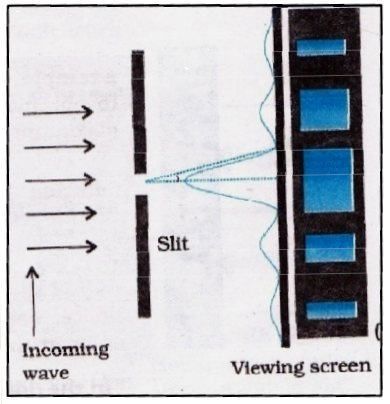
Draw the intensity pattern for single slit diffraction and double slit interference. Hence, state two differences between interference and diffraction patterns.
Answer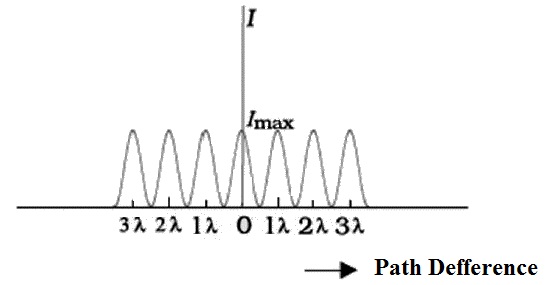
| Interference |
Diffraction |
| All maxima have equal intensity. |
Maxima have different (/rapidly decreasing) intensity. |
| All fringes have equal width. |
Different (/changing) width. |
| Superposition of two wavefronts. |
Superposition of wavelets from the same wavefront. |
View full question & answer→Question 162 Marks
Unpolarised light is passed through a polaroid $P_1.$ When this polarised beam passes through another polaroid $P_2$ and if the pass axis of $P_2$ makes angle $\theta$ with the pass axis of $P_1,$ then write the expression for the polarised beam passing through $P_2.$ Draw a plot showing the variation of intensity when $\theta$ varies from $0$ to $2\pi.$
Answer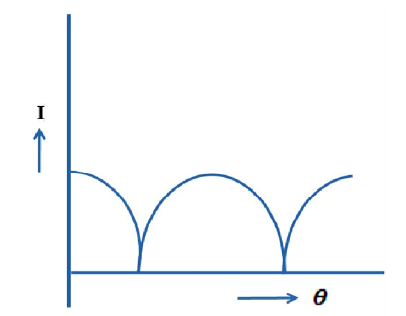 Intensity is $\frac{\text{I}}{2}\text{ }\cos^2\theta ($if $I0$ is the intensity of unpolarised light$.)$
Intensity is ${\text{I}}\text{ }\cos^2\theta ($if $I$ is the intensity of polarized light$.)$ View full question & answer→Question 172 Marks
The short wavelength limit for the Lyman series of the hydrogen spectrum is 913·4 $\mathring{\text{A}}$ Calculate the short wavelength limit for Balmer series of the hydrogen spectrum.
Answer$\frac{1}{\lambda}=R\bigg(\frac{1}{n_1^{\text{ }\text{ }2}}-\frac{1}{n_2^{\text{ }\text{ }2}}\bigg)$
$\therefore $ For Balmer Series: $(\lambda_B)_{\text{short}|}=4/\text{R}$
and For Lyman Series: $(\lambda_L)_{\text{short}|}=1/\text{R}$
$\therefore {\lambda_{B}}=913.4\times4\mathring{\text{A}}=3653.6\mathring{\text{A}}$
View full question & answer→Question 182 Marks
A parallel beam of light of $500 \ nm$ falls on a narrow slit and the resulting diffraction pattern is observed on a screen $1 \ m$ away. It is observed that the first minimum is at a distance of $2.5 \ mm$ from the centre of the screen. Calculate the width of the slit.
Answer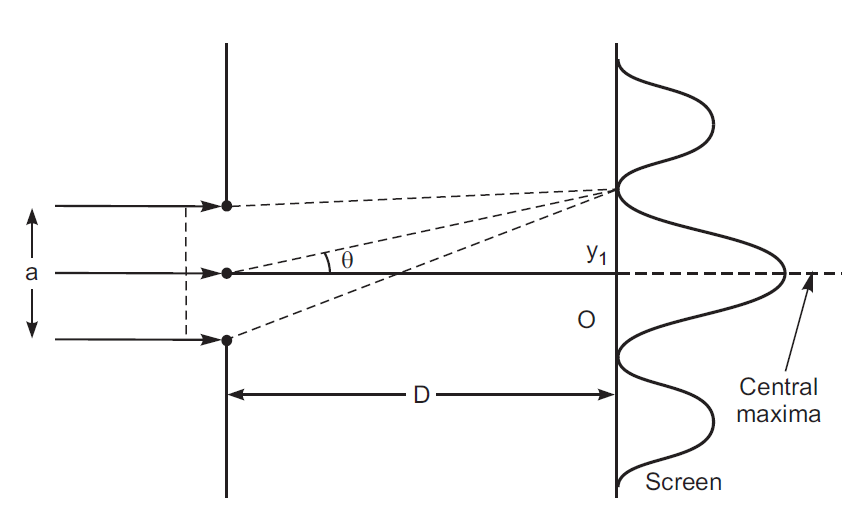
Hint: From condition of diffraction, $\sin\theta = \text{n}\lambda\text{ (for minima) }$
$ = \bigg(\text{n} + \frac{1}{2}\bigg)\lambda\text{ for maxima}$ Provided $n =1, 2, 3...$ and $n =0$ for central maxima,
From condition of minima
$\text{a}\sin\theta = \lambda (n =1)$
Since the value of $\lambda$ is of nm,
so $\text{a},\theta = \lambda$
$\text{a}.\frac{\text{y}}{\text{D}} = \lambda$
$\bigg[\text{angle} = \frac{\text{arc}}{\text{radius}}\bigg]$
$\therefore\text{a} = \frac{\lambda\text{D}}{\text{y}}$
$\text{a} =\frac{500\times10^{-9}\times1}{2.5\times10^{-3}}\text{m} =2x10^{–4} m.$ View full question & answer→Question 192 Marks
Define the term ‘linearly polarised light’.
When’ does the intensity of transmitted light become maximum, when a polaroid sheet is rotated between two crossed polaroids?
AnswerWhen the vibrations of the electric field vector $(\overrightarrow{\text{E}})$ are confined to only one direction then light is called linearly polarized light.Intensity of transmitted light is maximum when the Polaroid sheet makes an angle of $45^0$ with the pass axis.
Alternate Answer

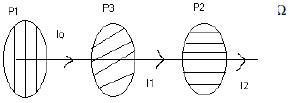
View full question & answer→Question 202 Marks
State one feature by which the phenomenon of interference can be distinguished from that of diffraction.
A parallel beam of light of wavelength $600 \ nm$ is incident normally on a slit of width ‘a’. If the distance between the slit and the screen is $0.8 m$ and the distance of $2nd$ order maximum from the centre of the screen is $15 \ mm$, calculate the width of the slit.
AnswerThe given features:-
| Interference |
Diffraction |
- Fringes of equal width
|
Fringes of unequal width |
- Fringes of equal intensity
|
Fringes of decreasing intensity |
- Due to superposition of two waves (wavefronts)
|
Due to superposition of secondary wavefronts. |
- Maximal at $\theta =\frac{\lambda}{\text{a}}$
|
Minima at $\theta = \frac{\lambda}{\text{a}}$ |
$\text{ (Numerical : Formula}\text{ y} =\frac{(2\text{n} + 1)\lambda\text{D}}{2\text{a}}\text{ or } \frac{5\lambda\text{D}}{2\text{a}}$
Substitution and Result: $8 \times 10^{–5} m$ or $0.08 \ mm.$ View full question & answer→Question 212 Marks
Find the intensity at a point on a screen in Young’s double slit experiment where the interfering waves have a path difference of (i) $\lambda/6$, and (ii) $\lambda/2.$
AnswerPhase difference $=\frac{2\pi}{\lambda}\times$ Path diffrence
Path difference $\frac{\lambda}{6}$ ⟹ phase difference $=\frac{\pi}{3}$
Path difference $\frac{\lambda}{2}$ ⟹ phase difference $={\pi}$
$\text{I}=4\text{I}_0\cos^{2}\bigg(\frac{\phi}{2}\bigg)$
- $\text{I}_1=4\text{I}_0\times\frac{3}{4}=3\text{I}_0$
- $\text{I}_2=4\text{I}_0\times0=0$
View full question & answer→Question 222 Marks
Find the intensity at a point on a screen in Young’s double slit experiment where the interfering waves of equal intensity have a path difference of (i) $\lambda/4$, and (ii) $\lambda/3$.
AnswerPath difference ?/4 ⟹ phase difference ?/2
Path difference ?/3 ⟹ phase difference (2?/3)
$I=4I_0\cos^2\Big(\frac{\theta}{2}\Big)$
- $I_1=4I_0\times\frac{1}{2}=2I_0$
- $I_2=4I_0\times\frac{1}{4}=I_0$
View full question & answer→Question 232 Marks
Distinguish between polarised and unpolarized light. Does the intensity of polarised light emitted by a Polaroid depend on its orientation? Explain briefly.
The vibrations in a beam of polarised light make an angle of 60° with the axis of the polaroid sheet. What percentage of light is transmitted through the sheet?
AnswerIf the direction of vibration of electric field vector/plane of vibration of electric field vector, does not change with time, the light is polarised. Whereas, if the direction of vibration of electric field vector/plane of vibration of electric field vector changes randomly in very short intervals of time/with time, the light is unpolarised.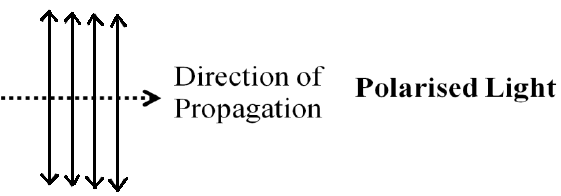
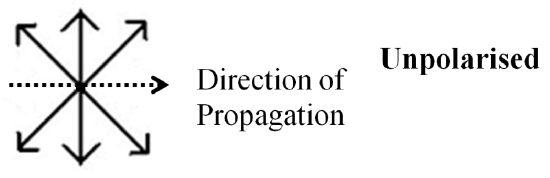
Yes, it depends upon orientation of Polaroid because electric field vibrations, that are not in the direction of pass axis of Polaroid, are absorbed. Hence, intensity changes. $I=I_0\cos^2\theta$ = angle between vibrations in light and axis of polaroid sheet) $I=I_0\cos^260^\circ=\frac{I_0}{4}$ $\Longrightarrow\frac{I}{I_0}\times100=\frac{1}{4}\times100=25\text{%}$ View full question & answer→Question 242 Marks
When are two objects just resolved? Explain. How can the resolving power of a compound microscope be increased? Use relevant formula to support your answer.
AnswerTwo objects are said to be just resolved when, in their diffraction patterns, central maxima of one object coincides with the first minima, of the diffraction pattern of the second object. Limit of resolution of compound microscope.
$ \text{d}_{min}=\frac{1.22{\lambda}}{2\text{ }n\text{ }sin\text{ }{\beta}}$
Resolving power is the reciprocal of limit of resolution $( \text{d}_{min})$
Therefore, to increase resolving power $\lambda$ can be reduced and refractive index of the medium can be increased.
View full question & answer→Question 252 Marks
State Brewster’s law.
The value of Brewster angle for a transparent medium is different for light of different colours. Give reason.
AnswerWhen unpolarized light is incident on the surface separating two media, the reflected light gets (completely) polarised only when the reflected light and refracted light become perpendicular to each other.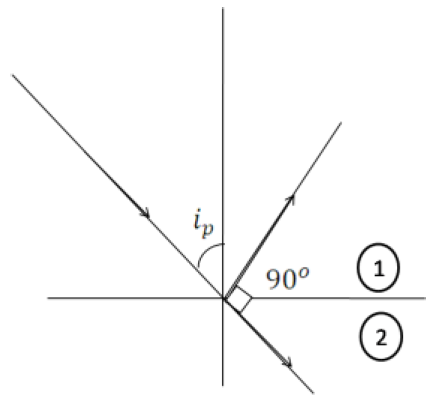
The refractive index of denser medium, with respect to rarer medium, is given by $\mu = \tan\text{i}_{p}$ Since Refractive index (μ) of a transparent medium is different for different colours, hence Brewster angle is different for different colours. View full question & answer→Question 262 Marks
Draw the output waveform at X, using the given inputs A and B for the logic circuit shown below. Also, identify the logic operation performed by this circuit.
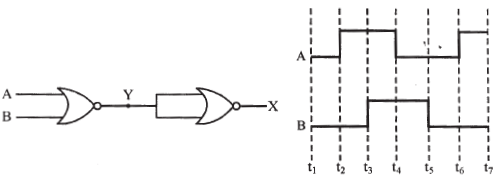
AnswerDrawing correct output waveform.
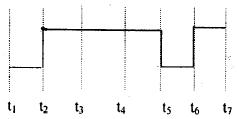
OR gate.
View full question & answer→Question 272 Marks
Define the term ‘Half$-$life’ of a radioactive substance. Two different radioactive substances have half$-$lives $T_1$ and $T_2$ and number of undecayed atoms at an instant $N_1$ and $N_2,$ respectively. Find the ratio of their activities at that instant.
AnswerHalf$-$life$:$ It is the time interval after which the activity of a radioactive sample reduces to half of initial value.
$\because\text{R}=\lambda\text{N}$
$\Rightarrow\frac{\text{R}_1}{\text{R}_2}=\frac{\lambda_1}{\lambda_2}\times\frac{\text{N}_1}{\text{N}_2}$
$\because\lambda=\frac{0.693}{\text{T}_\frac{1}{2}}$
$\Rightarrow\frac{\lambda_1}{\lambda_2}=\frac{\text{T}_2}{\text{T}_1}$
$\therefore\frac{\text{R}_1}{\text{R}_2}=\frac{\text{T}_2}{\text{T}_1}\times\frac{\text{N}_1}{\text{N}_2}$
View full question & answer→Question 282 Marks
Define wavefront of a travelling wave. Using Huygens principle, obtain the law of refraction at a plane interface when light passes from a denser to rarer medium.
Answer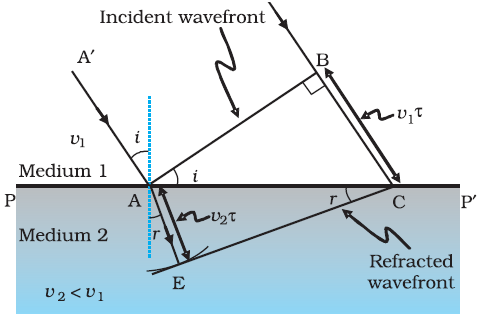
A plane wavefront $AB$ is incident in rarer medium at instant $t = 0$ on interface $XY$ separating it from a denser medium.
When wavelet $A$ is on interface $,B$ is at a distance $BB,$ from it. It takes t time to cover the distance $BB_{1 }= v_1t = $ to reach on interface $XY$.
Mean while, the wavelet from $A$ reaches to point $A_1$ covering a distance $AA_1 = v_2t$ in denser medium.
To locate $A_1,$ draw a secondary wavelet with radius $AA_1 = v_2t$ centre $A$.
Draw tangent from $B,$ into this $\sec$. wavelet intersecting at $A_1$.
$A_1B_1$ is refracted wavefront at instant $t$.
$i =$ angle of incidence,
$r =$ angle of refraction.
$\therefore\triangle\text{ABB}_1$
$\Rightarrow\sin\text{i}=\frac{\text{BB}_1}{\text{AB}_1}$
$\triangle\text{AA}_1\text{B}_1$
$\Rightarrow\sin\text{r}=\frac{\text{AA}_1}{\text{AB}_1}$
$\therefore\frac{\sin\text{i}}{\sin\text{r}}=\frac{\text{BB}_1}{\text{AA}_1}=\frac{\text{v}_1\text{t}}{\text{v}_2\text{t}}=\frac{\text{v}_1}{\text{v}_2}$
$\therefore\frac{\sin\text{i}}{\sin\text{r}}=\frac{\text{v}_1}{\text{v}_2}=\text{constant}$
Also, $\text{n}_1=\frac{\text{c}}{\text{v}_1}\text{n}_2=\frac{\text{c}}{\text{v}_2}$
$\frac{\text{n}_1}{\text{n}_2}=\frac{\text{v}_2}{\text{v}_1}$
$\Rightarrow\frac{\sin\text{i}}{\frac{\sin\text{r}}{}}=\frac{\text{n}_2}{\text{n}_1}=\text{constant}$
Which is Snell's law. View full question & answer→Question 292 Marks
An equilateral glass prism has a refractive index 1.6 in air. Calculate the angle of minimum deviation of the prism, when kept in a medium of refractive index $\frac{4\sqrt2}{5}.$
AnswerWhen the prism is kept in another medium. we have to take the refractive index of the prism with respect to the given medium:
$^{\text{medium}}\mu_\text{prism}=\frac{\mu_\text{prism}}{\mu_\text{medium}}=\frac{\sin\Big[\Big(\frac{\text{A}+\text{D}_\text{m}}{2}\Big)\Big]}{\sin\Big(\frac{\text{A}}{2}\Big)}$
$\frac{1.6}{\frac{4\sqrt2}{5}}=\frac{\sin\Big[\Big(\frac{60^\circ+\text{D}_\text{m}}{2}\Big)\Big]}{\sin\Big(\frac{60^\circ}{2}\Big)}$
$\sqrt2=\frac{\sin\Big[\Big(\frac{60^\circ+\text{D}_\text{m}}{2}\Big)\Big]}{\frac{1}{2}}$
$\sin^{-1}\Big(\frac{1}{\sqrt2}\Big)=\Big(\frac{60^\circ+\text{D}_\text{m}}{2}\Big)$
$90^\circ=60^\circ+\text{D}_\text{m}$
$\text{D}_\text{m}=30^\circ$
View full question & answer→Question 302 Marks
Calculate the radius of curvature of an equi$-$concave lens of refractive index $1.5,$ when it is kept in a medium of refractive index $1.4,$ to have a power of $-5D?$
AnswerUsing lens maker formulae for given equi$-$cancave lens,
$\frac{1}{\text{f}}=\Big(\frac{\text{n}_2}{\text{n}_1}-1\Big)\Big(\frac{1}{-\text{R}}-\frac{1}{\text{R}}\Big)$
$\Rightarrow\frac{1}{\text{f}}=\Big(\frac{\text{n}_2}{\text{n}_1}-1\Big)\Big(-\frac{2}{\text{R}}\Big)\ ...(1)$
Where $n_2$ and $n_1 n_2$ and $n_1$ are the refractive index of the lens and respectively. where $n_2 = 1.5 n_1 = 1.4$
Power of lens $= -5D ($Given$)$
Focal length, $\text{f}=\frac{1}{-5}\times100=-20\text{cm}$
Putting all the values in equation $1$, we get,
$\Rightarrow\frac{1}{-20}=\Big(\frac{1.5}{1.4}-1\Big)\Big(-\frac{2}{\text{R}}\Big)$
$\Rightarrow\frac{1}{20}=\Big(\frac{0.1}{1.4}\Big)\Big(\frac{2}{\text{R}}\Big)$
$\Rightarrow\text{R}=\frac{4}{1.4}=2.86\text{cm}$
View full question & answer→Question 312 Marks
The speed of the yellow light in a certain liquid is $2.4 \times 10^8\ m/s.$ Find the refractive index of the liquid.
Answer$\mu_\text{t}=\frac{1\times3\times10^8}{(2.4)\times10^8}=1.25$ $\Big[\text{since}, \mu=\frac{\text{velocity of light in vaccum}}{\text{velocity of light in the given medium}}\Big]$
View full question & answer→Question 322 Marks
The value of the Brewster angle for a transparent medium is different for lights of different colours.
AnswerBrewster’s angle, $\text{i}_\text{p}=\tan^{-1}(\text{n})$
As refractive index n varies as inverse value of wavelength; it is different for lights of different wavelengths (colours), therefore, Brewster’s angle is different for lights of different colours.
View full question & answer→Question 332 Marks
White light is used in a Young's double slit experiment. Find the minimum order of the violet fringe $(\lambda=400\ \text{nm}),$ which overlaps with a red fringe $(\lambda=700\ \text{nm}).$
AnswerLet $m^{th}$ bright fringe of violet light overlaps with $n^{th}$ bright fringe of red light.
$\therefore\frac{\text{m}\times400\text{nm}\times\text{D}}{\text{d}}=\frac{\text{n}\times700\text{nm}\times\text{D}}{\text{d}}$
$\Rightarrow\frac{\text{m}}{\text{n}}=\frac{7}{4}$
$\Rightarrow 7^{th}$ bright fringe of violet light overlaps with $4^{th}$ bright fringe of red light $($minimum$).$
Also, it can be seen that $14^{th}$ violet fringe will overlap $8^{th}$ red fringe.
Because, $\frac{\text{m}}{\text{n}}=\frac{7}{4}=\frac{14}{8}$
View full question & answer→Question 342 Marks
Is it necessary to have two waves of equal intensity to study interference pattern? Will there be an effect on clarity if the waves have unequal intensity?
AnswerInterference pattern can be studied with waves of unequal intensity.
$\text{I}=\text{I}_1+\text{I}_2+2\sqrt{[\text{I}_1\times\text{I}_2]}\cos(\phi),$
Where $\phi$, = phase difference.
In case of waves of unequal intensities, the contrast will not be clear, as the minima will not be completely dark.
View full question & answer→Question 352 Marks
No interference pattern is detected when two coherent sources are infinitely close to each other. Why?
AnswerFringe width of interference fringes is given by $\beta=\frac{\text{D}\lambda}{\text{d}}\alpha\frac{1}{\text{d}}.$ When d is infinitely small, fringe width β will be too large. In such a case even a single fringe may occupy the whole field of view. Hence, the interference pattern cannot be detected.
View full question & answer→Question 362 Marks
The linewidth of a bright fringe is sometimes defined as the separation between the points on the two sides of the central line where the intensity falls to half the maximum. Find the linewidth of a bright fringe in a Young's double slit experiment in terms of $\lambda$, d and D where the symbols have their usual meanings.
AnswerThe line width of a bright fringe is sometimes defined as the separation between the points on the two sides of the central line where the intensity falls to half the maximum.
We know that, for intensity to be half the maximum,
$\text{y}=\pm\frac{\lambda}{4\text{d}}$
$\therefore$ Line width $=\frac{\lambda\text{D}}{4\text{d}}+\frac{\lambda\text{D}}{4\text{d}}=\frac{\lambda\text{D}}{2\text{d}}.$
View full question & answer→Question 372 Marks
A parallel beam of light of wavelength 560nm falls on a thin film of oil (refractive index = 1.4). What should be the minimum thickness of the film so that it strongly reflects the light?
AnswerGiven that, $\lambda=560\times10^{-9}\text{m},\mu=1.4.$
For strong reflection, $2\mu\text{d}=(2\text{n}+1)\frac{\lambda}{2}\Rightarrow\text{d}=\frac{(2\text{n}+1)\lambda}{4\text{d}}$
For minimum thickness, putting n = 0.
$\Rightarrow\text{d}=\frac{\lambda}{4\text{d}}\Rightarrow\text{d}=\frac{560\times10^{-9}}{14}=10^{-7}\text{m}=100\text{nm}.$
View full question & answer→Question 382 Marks
The separation between the consecutive dark fringes in a Young's double slit experiment is $1.0\ mm.$ The screen is placed at a distance of $2.5m$ from the slits and the separation between the slits is $1.0\ mm.$ Calculate the wavelength of light used for the experiment.
AnswerGiven that, $\beta=1\text{mm}=10^{-3}\text{m}, $
$D = 2.5m$ and $d = 1\ mm = 10^{-3}m$
So, $10^{-3}\text{m}=\frac{25\times\lambda}{10^{-3}}$
$\Rightarrow\lambda=4\times10^{-7}\text{m}$
$=400\ \text{nm}.$
View full question & answer→Question 392 Marks
Find the angular separation between the consecutive bright fringes in a Young's double slit experiment with blue$-$green light of wavelength $500\ nm$. The separation between the slits is $2.0 \times 10^{-3}m.$
AnswerGiven that, $\lambda=500\text{nm}=500\times10^{-9}\text{m}$ and $d = 2 \times 10^{-3}m$
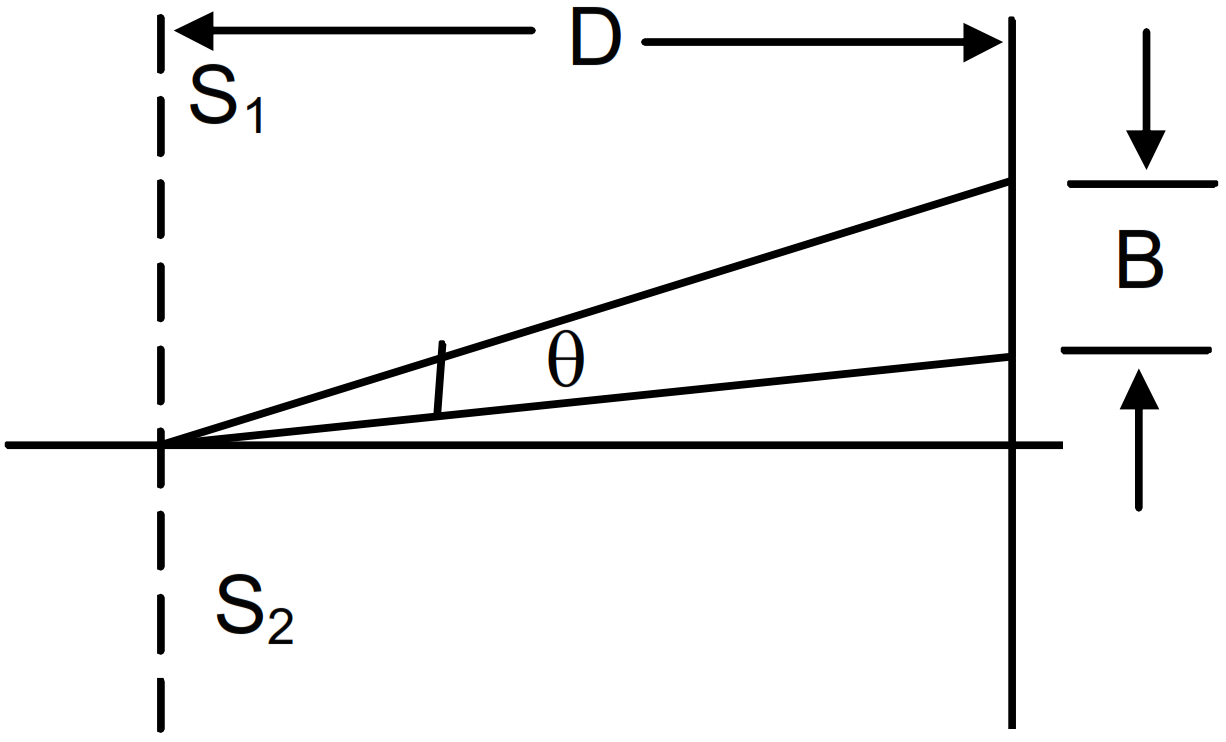
As shown in the figure, angular separation $\theta=\frac{\beta}{\text{D}}=\frac{\lambda\text{D}}{\text{dD}}=\frac{\lambda}{\text{d}}$
So, $\theta=\frac{\beta}{\text{D}}=\frac{\lambda}{\text{d}}=\frac{500\times10^{-9}}{2\times10^{-3}}=250\times10^{-6}$
$= 25 \times 10^{-5}$ radian
$= 0.01$4 degree. View full question & answer→Question 402 Marks
In a double slit interference experiment, the separation between the slits is $1.0mm$, the wavelength of light used is $5.0 \times 10^{-7}m$ and the distance of the screen from the slits is $1.0m.$
- Find the distance of the centre of the first minimum from the centre of the central maximum.
- How many bright fringes are formed in one centimeter width on the screen?
AnswerGiven that, $d = 1mm = 10^{-3}m, D = 1m.$
So, fringe with $=\frac{\text{D}\lambda}{\text{d}}=0.5\text{mm}.$
- So, distance of centre of first minimum from centre of central maximum $=\frac{0.5}{2}\text{mm}=0.25\text{mm}$
- No. of fringes $\frac{10}{0.5}=20.$
View full question & answer→Question 412 Marks
Why is the interference pattern not detected, when two coherent sources are far apart?
AnswerFringe width of interference fringes, is given by $\beta=\frac{\text{D}\lambda}{\text{d}}\alpha\frac{1}{\text{d}},$.If the sources are far apart; d is large; so fringe width $(\beta)$ will be so small that the fringes are not resolved and they do not appear separate. That is why the interference pattern is not detected for large separation of coherent sources.
View full question & answer→Question 422 Marks
A transparent paper $($refractive index $= 1.45)$ of thickness $0.02\ mm$ is pasted on one of the slits of a Young's double slit experiment which uses monochromatic light of wavelength 620nm. How many fringes will cross through the centre if the paper is removed?
AnswerGiven that, $\mu=1.45, t = 0.02mm = 0.02 \times 10^{-3}m$ and $\lambda=620\text{nm}=620\times10^{-9}\text{m}$
We know, when the transparent paper is pasted in one of the slits, the optical path changes by $(\mu-1)\text{t}.$
Again, for shift of one fringe, the optical path should be changed by $\lambda.$
So, no. of fringes crossing through the centre is given by,
$\text{n}=\frac{(\mu-1)\text{t}}{\lambda}=\frac{0.45\times0.02\times10^{-3}}{620\times10^{-9}}=14.5$
View full question & answer→Question 432 Marks
A source emitting light of wavelengths $480\ nm$ and $600\ nm$ is used in. a double slit interference experiment. The separation between the slits is $0.25\ mm$ and the interference is observed on a screen placed at $150\ cm$ from the slits. Find the linear separation between the first maximum $($next to the central maximum$)$ corresponding to the two wavelengths.
AnswerWe know that, the first maximum $($next to central maximum$)$ occurs at $\text{y}=\frac{\lambda\text{D}}{\text{d}}$
Given that, $\lambda_1=480\text{nm},\lambda_2=600\text{nm},$
$D = 150\ cm = 1.5m$ and $d = 0.25mm = 0.25 \times 10^{-3}m$
So, $\text{y}_1=\frac{\text{D}\lambda_1}{\text{d}}=\frac{1.5\times480\times10^{-9}}{0.25\times10^{-3}}=2.88\text{mm}$
$\text{y}_2=\frac{1.5\times600\times10^{-9}}{0.25\times10^{-3}}=3.6\text{mm}.$
So, the separation between these two bright fringes is given by,
$\therefore$ separation $= y_2 - y_1 = 3.60 - 2.88 = 0.72mm.$
View full question & answer→Question 442 Marks
A parallel beam of monochromatic light falls normally on a single narrow slit. How does the angular width of the principal maximum in the resulting diffraction pattern depend on the width of the slit?
AnswerWidth of central maximum, $\beta=\frac{2\lambda\text{D}}{\text{a}}\alpha \frac{1}{\text{a}},$ where a is width of the slit. That is angular width of principal maximum decreases with increase of width of the slit.
View full question & answer→Question 452 Marks
The refractive index of a material is. What is the angle of refraction if the unpolarised light is incident on it at the polarising angle of the medium?
AnswerFrom Brewster's law,
polarising angle $\text{i}_\text{B}=\tan^{-1}\text{(n)}=\tan^{-1}\sqrt3=60^\circ$
Also $\text{i}_\text{B}+\text{r}=90^\circ$
$\therefore$ Angle of refrection $=90^\circ-\text{i}_\text{B}=90^\circ-60^\circ=30^\circ.$
View full question & answer→Question 462 Marks
In a Young's double slit experiment, two narrow vertical slits placed 0.800mm apart are illuminated by the same source of yellow light of wavelength 589nm. How far are the adjacent bright bands in the interference pattern observed on a screen 2.00m away?
AnswerGiven that, $\text{d} = 0.8\text{mm} = 0.8 × 10^{-3}\text{m},$ $\lambda=589\text{nm}=589\times10^{-9}\text{m}\text{ and D}=2\text{m}.$
So, $\beta=\frac{\text{D}\lambda}{\text{d}}=\frac{589\times10^{-9}\times2}{0.8\times10^{-3}}=1.47\times10^{-3}=147\text{mm}.$
View full question & answer→Question 472 Marks
State the importance of coherent sources in the phenomenon of interference.
AnswerIf coherent sources are not taken, the phase difference between two interfering waves, meeting at any point will change continuously and a sustained interference pattern will not be obtained. Thus, coherent sources provide sustained interference pattern.
View full question & answer→Question 482 Marks
A convex lens of diameter 8.0cm is used to focus a parallel beam of light of wavelength 620nm. If the light be focused at a distance of 20cm from the lens, what would be the radius of the central bright spot formed?
Answer$\lambda=620\text{nm}=620\times10^{-9}\text{m},$
$\text{D}=20\text{cm}=20\times10^{-2}\text{m},\text{b}=8\text{cm}=8\times10^{-2}\text{m}$
$\therefore\text{R}=1.22\times\frac{620\times10^{-4}\times20\times10^{-2}}{8\times10^{-2}}$ $=1891\times10^{-9}=1.9\times10^{-6}\text{m}$
So, diameter $=2\text{R}=3.8\times10^{-6}\text{m}$
View full question & answer→Question 492 Marks
In a Young's double slit experiment $\lambda=500\ \text{nm}, d = 1.0\ \text{mm}$ and $D = 1.0m.$ Find the minimum distance from the central maximum for which the intensity is half of the maximum intensity.
AnswerGiven that$, D = 1m, d = 1\text{mm} = 10^{-3}m, \lambda=500\text{nm}=5\times10^{-7}\text{m}$
For intensity to be half the maximum intensity.
$\text{y}=\frac{\lambda\text{D}}{4\text{d}}$
$\Rightarrow\text{y}=\frac{5\times10^{-7}\times1}{4\times10^{-3}}$
$\Rightarrow\text{y}=1.25\times10^{-4}\text{m}.$
View full question & answer→Question 502 Marks
A double slit $S_1 - S_2$ is illuminated by a coherent light of wavelength $\lambda.$ The slits are separated by a distance $d.$ A plane mirror is placed in front of the double slit at a distance $D_1$ from it and a screen $\sum$ is placed behind the double slit at a distance $D_2$ from it $($figure $17-E_2).$ The screen $E$ receives only the light reflected by the mirror. Find the fringe$-$width of the interference pattern on the screen.
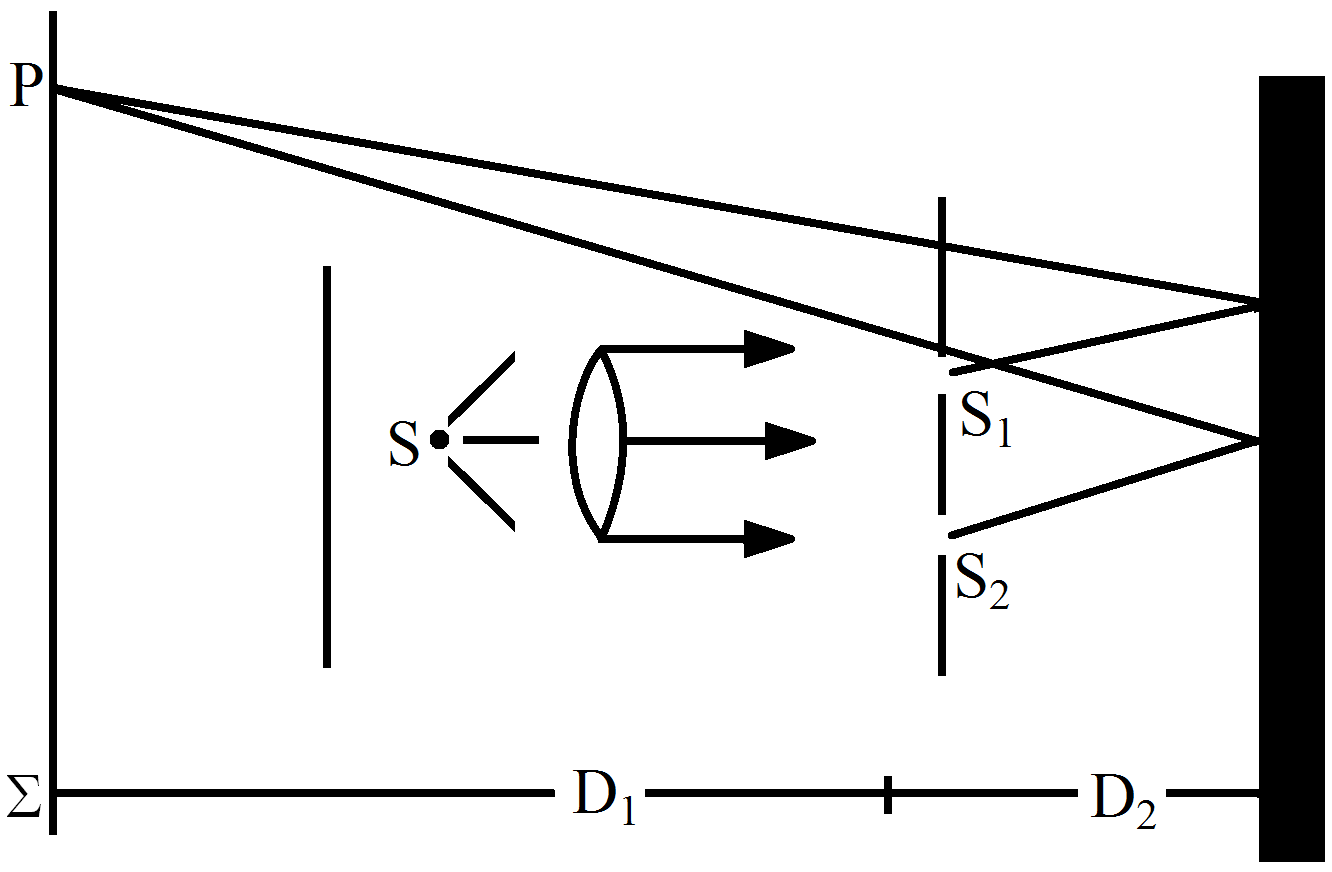
AnswerIt can be seen from the figure that, the apparent distance of the screen from the slits is,
$D = 2D_1 + D_2$
So, Fringe width $=\frac{\text{D}\lambda}{\text{d}}=\frac{(2\text{D}_1+\text{D}_2)\lambda}{\text{d}}$
View full question & answer→