Question
A parallel plate air capacitor has capacity ′C′ farad, potential ′V′ volt and energy ′E′ joule. When the gap between the plates is completely filled with dielectric.

Answer

  1. Both V and E decrease
Explanation:
A parallel- plate capacitor with a dielectric. The electric field is reduced between the plates because the dielectric material is polarized, producing an opposing field. When there is a dielectric, the potential is also reduced because potential is inversely proportional to dielectric

Need a full question paper?

Generate a complete, print-ready paper with questions like this in minutes — across 16+ boards, with answer keys.
Start Generating Free

Similar questions

What is the atomic mass (u) of sodium?
The spectra used to identify the elements in the mixture is:
A particle moves in a closed orbit around the origin, due to a force which is directed towards the origin. The de Broglie wavelength of the particle varies cyclically between two values $\lambda _1, \lambda _2$ with $\lambda _{1 }> \lambda _2$. Whichof the following statement are true?
If a star can convert all the He nuclei completely into oxygen nuclei. The energy released per oxygen nuclei is [Mass of He nucleus is 4.0026 amu and mass of Oxygen nucleus is 15.9994 amu]:
The value of Curie temperature for Ni is nearly:
The equivalent capacitance of three capacitors of capacitance $C_1, C_2$ and $C_3$ are connected in parallel is $12$ units and product $C_1 \cdot C_2 \cdot C_3=48$. When the capacitors $C_1$ and $C_2$ are connected in parallel, the equivalent capacitance is $6$ units. Then the capacitance are
A parallel combination of two capacitors of capacitance $C_1$ and $C_2$ is given a charge $Q$. If there is $Q_1$ charge on $C_1$ and $Q_2$ charge on $C_2$, the ratio of $\frac{Q_1}{Q_2}$ will be:
Ten electrons are equally spaced and fixed around a circle of radius $R$. Relative to $V=0$ at infinity, the electrostatic potential $V$ and the electric field $E$ at the centre $C$ are
Nuclear fission was discovered by(a) Auto Hahn and F. strassmann(b) Fermi(c) Bethe(d) Rutherford
   
   
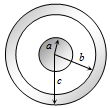
A solid conducting sphere of radius $a$ has a net positive charge $2Q$. A conducting spherical shell of inner radius $b$ and outer radius $c$ is concentric with the solid sphere and has a net charge $– Q$. The surface charge density on the inner and outer surfaces of the spherical shell will be