MCQ
A parallel plate air capacitor has capacity ′C′ farad, potential ′V′ volt and energy ′E′ joule. When the gap between the plates is completely filled with dielectric.
  • A
    Both V and E increase
  • B
    Both V and E decrease
  • C
    V decreases, E increases
  • D
    V increases, E decreases

Answer

  1. Both V and E decrease

Explanation:

A parallel- plate capacitor with a dielectric. The electric field is reduced between the plates because the dielectric material is polarized, producing an opposing field. When there is a dielectric, the potential is also reduced because potential is inversely proportional to dielectric

Need a full question paper?

Generate a complete, print-ready paper with questions like this in minutes — across 16+ boards, with answer keys.

Start Generating Free

Similar questions

Two wires of the same material are given. The first wire is twice as long as the second and has twice the diameter of the second. The resistance of the first will be

(a) Twice of the second

(b) Half of the second

(c) Equal to the second

(d) Four times of the second

The S.I. unit of magnetic permeability is

(a)  

(b) Am

(c)  

(d) No unit, it is a dimensionless number

The potential drop across the 3W resistor is

(a) 1 V

(b) 1.5 V

(c) 2 V

(d) 3 V

On a glass plate a light wave is incident at an angle of 60°. If the reflected and the refracted waves are mutually perpendicular, the refractive index of material is

(a)  

(b)  

(c)   

(d)

An electrically maintained tuning fork vibrates with constant frequency and constant amplitude. If the temperature of the surrounding air increases but pressure remains constant, the sound produced will have:
  1. Larger wavelength.
  2. Larger frequency.
  3. Larger velocity.
  4. Larger time period.
A charged particle enters a magnetic field H with its initial velocity making an angle of 45° with H. Then the path of the particle will be:
Magnetic field can be defined as the:

In comparison to a half wave rectifier, the full wave rectifier gives lower

(a) Efficiency

(b) Average dc

(c) Average output voltage

(d) None of these

A parallel beam of light is incident on a converging lens parallel to its principal axis. As one moves away from the lens on the other side on its principal axis, the intensity of light:
  1. Remains, constant.
  2. Continuously increases.
  3. Continuously decreases.
  4. First increases then decreases.

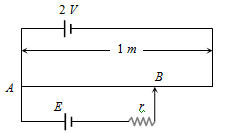
In the given figure, battery E is balanced on 55 cm length of potentiometer wire but when a resistance of 10 W is connected in parallel with the battery then it balances on 50 cm length of the potentiometer wire then internal resistance r of the battery is

(a) 1 W

(b) 3 W

(c) 10 W

(d) 5 W