Questions · Page 1 of 6

M.C.Q [1M]

🎯

Test yourself on this topic

50 questions · timed · auto-graded

MCQ 11 Mark
A point charge is situated at an axial point of a small electric dipole at a large distance from it. The charge experiences a force F. If the distance of the charge is doubled, the force acting on the charge will become:
  • A
    $2\text{F}$
  • B
    $\frac{\text{F}}{2}$
  • C
    $\frac{\text{F}}{4}$
  • D
    $\frac{\text{F}}{8}$
Answer
  1. $\frac{\text{F}}{8}$

Explanation:

The electric field due to dipole at distance r is $\text{E}\propto\frac{1}{\text{r}^3}.$

Thus force on charge is $\text{F}=\text{qE}$

$\Rightarrow\text{F}\propto\frac{1}{(2\text{r})^3}=\frac{\text{F}}{8}.$

View full question & answer
MCQ 21 Mark
An electric dipole consisting of charges +q and -q separated by a distance L is in stable equilibrium in a uniform electric field $\vec{\text{E}}.$ The electrostatic potential energy of the dipole is:
  • A
    qLE
  • B
    zero
  • C
    –qLE
  • D
    –2 qEL
Answer
  1. –qLE

Explanation:

The electrostatic potential energy of the dipole is -qLE.

Given:

An electric dipole consisting of charges +q and -q.

Separation between these two charges is L.

We need to find the electrostatic potential energy of the dipole.

We know electrostatic potential energy of the dipole is given by:

P = -pE .....(1)

Here, p is electric dipole defined by product of charge and distance between them.

p = qL.

Putting value of p in equation 1,

We get, P = -qLE.

View full question & answer
MCQ 31 Mark
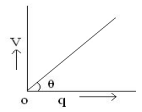
For an isolated object, the graph between potential and charge is given below. The capacity of an object is-
Image
  • A
    $\sin \theta$
  • B
    $\cos \theta$
  • C
    $\tan \theta$
  • $\cot \theta$
Answer
Correct option: D.
$\cot \theta$
D
View full question & answer
MCQ 41 Mark
When air in a capacitor is replaced by a medium of dielectric constant K, the capacity
  • A
    Decreases K times
  • Increases K times
  • C
    Increases times
  • D
    Remains constant
Answer
Correct option: B.
Increases K times
B
View full question & answer
MCQ 61 Mark
How is the electric field at the surface of a charged conductor related to the surface charge density?
  • A
    Proportional to each other.
  • B
    Indirectly proportional.
  • C
    Independent.
  • D
    Exponential.
Answer
  1. Proportional to each other.

Explanation:

The electric field at the surface of a charged conductor is proportional to the surface charge density. The electric field is zero inside the conductor and just outside, it is normal to the surface. The contribution to the total flux comes only from its outer cross-section.

View full question & answer
MCQ 71 Mark
How does the capacitance change with the effect of the dielectric when the battery remains connected across the capacitor?
  • A
    Increases
  • B
    Decreases
  • C
    Zero
  • D
    Remains constant
Answer
  1. Increases

Explanation:

When a dielectric is introduced, and the battery remains connected across the capacitor, the capacitance increases from C0 to C.

C = kC0.

View full question & answer
MCQ 91 Mark
In a region of constant potential:
  • A
    The electric field is uniform.
  • B
    The electric field is zero.
  • C
    The electric field shall necessarily change if a charge is placed outside the region.
  • D
    None of these.
Answer
  1. The electric field is zero.
View full question & answer
MCQ 101 Mark
In an electrical circuit, which of the following quantities is analogous to temperature?
  • A
    Potential
  • B
    Resistance
  • C
    Current
  • D
    Charge
Answer
  1. Potential

Explanation:

When there is a temperature difference, heat flows from high temperature to low temperature. Similarly, when there is a potential difference electric current flows from high potential to low potential. Hence, potential is analogous to temperature.

View full question & answer
MCQ 111 Mark
What is the order of potential difference built up by the Van de Graff generator?
  • A
    Potential difference of the order of hundreds.
  • B
    Potential difference of the order of several million volts.
  • C
    Potential difference of the order of thousands.
  • D
    Potential difference of the order of tens.
Answer
  1. Potential difference of the order of several million volts.

Explanation:

A Van de Graff generator, by means of a moving belt and suitable brushes, transfers charge continuously to a large spherical conducting shell. As a result, a potential difference of the order of several million volts is built up and this can be used for accelerating charged particles.

View full question & answer
MCQ 121 Mark
is equal to the work done by an external agent in carrying a unit of positive charge from the arbitrarily chosen reference point (usually infinity) to that point without any acceleration.
  • A
    Electric potential energy.
  • B
    Electric field.
  • C
    Electric potential.
  • D
    Electric potential difference.
Answer
  1. Electric potential.

Explanation:

Electric potential is equal to work done by an external agent in carrying a unit positive charge from the arbitrary chosen reference point to that point without any acceleration.

View full question & answer
MCQ 161 Mark
It becomes possible to define potential at a point in an electric field because electric field:
  • A
    Is a conservative field.
  • B
    Is a non-conservative field.
  • C
    Is a vector field.
  • D
    Obeys principle of superposition.
Answer
  1. Is a conservative field.
View full question & answer
MCQ 171 Mark
A 1mm thick paper of dielectric constant 4 lies between the plates of a parallel-plate capacitor. It is charged to 100 volt the intensity of electric field between the plates of the condenser will be:
  • A
    100
  • B
    100000
  • C
    400000
  • D
    25000
Answer
  1. 25000

Explanation:

The electric field in between the plates in the presence of dielectric is

$\text{E}=\frac{\text{V}}{\text{Kd}}=\frac{100}{4\times10^{-3}}=25000\text{V/m}$

View full question & answer
MCQ 181 Mark
The positive terminal of 12V battery is connected to the ground. Then the negative terminal will be at:
  • A
    - 6V
  • B
    + 12V
  • C
    Zero
  • D
    - 12V
Answer
  1. - 12V
View full question & answer
MCQ 191 Mark
ECG is a method of diagnosis used to check the functioning of heart, it is based on the principle that there is:
  • A
    A pattern of magnetic field associated with the functioning of heart.
  • B
    An electrical impulse associated with the functioning of organs and tissues of human body.
  • C
    A varying electrical field associated. with organs and tissues of human body.
  • D
    A varying magnetic field associated with organs and tissues of human body.
Answer
  1. An electrical impulse associated with the functioning of organs and tissues of human body.

Explanation:

The heart generates by itself an electrical activity which is transmitted through all the organ and produces its contraction. The Electrocardiogram is no other than the graphical representation of this electrical activity.

View full question & answer
MCQ 201 Mark
The total capacitance of capacitors connected in parallel is given by _____?
  • A
    Product of the individual capacitors in parallel.
  • B
    Sum of all the individual capacitors in parallel.
  • C
    Sum of their reciprocals.
  • D
    Product of their reciprocals.
Answer
  1. Sum of all the individual capacitors in parallel.

Explanation:

The equivalent capacitance of the capacitors connected in parallel is given by sum of their individual capacitances, that is if there are n capacitors in parallel the total capacitance is given by, C = C+ C+ C+ C+ ….. + Cn.

View full question & answer
MCQ 211 Mark
The electrostatic potential on the surface of a charged conducting sphere is 100V. Two statements are made in this regard S1 at any point inside the sphere, electric intensity is zero. S2 at any point inside the sphere, the electrostatic potential is 100V. Which of the following is a correct statement?
  • A
    S1 is true but S2 is false.
  • B
    Both S1 and S2 are false.
  • C
    S1 is true, S2 is also true and S1 is the cause of S2.
  • D
    S1 is true, S2 is also true, but the statements are independant.
Answer
  1. S1 is true, S2 is also true and S1 is the cause of S2.
View full question & answer
MCQ 221 Mark
A capacitor is charged by a battery and then the battery is disconnected. A dielectric slab is introduced between the plates. The result is:
  • A
    P.d between the plates increases, charge on the plate decreases.
  • B
    P.d between the plates decreases, charge remains same.
  • C
    P.d increases, charge remain constant.
  • D
    P.d decreases, charge increases.
Answer
  1. P.d between the plates decreases, charge remains same.

Explanation:

As dielectric slab does not affect charges:

$\text{V}=\frac{\text{Q}}{\text{C}}=\frac{\text{Qd}}{\text{K}\in_0\text{A}}$

View full question & answer
MCQ 231 Mark
In the circuit shown in Fig. initially key K1 is closed and key K2 is open. Then K1 is opened and K2 is closed (order is important). [Take Q1' and Q2' as charges on C1 and C2 and V1 and V2 as voltage respectively.]


Then

  • A
    Charge on C1 gets redistributed such that V1 = V2.
  • B
    Charge on C1 gets redistributed such that Q1' = Q2'.
  • C
    Charge on C1 gets redistributed such that C1V1 + C2V2 = C1 E.
  • D
    Charge on C1 gets redistributed such that Q1' + Q2' = Q.
Answer
  1. Charge on C1 gets redistributed such that V1 = V2.
  1. Charge on C1 gets redistributed such that Q1' + Q2' = Q.

Initially key K1 is closed and key K2 is open, the capacitor C1 is charged by battery and capacitor C2 is still uncharged. Now K1 is opened and K2 is closed, the capacitors C1 and C2 both are connected in parallel. The charge stored by capacitor C1, gets redistributed between C1 and C2 till their potentials become same, i.e., V2 = V1.

By law of conservation of charge, the charge stored in capacitor Cx is equal to sum of charges on capacitors C1 and C2 when K1 is opened and K2 is closed, i.e., Q'1 + Q'2 = Q.

View full question & answer
MCQ 241 Mark
There are two metallic spheres of same radii, but one is solid, and the other is hollow, then:
  • A
    Solid sphere can be given more charge.
  • B
    Hollow sphere can be given more charge.
  • C
    They can be charged equally (maximum).
  • D
    None of the above.
Answer
  1. They can be charged equally (maximum).
View full question & answer
MCQ 251 Mark
what is the potential difference between two points, if 2J of work must be done to move a 4 mC charge from one point to another is:
  • A
    50 V
  • B
    500 V
  • C
    5 V
  • D
    5000 V
Answer
  1. 500 V

Explanation:

The total work done = energy transferred.

So, we might see the equation energy = voltage x charge, E = V × Q, written as,

work = voltage x charge, W = V × Q.

In this case, the charge is 4 mC, that is, 0.004 C and work done is 2J.

View full question & answer
MCQ 261 Mark
Energy is stored in a capacitor in the form of:
  • A
    Electrostatic energy.
  • B
    Magnetic energy.
  • C
    Light energy.
  • D
    Heat energy.
Answer
  1. Electrostatic energy.
View full question & answer
MCQ 271 Mark
The dimensions of electric potential are:
  • A
    [M1 L2 T-3 A-1]
  • B
    [M L-2 T3 A-1]
  • C
    [M L-3 T-3 A-2]
  • D
    [M L-3 T-2 A-1]
Answer
  1. [M1 L2 T-3 A-1]
View full question & answer
MCQ 301 Mark
The surface with a constant value of potential at all points on the surface is called as:
  • A
    Equielectric field surface.
  • B
    Equipotential surface.
  • C
    Constant potential surface.
  • D
    None.
Answer
  1. Equipotential surface.
View full question & answer
MCQ 311 Mark
Electric field is in the direction in which the potential ____ steepest.
  • A
    Increases.
  • B
    Decreases.
  • C
    Remains same.
  • D
    None.
Answer
  1. Decreases.
View full question & answer
MCQ 321 Mark
The maximum electric field that a dielectric medium can withstand without break-down is called its:
  • A
    Permittivity.
  • B
    Dielectric constant.
  • C
    Electric susceptibility.
  • D
    Dielectric strength.
Answer
  1. Dielectric strength.
View full question & answer
MCQ 331 Mark
Electrostatic potential is ______ throughout the volume of the conductor and has _____ value on its surface.
  • A
    Same, constant.
  • B
    Constant, same.
  • C
    Different, same.
  • D
    Constant, different.
Answer
  1. Constant, same.
View full question & answer
MCQ 341 Mark
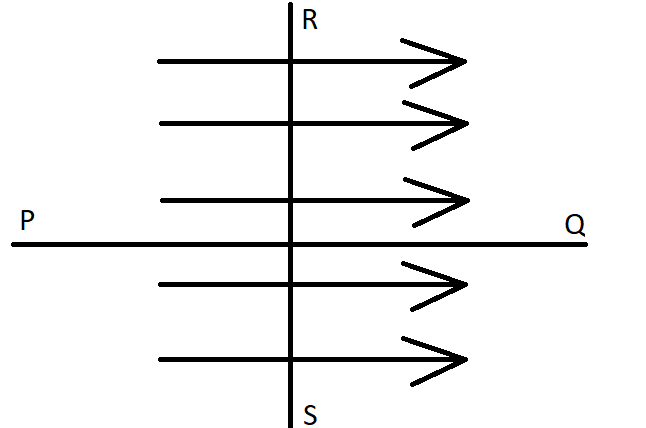
According to the diagram, the equipotential points are _____. The arrows are the direction of the electric field.
Image
  • A
    P and Q
  • B
    S and Q
  • C
    S and R
  • D
    P and R
Answer
  1. S and R

Explanation:

The equipotential surface is always perpendicular to the electric field lines. In the diagram, the electric field lines are horizontal and parallel to each other. Therefore, the equipotential lines must be vertical and the points that have equal potential should be on the vertical line. Therefore, R and S have equal potential.

View full question & answer
MCQ 351 Mark
 Dielectrics are _____________?
  • A
    Conducting substances.
  • B
    Non-conducting substances.
  • C
    Semi-conducting substances.
  • D
    None of the option.
Answer
  1. Non-conducting substances.

Explanation:

Dielectrics are non-conducting substances.

View full question & answer
MCQ 361 Mark
When a dielectric slab is introduced between the two plates of condenser then its capacity ___________.
  • A
    Remains constant
  • B
    Increases
  • C
    Decreases
  • D
    May increase or decrease depending on the material of dielectric slab
Answer
  1. Increases

Explanation:

As the dielectric slab is introduced there is some charge distribution in the slab and because of this the electric field between the two plates is decreased, due to which the capacitor can hold more charge. Thus, the capacity to hold charge of the capacitor is increased.

View full question & answer
MCQ 371 Mark
1V equals:
  • A
    1J
  • B
    1JC−1
  • C
    1CJ−1
  • D
    1JC
Answer
  1. 1JC−1

Explanation:

1 volt is equal to 1 joule of electric potential energy per (divided by) 1 coulomb of charge.

V= J/ C = joule/ coulomb

View full question & answer
MCQ 381 Mark
Which of the following quantities do not depend on the choice of zero potential or zero potential energy?
  • A
    Potential at a point.
  • B
    Potential difference between two points.
  • C
    Potential energy of a two-charge system.
  • D
    None of these.
Answer
  1. Potential difference between two points.
View full question & answer
MCQ 391 Mark
A capacitor works in:
  • A
    A. C. circuits.
  • B
    D. C. circuits.
  • C
    Both (a) and (b).
  • D
    Neither (a) nor (b).
Answer
  1. Neither (a) nor (b).
View full question & answer
MCQ 401 Mark
If a unit positive charge is taken from one point to another over an equipotential surface, then:
  • A
    Work is done on the charge.
  • B
    Work is done by the charge.
  • C
    Work done is constant.
  • D
    No work is done.
Answer
  1. No work is done.
View full question & answer
MCQ 411 Mark
Which of the following is / are true about the principle of Van de Graaff generator?
  • A
    The action of sharp points.
  • B
    The charge given to a hollow conductor is tranferred to outer surface and is distributed uniformly over it.
  • C
    It is used for accelerating uncharged particle.
  • D
    Both (a) and (b).
Answer
  1. Both (a) and (b).
View full question & answer
MCQ 421 Mark
Capacity of a parallel plate condenser can be increased by:
  • A
    Increasing the distance between the plates.
  • B
    Increasing the thickness of the plates.
  • C
    Decreasing the thickness of the plates.
  • D
    Decreasing the distance between the plates.
Answer
  1. Decreasing the distance between the plates.
View full question & answer
MCQ 431 Mark
If in a parallel plate capacitor, which is connected to a battery, we fill dielectrics in whole space of its plates, then which of the following increases?
  • A
    Q and V
  • B
    V and E
  • C
    E and C
  • D
    Q and C
Answer
  1. Q and C

Explanation:

Since battery remains connected so P.D. between the plates is constant. But as we introduce the dielectric the capacitance increases and hence charge increases.

View full question & answer
MCQ 441 Mark
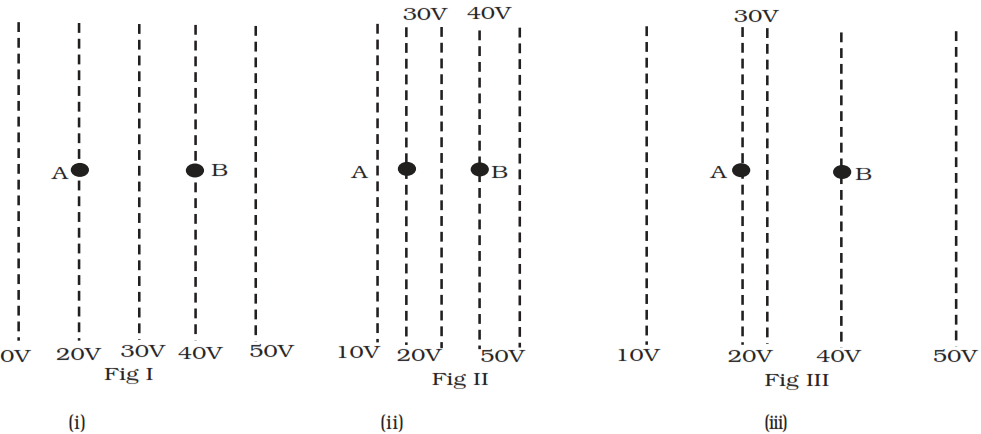
Figure shows some equipotential lines distributed in space. A charged object is moved from point A to point B.

  • A
    The work done in Fig. (i) is the greatest.
  • B
    The work done in Fig. (ii) is least.
  • C
    The work done is the same in Fig. (i) Fig. (ii) and Fig. (iii).
  • D
    The work done in Fig. (iii) is greater than Fig. (ii)but equal to that in Fig. (i).
Answer
  1. The work done is the same in Fig. (i) Fig. (ii) and Fig. (iii).

Key concept: For a given charge distribution, locus of all points or regions for which the electric potential has a constant value are called equipotential regions. Such equipotential can be surfaces, volumes or lines. Regarding equipotential surface the following points should be kept in mind:
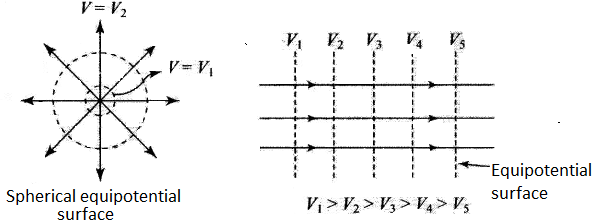
  1. The density of the equipotential lines gives an idea about the magnitude of electric field. Higher the density, larger the field strength.
  2. The direction of electric field is perpendicular to the equipotential surfaces or lines.
  3. The equipotential surfaces produced by a point charge or a spherically charge distribution are a family of concentric spheres.
  4. For a uniform electric field, the equipotential surfaces are a family of plane perpendicular to the field lines.
  5. A metallic surface ofany shape is an equipotential surface.
  6. Equipotential surfaces can never cross each other.
  7. The work done in moving a charge along an equipotential surface is always zero.

As the direction of electric field is always perpendicular to one equipotential surface maintained at high electrostatic potential than other equipotential surface maintained at low electrostatic potential. Hence direction of electric field is from B to A in all three cases.
The positively charged particle experiences electrostatic force along the direction of electric field, hence moves in the direction opposite to electric field. Thus, the work done by the electric field on the charge will be negative. We know

$\text{W}_\text{electrical}=-\Delta\text{U}=-\text{q}\Delta\text{V}=\text{q}(\text{V}_\text{Intial}-\text{V}_\text{final})$

Here initial and final potentials are same in all three cases and same charge is moved, so work done is same in all three cases.
View full question & answer
MCQ 451 Mark
Two metal pieces having a potential difference of 800V are 0.02m apart horizontally. A particle of mass 1.96 × 10⁻¹⁵kg is suspended in equilibrium between the plates. If e is the elementary charge, then charge on the particle is:
  • A
    8
  • B
    6
  • C
    0.1
  • D
    3
Answer
  1. 3
View full question & answer
MCQ 461 Mark
Electric conduction takes place in a discharge tube due to the movement of:
  • A
    Positive ions.
  • B
    Negative ions.
  • C
    Electrons.
  • D
    Protons.
Answer
  1. Positive ions.
  2. Negative ions.
  3. Electrons.

Explanation:

Some ions are always present in gases due to cosmic rays and other factors. When we apply potential difference  across a discharge tube, the ions get accelerated due to the electric field. If the potential difference is large, then the ions get enough energy to ionise the molecules on collision. Thus, a large number of ions are produced and conduction starts. Generally, an electron gets detached from a molecule to make the molecule a positive ion. At low pressure, this electron moves through a large distance and gets attached to another molecule and forms a negative ion. Thus, electric conduction takes place in a discharge tube due to the movement of positive ions, negative ions and electrons.

View full question & answer
MCQ 471 Mark
The potential gradient at which the dielectric of a condenser just gets punctured is called:
  • A
    Dielectric constant.
  • B
    Dielectric strength.
  • C
    Dielectric resistance.
  • D
    Dielectric number.
Answer
  1. Dielectric strength.
View full question & answer
MCQ 481 Mark
Find the true statement.
  • A
    A Van de Graff generator produces large voltage and less current.
  • B
    A Van de Graff generators produces large resistance and less voltage.
  • C
    A Van de Graff generators produces large current and large resistance.
  • D
    A Van de Graff generators produces large current and less voltage.
Answer
  1. A Van de Graff generator produces large voltage and less current.

Explanation:

A Van de Graff generators produces large voltage and less current. A Van de Graff generator is an electrostatic generator which creates very high electric potentials. It produces very high voltage direct current electricity at low current levels.

View full question & answer
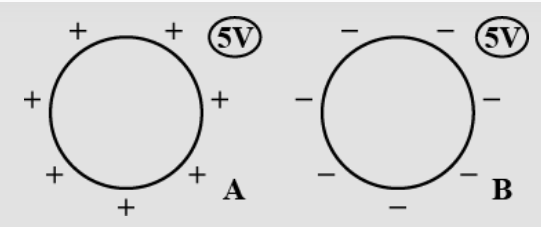
MCQ 491 Mark
Identify the correct statement from below:

  • A
    A will be at higher potential.
  • B
    B will be at higher potential.
  • C
    Both will be at same potential.
  • D
    Can't be said.
Answer
  1. A will be at higher potential.

Explanation:

Point A have positive charge.

More is the positive charge, more will be the potential. So, A will be at higher potential.

View full question & answer
MCQ 501 Mark
If the capacitors having capacitance C1 and C2 are connected in parallel then their effective capacitance is given by:
  • A
    C = C1 - C2
  • B
    C = C1 + C2
  • C
    1/C = 1/C1 + 1/C2
  • D
    1/C = 1/C1 - 1/C2
Answer
  1. C = C1 + C2
View full question & answer
M.C.Q [1M] - Physics STD 12 Science Questions - Vidyadip