Question
A parallel plate capacitor has a capacitance $\mathrm{C}=200 \mathrm{pF}$. It is connected to $230 \mathrm{~V}$ ac supply with an angular frequency $300 \mathrm{rad} / \mathrm{s}$. The $\mathrm{rms}$ value of conduction current in the circuit and displacement current in the capacitor respectively are :

Answer

$I=\frac{V}{X_C}=230 \times 300 \times 200 \times 10^{-12}=13.8 \mu \mathrm{A}$

Need a full question paper?

Generate a complete, print-ready paper with questions like this in minutes — across 16+ boards, with answer keys.

Start Generating Free

Similar questions

Plane polarised light is passed through a polaroid. On viewing through the polaroid we find that when the polariod is given one complete rotation about the direction of the light, one of the following is observed
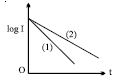
A capacitor of capacity $C$ is charged to a steady potential difference $V$ and connected in series with an open key and a pure resistor $'R'$. At time $t = 0$, the key is closed. If $I =$ current at time $t$, a plot of log $I$ against $'t'$ is as shown in $(1)$ in the graph. Later one of the parameters i.e. $V, R$ or $C$ is changed keeping the other two constant, and the graph $(2)$ is recorded. Then
A table tennis ball has radius $(3 / 2) \times 10^{-2} m$ and mass $(22 / 7) \times 10^{-3} kg$. It is slowly pushed down into a swimming pool to a depth of $d=0.7 m$ below the water surface and then released from rest. It emerges from the water surface at speed $v$, without getting wet, and rises up to a height $H$. Which of the following option(s) is (are) correct?

[Given: $\pi=22 / 7, g=10 ms ^{-2}$, density of water $=1 \times 10^3 kg m ^{-3}$, viscosity of water $=1 \times 10^{-3} Pa$-s.]

$(A)$ The work done in pushing the ball to the depth $d$ is $0.077 J$.

$(B)$ If we neglect the viscous force in water, then the speed $v=7 m / s$.

$(C)$ If we neglect the viscous force in water, then the height $H=1.4 m$.

$(D)$ The ratio of the magnitudes of the net force excluding the viscous force to the maximum viscous force in water is $500 / 9$.
A heavy nucleus $N$, at rest, undergoes fission $N \rightarrow P+Q$, where $P$ and $Q$ are two lighter nuclei. Let $\delta=M_N-M_P-M_Q$, where $M_P, M_Q$ and $M_N$ are the masses of $P, Q$ and $N$, respectively. $E_P$ and $E_Q$ are the kinetic energies of $P$ and $Q$, respectively. The speed of $P$ and $Q$ are $v_P$ and $v_Q$, respectively. If $c$ is the speed of light, which of the following statement(s) is(are) correct ?

$(A)$ $E_P+E_Q=c^2 \delta$

$(B)$ $E_P=\left(\frac{M_P}{M_P+M_Q}\right) c^2 \delta$

$(C)$ $\frac{v_P}{v_Q}=\frac{M_Q}{M_P}$

$(D)$ The magnitude of momentum for $P$ as well as $Q$ is $c \sqrt{2 \mu \delta}$, where $\mu=\frac{M_P M_Q}{\left(M_P+M_Q\right)}$

The refractive indices of glass and water w.r.t. air are $3/2$ and $4/3$ respectively. The refractive index of glass w.r.t. water will be
A whistle emitting a loud sound of frequency $540 \,Hz$ is whirled in a horizontal circle of radius $2 \,m$ and at a constant angular speed of $15 \,rad / s$. The speed of sound is $330 \,m / s$. The ratio of the highest to the lowest frequency heard by a listener standing at rest at a large distance from the centre of the circle is
The current density in a cylindrical wire of radius $4 \; mm$ is $4 \times 10^{6} \; Am ^{-2}$. The current through the outer portion of the wire between radial distance $\frac{R}{2}$ and $R$ is $\dots \; \pi A .$
A particle is moving in a straight line. The variation of position ' $x$ ' as a function of time ' $t$ ' is given as $x=\left(t^3-6 t^2+20 t+15\right) m$. The velocity of the body when its acceleration becomes zero is :
A simple pendulum with bob of mass $m$ and length $x$ is held in position at an angle $\theta_1$ and then angle $\theta_2$ with the vertical. When released from these positions, speeds with which it passes the lowest positions are $v_1$ and $v_2$ respectively. Then, $\frac{v_1}{v_2}$ is .............
Propanal on treatment with dilute sodium hydroxide forms