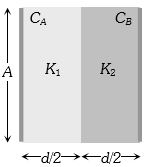
A parallel plate capacitor has capacitance $C$. If it is equally filled with parallel layers of materials of dielectric constants $K_1$ and $K_2$ its capacity becomes $C_1$. The ratio of $C_1$ to $C$ is
Experience the future of education. Simply download our apps or reach out to us for more information. Let's shape the future of learning together!No signup needed.*
Two identical thin metal plates has charge $q _{1}$ and $q _{2}$ respectively such that $q _{1}> q _{2}$. The plates were brought close to each other to form a parallel plate capacitor of capacitance $C$. The potential difference between them is.
The electrostatic potential $V$ at a point on the circumference of a thin non-conducting disk of radius $r$ and uniform charge density $\sigma$ is given by equation $V = 4 \sigma r$. Which of the following expression correctly represents electrostatic energy stored in the electric field of a similar charged disk of radius $R$?
Two identical particles of mass m carry a charge $Q$ each. Initially one is at rest on a smooth horizontal plane and the other is projected along the plane directly towards first particle from a large distance with speed $v.$ The closest distance of approach be
A parallel plate capacitor having plates of area $S$ and plate separation $d$, has capacitance $C _1$ in air. When two dielectrics of different relative permittivities $\left(\varepsilon_1=2\right.$ and $\left.\varepsilon_2=4\right)$ are introduced between the two plates as shown in the figure, the capacitance becomes $C _2$. The ratio $\frac{ C _2}{ C _1}$ is
Seven capacitors, each of the capacitance $2\,\mu F$, are to be connected in a configuration to obtain an effective capacitance of $\left( {\frac{6}{{13}}} \right)\,\mu F$. Which of the combinations, shown in figures below, will achieve the desired value ?
The switch in circuit shifts from $1$ to $2$ when $V_C > 2V/3$ and goes back to $1$ from $2$ when $V_C < V/3$ . The voltmeter reads voltage as plotted. What is the period $T$ of the wave form in terms of $R$ and $C$ ?
charge $Q$ is uniformly distributed over a long rod $AB$ of length $L$ as shown in the figure. The electric potential at the point $O$ lying at distance $L$ from the end $A$ is
A $2 \ \mu F$ capacitor is charged as shown in figure. The percentage of its stored energy dissipated after the switch $S$ is turned to position $2$ is