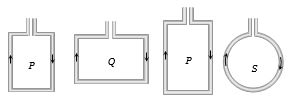
Four wires each of length $2.0\, metres$ are bent into four loops $P$, $Q$, $R$ and $S$ and then suspended into uniform magnetic field. Same current is passed in each loop. Which statement is correct
Easy


Download our appand get started for free
Experience the future of education. Simply download our apps or reach out to us for more information. Let's shape the future of learning together!No signup needed.*
Similar Questions
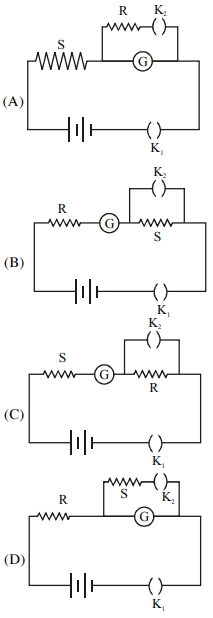
- 1In the circuit diagrams $(A, B, C$ and $D$) shown below, $R$ is a high resistance and $S$ is a resistance of the order of galvanometer resistance $G$. The correct circuit, corresponding to the half deflection method for finding the resistance and figure of merit of the galvanometer, is the circuit labelled asView Solution
- 2The magnetic force acting on charged particle of charge $2\,\mu C$ in magnetic field of $2\, T$ acting in $y-$ direction , when the particle velocity is $\left( {2\hat i + 3\hat j} \right) \times {10^6}\,m{s^{ - 1}}$ isView Solution
- 3View SolutionThe motion of a charged particle can be used to distinguish between a magnetic field and electric field in a certain region by firing the charge
- 4View SolutionA beam of electrons and protons move parallel to each other in the same direction, then they
- 5A single turn current loop in the shape of a right angle triangle with sides $5\,cm , 12\,cm , 13\,cm$ is carrying a current of $2\,A$. The loop is in a uniform magnetic field of magnitude $0.75\,T$ whose direction is parallel to the current in the $13\,cm$ side of the loop. The magnitude of the magnetic force on the $5\,cm$ side will be $\frac{ x }{130}\,N$. The value of $x$ is $..........$View Solution
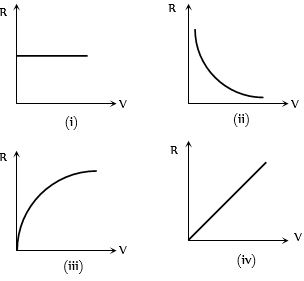
- 6The graph which represents the relation between the total resistance $R$ of a multi range moving coil voltmeter and its full scale deflection $V$ isView Solution
- 7An $\alpha - $ particle travels in a circular path of radius $0.45\, m$ in a magnetic field $B = 1.2\,Wb/{m^2}$ with a speed of $2.6 \times {10^7}\,m/\sec $. The period of revolution of the $\alpha - $ particle isView Solution
- 8Two identical conducting wires $AOB$ and $COD$ are placed at right angles to each other. The wire $AOB$ carries an electric current $I_1$ and $COD$ carries a current $I_2$ . The magnetic field on a point lying at a distance $d$ from $O$, in a direction perpendicular to the plane of the wires $AOB$ and $COD$, will be given byView Solution
- 9Two particles of charges $+Q$ and $-Q$ are projected from the same point with a velocity $v$ in a region of uniform magnetic field $B$ such that the velocity vector makes an angle $q$ with the magnetic field. Their masses are $M$ and $2M,$ respectively. Then, they will meet again for the first time at a point whose distance from the point of projection isView Solution
- 10In a mass spectrometer used for measuring the masses of ions, the ions are initially accelerated by an electric potential $V$ and then made to describe semicircular paths of radius $R$ using a magnetic field $B$. If $V$ and $B$ are kept constant, the ratio $\left( {\frac{{{\text{charge on the ion}}}}{{{\text{mass of the ion}}}}} \right)$ will be proportional toView Solution