MCQ
A parallel plate capacitor has capacitance C. If it is equally filled with parallel layers of materials of dielectric constants $\mathrm{K}_1$ and $\mathrm{K}_2$ its capacity becomes $C_1$. The ratio of $C_1$ to $C$ is
  • A
    $K_1+K_2$
  • B
    $\frac{K_1+K_2}{K_1-K_2}$
  • C
    $\frac{K_1+K_2}{K_1K_2}$
  • $\frac{2K_1K_2}{K_1+K_2}$

Answer

Correct option: D.
$\frac{2K_1K_2}{K_1+K_2}$
(d) $\frac{2K_1K_2}{K_1+K_2}$

Need a full question paper?

Generate a complete, print-ready paper with questions like this in minutes — across 16+ boards, with answer keys.

Start Generating Free

Similar questions

A coil of $100$ turns carries a current of $5 \ mA$ and creates a magnetic flux of $10^{-5}$ weber. the inductance is
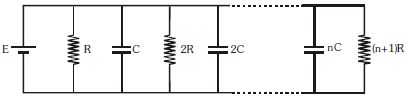
For shown situation, in steady state condition ratio of charge stored in the first and last $n^{th}$ capacitor is
Two identical charged spheres are suspended by strings of equal lengths. The strings make an angle $\theta$ with each other. When suspended in water the angle remains the same. If density of the material of the sphere is $1.5 \mathrm{~g} / \mathrm{cc}$, the dielectric constant of water will be

(Take density of water $=1 \mathrm{~g} / \mathrm{cc}$ )

Two beams of light having intensities I and 4I interfere to produce a fringe pattern on a screen. The phase difference between the beams is $\frac{\pi}{2}$ at point A and p at point B. Then the difference between the resultant intensities at A and B is 
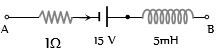
The network shown in the figure is a part of a complete circuit. If at a certain instant the current $i$ is $5\, A$ and is decreasing at the rate of ${10^3}A/s$ then ${V_A} - {V_B}$ is......$ V$
Infinite number of cells having $emf$ and internal resistance $\left( {E,r} \right)$, $\left( {\frac{E}{n},\frac{r}{n}} \right)$, $\left( {\frac{E}{{{n^2}}},\frac{r}{{{n^2}}}} \right)$, $\left( {\frac{E}{{{n^3}}},\frac{r}{{{n^3}}}} \right)$..... are connected in series in same manner across an external resistance of $\frac{{nr}}{{n + 1}}$ . Current flowing through the external resistor is
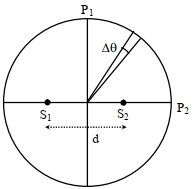
Two coherent monochromatic point sources $S_1$ and $S_2$ of wavelength $\lambda=600 \mathrm{~nm}$ are placed symmetrically on either side of the centre of the circle as shown. The sources are separated by a distance $d=1.8 ~mm$. This arrangement produces interference fringes visible as alternate bright and dark spots on the circumference of the circle. The angular separation between two consecutive bright spots is $\Delta \theta$. Which of the following options is/are correct?

(image)

$[A]$ A dark spot will be formed at the point $\mathrm{P}_2$

$[B]$ At $P_2$ the order of the fringe will be maximum

$[C]$ The total number of fringes produced between $P_1$ and $P_2$ in the first quadrant is close to $3000$

$[D]$ The angular separation between two consecutive bright spots decreases as we move from $P_1$ to $P_2$ along the first quadrant

A body has – 80 micro coulomb of charge. Number of additional electrons in it will be
Light rays from a source are incident on a glass prism of index of refraction $\mu $ and angle of prism $\alpha $. At near normal incidence, the angle of deviation of the emerging rays is
An electromagnetic wave of wavelength $\lambda$ is incident on a photosensitive surface of negligible work function. If $m$ mass is of photoelectron emitted from the surface has de-Broglie wavelength $\lambda_{\mathrm{d}}$, then