Question
A parallel $-$ plate capacitor having plate area $20\ cm^2$ and separation between the plates $1.00\ mm$ is connected to a battery of $12.0V$. The plates are pulled apart to increase the separation to $2.0\ mm$.
  1. Calculate the charge flown through the circuit during the process.
  2. How much energy is absorbed by the battery during the process?
  3. Calculate the stored energy in the electric field before and after the process.
  4. Using the expression for the force between the plates, find the work done by the person pulling the plates apart.
  5. Show and justify that no heat is produced during this transfer of charge as the separation is increased.
Answer

Area $= a = 20\ cm^2 = 2 \times 10^{-2}m^2 d =$ Separation $= 1\ mm = 10^{-3}m$ $\text{C}_{\text{i}}=\frac{\epsilon_0\times2\times10^{-3}}{10^{-3}}=2\epsilon_0$
$\text{C}_{\text{f}}=\frac{\epsilon_0\times2\times10^{-3}}{2\times10^{-3}}=\epsilon_0$
$\text{q}_{\text{i}}=24\epsilon_0$
$\text{q}_{\text{f}}=12\epsilon_0$
  1. So $, q$ flown out $12\epsilon_0.$ i.e. $, q_i - q_f$
So $, q = 12 \times 8.85 \times 10^{-12} = 106.2 \times 10^{-12}C = 1.06 \times 10^{-10}C$
  1. Energy absorbed by battery during the process
$= q \times v = 1.06 \times 10^{-10}C \times 12$
$= 12.7 \times 10^{-10}J$
  1. Before the process
$\text{E}_{\text{i}}=\Big(\frac{1}{2}\Big)\times\text{C}_{\text{i}}\times\text{V}^2$
$=\Big(\frac{1}{2}\Big)\times2\times8.85\times10^{-12}\times144$
$=12.7\times10^{-10}\text{J}$
After the force
$\text{E}_{\text{f}}=\Big(\frac{1}{2}\Big)\times\text{C}_{\text{f}}\times\text{V}^2$
$=\Big(\frac{1}{2}\Big)\times8.85\times10^{-12}\times144$
$=6.35\times10^{-10}\text{J}$
  1. Workdone $=$ Force $\times$ Distance
$=\frac{1}{2}\frac{\text{q}^2}{\epsilon_0\text{A}}=1\times10^{3}$
$=\frac{1}{2}\times\frac{12\times12\times\epsilon_0\times\epsilon_0\times10^{-3}}{\epsilon_0\times2\times10^{-3}}$
  1. From $(c)$ and $(d)$ we have calculated, the energy loss by the separation of plates is equal to the work done by the man on plate.
  2. Hence no heat is produced in transformer.

Need a full question paper?

Generate a complete, print-ready paper with questions like this in minutes — across 16+ boards, with answer keys.

Start Generating Free

Similar questions

A capacitor of capacitance $5.00\mu\text{F}$ is charged to $24.0V$ and another capacitor of capacitance $6.0\mu\text{F}$ is charged to $12.0V$ :
  1. Find the energy stored in each capacitor.
  2. The positive plate of the first capacitor is now connected to the negative plate of the second and vice versa. Find the new charges on the capacitors.
  3. Find the loss of electrostatic energy during the process.
  4. Where does this energy go?
A proton and an $\alpha -$particle are accelerated, using the same potential difference. How are the de$-$Broglie wavelengths $\lambda _p$ and $\lambda _a$ related to each other?
A student is studying a book placed near the edge of a circular table of radius $R$. A point source of light is suspended directly above the centre of the table. What should be the height of the source above the table so as to produce maximum illuminance at the position of the book?
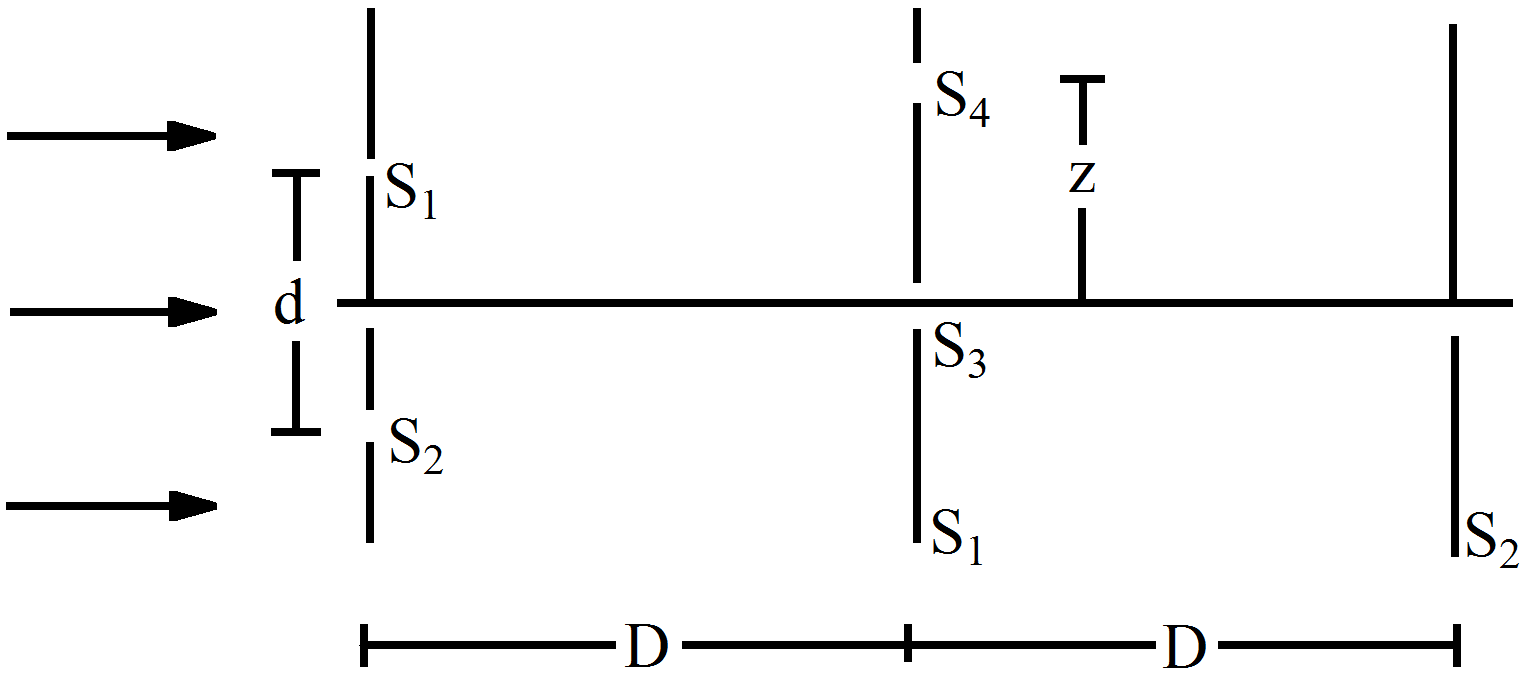
Consider the situation shown in figure $(17-E6)$. The two slits $S_1$ and $S_2\ p$ laced symmetrically around the central line are illuminated by a monochromatic light of wavelength $\lambda.$ The separation between the slits is $d$. The light transmitted by the slits falls on a screen $E_1$ placed at a distance $D$ from the slits. The slit $S_3$ is at the central line and the slit $S_4$ is at a distance $z$ from $S_3$. Another
screen $\sum_2$ is placed a further distance $D$ away from $\sum_1$. Find the ratio of the maximum to minimum intensity observed on $\sum_2$, if z is equal to,
  1. $\text{z}=\frac{\lambda\text{D}}{2\text{d}}$
  2. $\frac{\lambda\text{D}}{\text{d}}$
  3. $\frac{\lambda\text{D}}{4\text{d}}$
Water leaks out from an open tank through a hole of area $2\ mm^2$ in the bottom. Suppose water is filled up to a height of $80\ cm$ and the area of cross $-$ section of the tank is $0.4m^2$. The pressure at the open surface and at the hole are equal to the atmospheric pressure. Neglect the small velocity of the water near the open surface in the tank.
  1. Find the initial speed of water coming out of the hole.
  2. Find the speed of water coming out when half of water has leaked out.
  3. Find the volume of water leaked out during a time interval dt after the height remained is $h$. Thus find the decrease in height dh in terms of $h$ and dt.
  4. From the result of part $c$ find the time required for half of the water to leak out.
A small plane area is rotated in an electric field. In which orientation of the area is the flux of electric field through the area maximum? In which orientation is it zero?
Define electric dipole moment. Calculate the value of electric potential generated from electric dipole and prove that its value is maximum at the point situated on the axis and zero at the equatorial point? ###Define electric dipole moment of electric dipole. Obtain an expression for the electric potential at a common point due to electric dipole. Also draw necessary diagram.
Consider $N = n_1n_2$ identical cells, each of emf $\epsilon$ and internal resistance $r$. Suppose $n_1$ cells are joined in series to form a line and $n_2$ such lines are connected in parallel. The combination drives a current in an external resistance $R. (a)$ Find the current in the external resistance. $(b)$ Assuming that $n_1$ and $n_2$ can be continuously varied, find the relation between $n_1, n_2, R$ and $r$ for which the current in $R$ is maximum.
Calculate the work done in moving a test charge q0 from point A to point B against the repulsive force acting on it due to the other charge Q > 0 located at the origin.
Exlplain ac voltage applied on a series LCR circuit. Explain its solution by phasor diagram.