Question
A proton and an $\alpha -$particle are accelerated, using the same potential difference. How are the de$-$Broglie wavelengths $\lambda _p$ and $\lambda _a$ related to each other?

Answer

Key concept:
Hence de$-$Broglie wavelength : $\lambda=\frac{\text{h}}{\text{p}}=\frac{\text{h}}{\sqrt{2\text{mE}}}=\frac{\text{h}}{\sqrt{2\text{mqV}}}$
In this problrm since both proton and $\alpha-$ particle are accelerated through same potential difference,
We know that, $\lambda=\frac{\text{h}}{\sqrt{2\text{mqv}}}$
$\therefore\ \lambda\propto\frac{1}{\sqrt{\text{mq}}}$
$\frac{\lambda_\text{p}}{\lambda_\alpha}=\frac{\sqrt{\text{m}_\alpha\text{q}_\alpha}}{\text{m}_\text{p}\text{q}_\text{p}}$
$=\frac{\sqrt{4\text{m}_\text{p}\times2\text{e}}}{\sqrt{\text{m}_\text{p}\times\text{e}}}$
​​​​​​​$=\sqrt{8}$
$\therefore\ \lambda_\text{p}=\sqrt{8}\lambda_\alpha$
i.e., wavelength of proton is times wavelength of $\alpha-$particle.
Important point:
De$-$Broglie wavelength associated with the charged particles:
The energy of a charged particle acceletated through potential difference $V$ is $\text{E}=\frac{1}{2}\text{mv}^2=\text{qV}$
Hence de$-$Broglie wavelength $\lambda=\frac{\text{h}}{\text{p}}=\frac{\text{h}}{\sqrt{2\text{mE}}}=\frac{\text{h}}{\sqrt{2\text{mqV}}}$
$\lambda_\text{Electron}=\frac{12.27}{\sqrt{\text{V}}}\mathring{\text{A}},\lambda_\text{Proton}=\frac{0.286}{\sqrt{\text{V}}}\mathring{\text{A}}$
$\lambda_\text{Deutron}=\frac{0.200}{\sqrt{\text{V}}}\mathring{\text{A}},\lambda_{\alpha-\text{particle}}=\frac{0.101}{\sqrt{\text{V}}}\mathring{\text{A}}$

Need a full question paper?

Generate a complete, print-ready paper with questions like this in minutes — across 16+ boards, with answer keys.
Start Generating Free

Similar questions

A $100$ turn closely wound circular coil of radius $10 \ cm$ carries a current of $3.2 A. \ (a)$ What is the field at the centre of the coil? $(b)$ What is the magnetic moment of this coil?
The coil is placed in a vertical plane and is free to rotate about a horizontal axis which coincides with its diameter. A uniform magnetic field of $2 T$ in the horizontal direction exists such that initially the axis of the coil is in the direction of the field. The coil rotates through an angle of $90^{\circ}$ under the influence of the magnetic field. $(c)$ What are the magnitudes of the torques on the coil in the initial and final position?
$(d)$ What is the angular speed acquired by the coil when it has rotated by $90^{\circ}$ ? The moment of inertia of the coil is $0.1 \ kg m ^2$.
Find the wavelength of the radiation emitted by hydrogen in the transitions $(a) n = 3$ to $n= 2, (b) n = 5$ to $n = 4$ and $(c) n = 10$ to $n = 9.$
Establish the relation between electric field and potential gradient.
Test if the following equations are dimensionally correct:
  1. $\text{h}=\frac{2\text{S}\cos\theta}{\rho\text{rg}}$
  2. $\text{u}=\sqrt{\frac{\text{P}}{\rho}}$
  3. $\text{V}=\frac{\pi\text{Pr}^4\text{t}}{8\eta l}$
  4. $\text{v}=\frac{1}{2\pi}\sqrt{\frac{\text{mg}l}{\text{I}}}$
where h = height, S = surface tension, $\rho$ = density, P = pressure, V = volume, $\eta$ = coefficient of viscosity, v = frequency and I = moment of inertia.
The benches of a gallery in a cricket stadium are 1m wide and 1m high. A batsman strikes the ball at a level one metre above the ground and hits a mammoth sixer. The ball starts at 35m/s at an angle of 53° with the horizontal. The benches are perpendicular to the plane of motion and the first bench is 110m from the batsman. On which bench will the ball hit?
  1. State Kirchhoff’s rules for an electric network. Using Kirchhoff’s rules, obtain the balance condition in terms of the resistances of four arms of Wheat sone bridge.
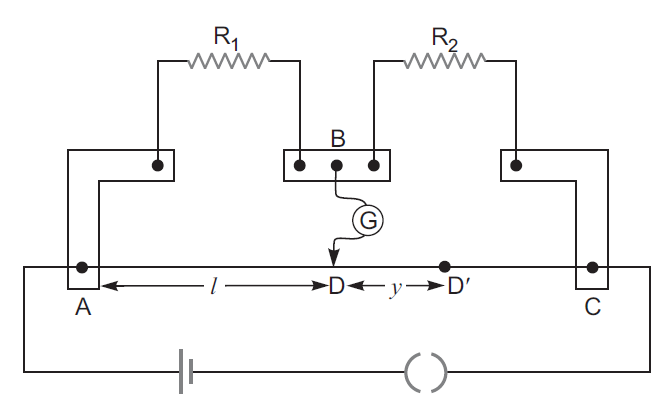
  2. In the meter bridge experimental set up, shown in the figure, the null point $'D\ '$ is obtained at a distance of $40 \ cm$ from end $A$ ofthe meter bridge wire. If a resistance of $10 \Omega$ is connected in series with $R_1,$ null point is obtained at $AD = 60 \ cm$. Calculate the value of $R_1$ and $R_2$.
A parallel plate capacitor is charged by a battery. After some time the battery is disconnected and a dielectric slab with its thickness equal to the plate separation is inserted between the plates. What change, in any will take place in
i. charge on the plates
ii. electric field intensity between the plates
iii. the capacitance of the capacitor,
iv. a potential difference between the plates and
v. the energy stored in the capacitor? Justify your answer in each case. OR

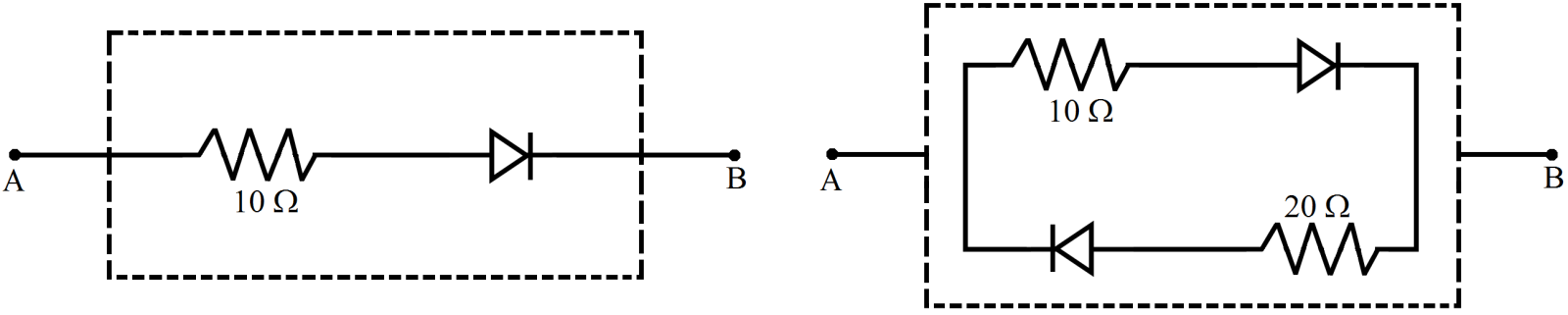
Draw the current-voltage characteristics for the device shown in figure. between the terminals A and B.
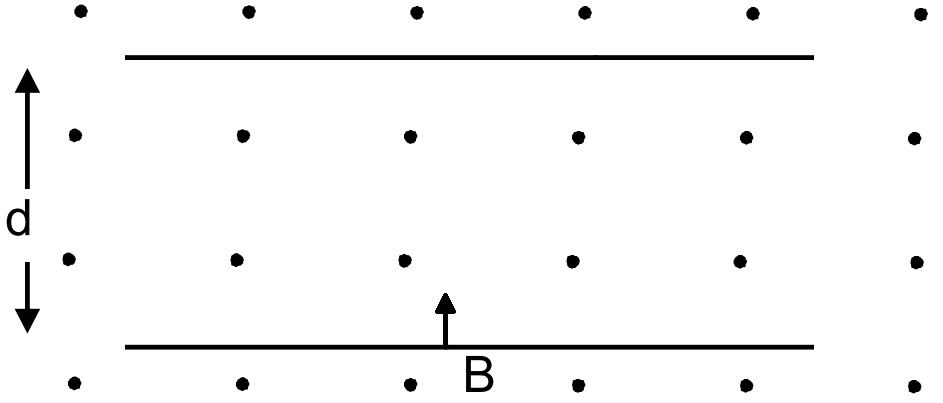
An electron is emitted with negligible speed from the negative plate of a parallel$-$plate capacitor charged to a potential difference $V$. The separation between the plates is $d$ and $a$ magnetic field Bexists in the space, as shown in the figure. Show that the electron will fail to strike the upper plates if $\text{d} > \Big(\frac{2\text{m}_\text{e}\text{v}}{\text{eB}^2}\Big)^{\frac{1}{2}}.$
Two coherent point sources $S_1$ and $S_2$ vibrating in phase emit light of wavelength $\lambda$. The separation between the sources is $2\lambda$. Consider a line passing through $S_2$ and perpendicular to the line $S_1S_2.$ What is the smallest distance from $S_2$ where a minimum of intensity occurs?