Question
A parallel-plate capacitor having plate area 20cm2 and separation between the plates 1.00mm is connected to a battery of 12.0V. The plates are pulled apart to increase the separation to 2.0mm.
  1. Calculate the charge flown through the circuit during the process.
  2. How much energy is absorbed by the battery during the process?
  3. Calculate the stored energy in the electric field before and after the process.
  4. Using the expression for the force between the plates, find the work done by the person pulling the plates apart.
  5. Show and justify that no heat is produced during this transfer of charge as the separation is increased.
Answer

Area = a = 20cm2 = 2 × 10⁻²m2

d = Separation = 1mm = 10-3m

$\text{C}_{\text{i}}=\frac{\in_0\times2\times10^{-3}}{10^{-3}}=2\in_0$

$\text{C}_{\text{f}}=\frac{\in_0\times2\times10^{-3}}{2\times10^{-3}}=\in_0$

$\text{q}_{\text{i}}=24\in_0$

$\text{q}_{\text{f}}=12\in_0$

  1. So, q flown out $12\in_0.$ i.e., qi - qf

So, q = 12 × 8.85 × 10-12 = 106.2 × 10⁻¹²C = 1.06 × 10⁻¹⁰C

  1. Energy absorbed by battery during the process

= q × v = 1.06 × 10-10C × 12

= 12.7 × 10⁻¹⁰J

  1. Before the process

$\text{E}_{\text{i}}=\Big(\frac{1}{2}\Big)\times\text{C}_{\text{i}}\times\text{V}^2$

$=\Big(\frac{1}{2}\Big)\times2\times8.85\times10^{-12}\times144$

$=12.7\times10^{-10}\text{J}$

After the force

$\text{E}_{\text{f}}=\Big(\frac{1}{2}\Big)\times\text{C}_{\text{f}}\times\text{V}^2$

$=\Big(\frac{1}{2}\Big)\times8.85\times10^{-12}\times144$

$=6.35\times10^{-10}\text{J}$

  1. Workdone = Force × Distance

$=\frac{1}{2}\frac{\text{q}^2}{\in_0\text{A}}=1\times10^{3}$

$=\frac{1}{2}\times\frac{12\times12\times\in_0\times\in_0\times10^{-3}}{\in_0\times2\times10^{-3}}$

  1. From (c) and (d) we have calculated, the energy loss by the separation of plates is equal to the work done by the man on plate. Hence no heat is produced in transformer.

Need a full question paper?

Generate a complete, print-ready paper with questions like this in minutes — across 16+ boards, with answer keys.

Start Generating Free

Similar questions

Water at 50°C is filled in a closed cylindrical vessel of height 10cm and cross sectional area 10cm2. The walls of the vessel are adiabatic but the flat parts are made of 1mm thick aluminium $(\text{K}=200\text{Js}^{-1}\text{m}^{-1}{^{\circ}}\text{C}^{-1}).$ Assume that the outside temperature is 20°C. The density of water is 1000kgm-3, and the specific heat capacity of water $= 4200\text{Jkg}^{-1}{^{\circ}}\text{C}^{-1}.$ Estimate the time taken for the temperature to fall by 1.0°C. Make any simplifying assumptions you need but specify them.
How many time constants will elapse before the energy stored in the capacitor reaches half of its equilibrium value in a charging RC circuit?
A suitcase kept on a shop's rack is measured 50cm × 25cm × 10cm by the shop's owner. A traveller takes this suitcase in a train moving with velocity 0.6c.
If the suitcase is placed with its length along the train's velocity, find the dimensions measured by:
  1. The traveller and.
  2. A ground observer.
What is interference of light? Write two essential conditions for sustained interference pattern to be produced on the screen.
Draw a graph showing the variation of intensity versus the position on the screen in Young’s experiment when (a) both the slits are opened and (b) one of the slits is closed.
What is the effect on the interference pattern in Young’s double slit experiment when:
  1. Screen is moved closer to the plane of slits?
  2. Separation between two slits is increased?
Explain your answer in each case.
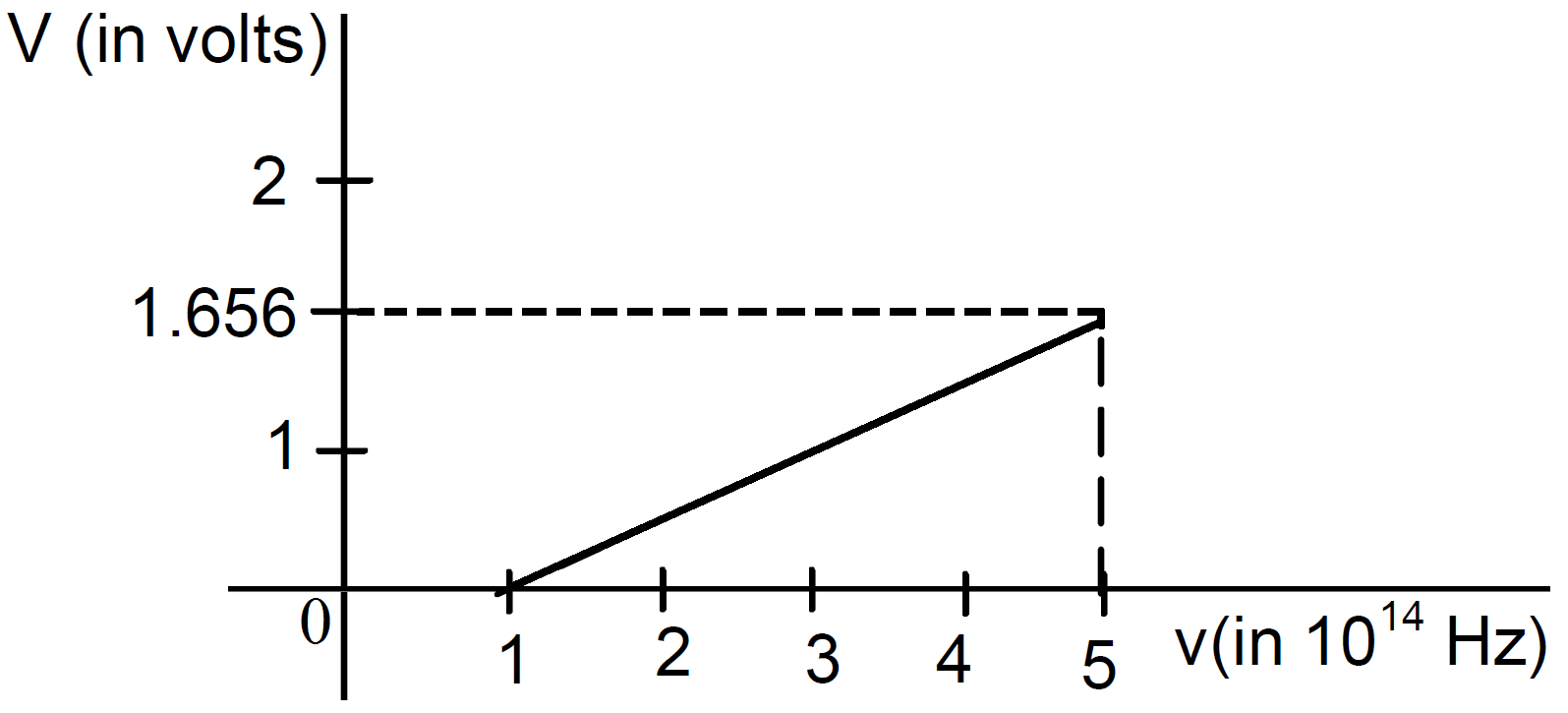
Figure is the plot of the stopping potential versus the frequency of the light used in an experiment on photoelectric effect. Find.

  1. The ratio h/e and.
  2. The work function.

Verify the Gauss’s law for magnetic field of a point dipole of dipole moment m at the origin for the surface which is a sphere of radius R.
Two spherical bodies, each of mass 50kg, are placed at a separation of 20cm. Equal charges are placed on the bodies and it is found that the force of Coulomb repulsion equals the gravitational attraction in magnitude. Find the magnitude of the charge placed on either body.
Define various types of magnetism on the basis of atomic model of magnetisation.
The $\text{K}_\beta$ X-rays from certain elements are given below. Draw a Moseley-type plot of $\sqrt{\text{v}}$ versus Z for $\text{K}_\beta$ radiation.
Element
Ne
P
Ca
Mn
Zn
Br
Energy (keV)
0.858
2.14
4.02
6.51
9.57
13.3