Question
What is interference of light? Write two essential conditions for sustained interference pattern to be produced on the screen.
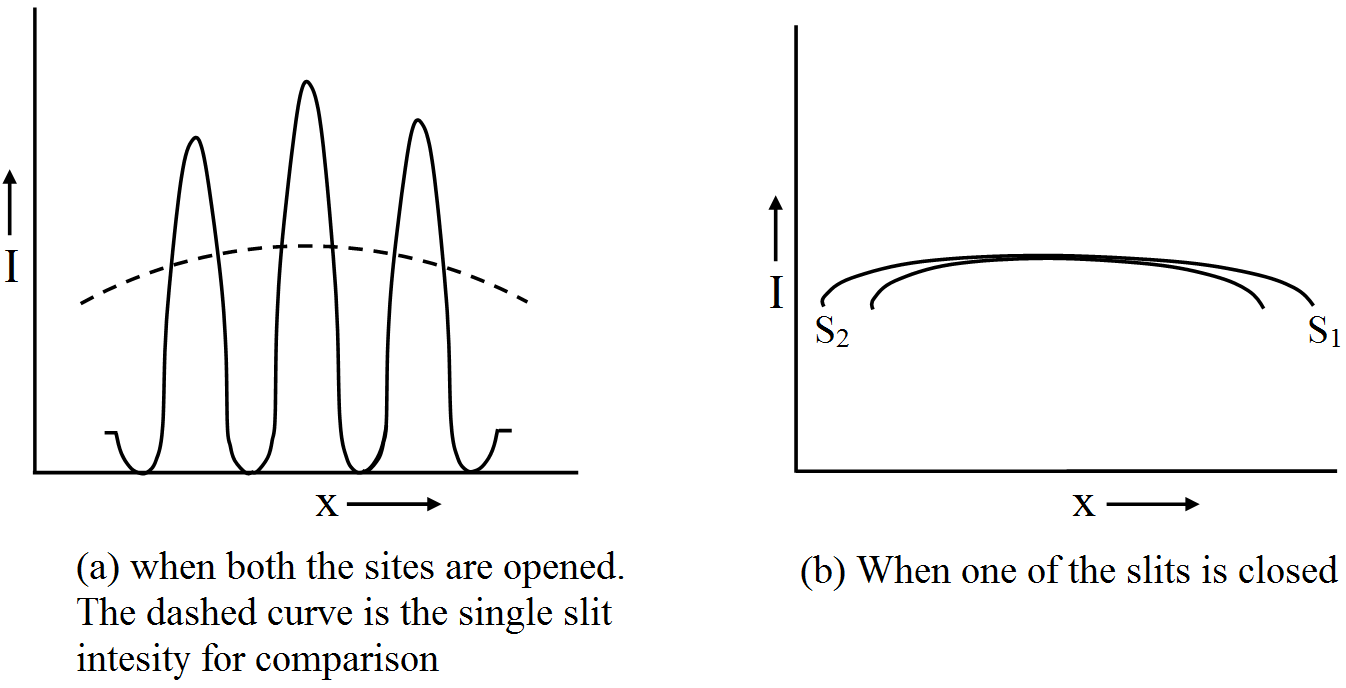
Draw a graph showing the variation of intensity versus the position on the screen in Young’s experiment when (a) both the slits are opened and (b) one of the slits is closed.
What is the effect on the interference pattern in Young’s double slit experiment when:
  1. Screen is moved closer to the plane of slits?
  2. Separation between two slits is increased?
Explain your answer in each case.

Answer

Interference of light: When two waves of same frequency and constant initial phase difference travel in the same direction along a straight line simultaneously, they superpose in such a way that the intensity of the resultant wave is maximum at certain points and minimum at certain other points. This phenomenon of redistribution of energy due to superposition of two waves of same frequency and constant initial phase difference is called interference
Conditions for Sustained Interference of Light Waves:

To obtain sustained (well-defined and observable) interference pattern, the intensity must be maximum and zero at points corresponding to constructive and destructive interference. For the purpose following conditions must be fulfilled:

  1. The two interfering sources must be coherent and of same frequency, i.e., the sources should emit light of the same wavelength or frequency and their initial phase should remain constant. If this condition is not satisfied the phase difference between the interfering waves will vary continuously. As a result the resultant intensity at any point will vary with time being alternately maximum and minimum, just like the phenomenon of beats in sound.
  2. The interfering waves must have equal amplitudes. Otherwise the minimum intensity will not be zero and there will be general illumination.

The variation of intensity I versus the position x on the screen in Young’s experiment. Fringe width, $\beta=\frac{\text{D}\lambda}{\text{d}}.$

  1. $\text{B}\alpha\text{D},$ therefore with the decrease of separation between the plane of slits and screen, the fringe width decreases.
  2. On increasing the separation between two slits (d), the fringe separation decreases as β is inversely proportional to d $(\text{i.e.,}\beta\alpha\frac{1}{\text{d}}.)$

Need a full question paper?

Generate a complete, print-ready paper with questions like this in minutes — across 16+ boards, with answer keys.

Start Generating Free

Similar questions

A parallel beam of white light is incident normally on a water film 1.0 × 10-4cm thick. Find the wavelength in the visible range (400nm - 700nm) which are strongly transmitted by the film. Refractive index of water = 1.33.
The volume of an ideal gas $(\gamma=1.5)$ is changed adiabatically from 4.00 litres to 3.00 litres. Find the ratio of,
  1. The final pressure to the initial pressure.
  2. The final temperature to the initial temperature.
Two cells of emf 1V, 2V and internal resistances $2\Omega$ and $1\Omega$ respectively are connected in (i) series. (ii) Parallel. What should be the external resistance in the circuit so that the current through the resistance be the same in the two cases? In which case is more heat generated in the cells?
The voltmeter shown in the figure. reads 18V across the $50\Omega$ resistor. Find the resistance of the voltmeter.

Take the potential of the point B in figure to be zero:
  1. Find the potentials at the points C and D.
  2. If a capacitor is connected between C and D, what charge will appear on this capacitor?

Two identical pith balls, each carrying a charge q, are suspended from a common point by two strings of equal length l. Find the mass of each ball if the angle between the strings is $2\theta$ in equilibrium.
Explain Hertz experiment for communication of electromagnetic waves. Draw labelled diagram of apparatus used in the experiment.
$(or)$
Explain Hertz experiment related with electromagnetic waves and also explain experiments of Jagdish Chandra Basu and Marconi.
$(or)$
Critically evaluate Hertz experiment of production and communication of electromagnetic waves.
Consider the situation shown in figure. The system is released from rest and the block of mass 1.0kg is found to have a speed 0.3m/s after it has descended through a distance of 1m. Find the coefficient of kinetic friction between the block and the table.

1 litre of an ideal gas $(\gamma=1.5)$ at 300K is suddenly compressed to half its original volume.
  1. Find the ratio of the final pressure to the initial pressure.
  2. If the original pressure is 100kPa, find the work done by the gas in the process.
  3. What is the change in internal energy?
  4. What is the final temperature?
  5. The gas is now cooled to 300K keeping its pressure constant. Calculate the work done during the process.
  6. The gas is now expanded isothermally to achieve its original volume of 1 litre. Calculate the work done by the gas.
  7. Calculate the total work done in the cycle.
The speed of sound in hydrogen at 0°C is 1280ms-1. The density of hydrogen at STP is 0.089kg/m-3. Calculate the molar heat capacities Cp and Cv of hydrogen.